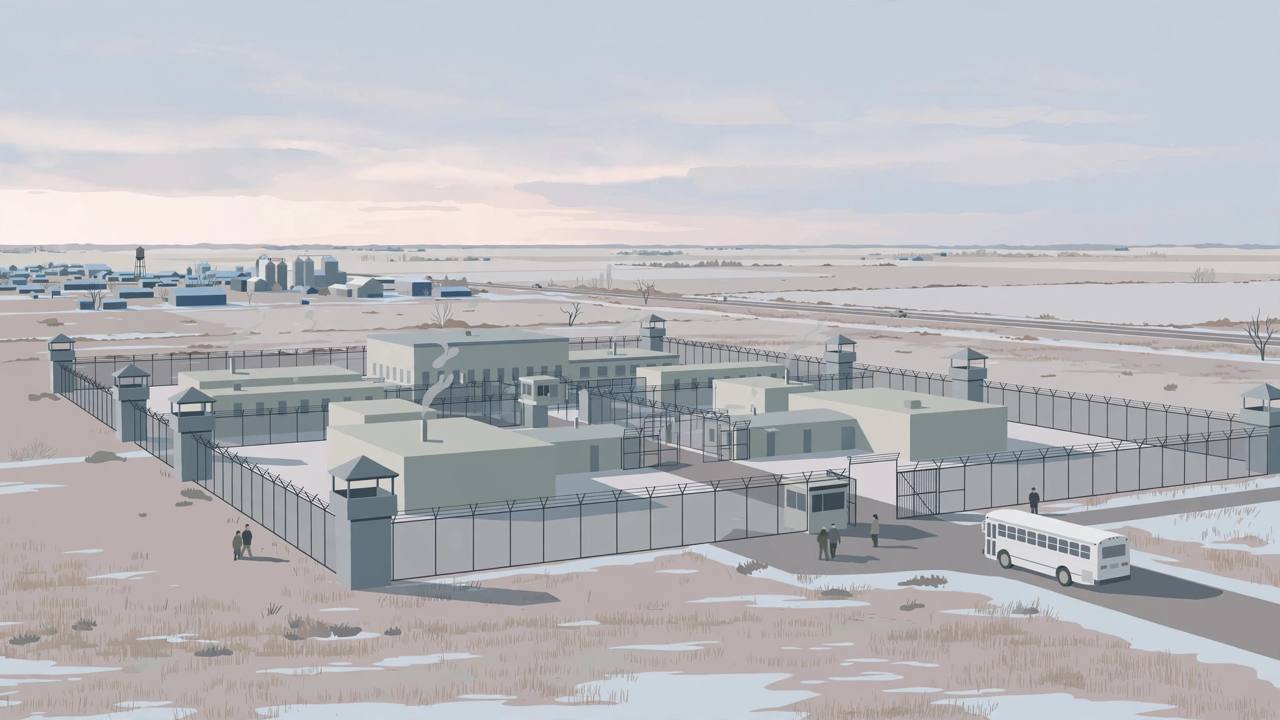
The Department of Homeland Security has confirmed that the Appleton Detention Facility in western Minnesota is open and in use, after the department opened the site on November 9 and the first detainees began arriving at a prison that had stood empty since 2010. The confirmation, given to FOX 9 in a statement from a DHS spokesperson, turns a controversial $495.6 million purchase into a working immigration detention centre with room for up to 1,600 people.
Source: FOX 9 via Gopher Current
This is a new development in a story Awaaz Punjab has followed since November 2, when the federal purchase of the shuttered Prairie Correctional Facility was first reported. What has changed this week is that the site is no longer a plan or a purchase: it is operating, and local attorneys and observers have reported buses and vans bringing people into the centre, according to Particle News reporting on the opening.
What DHS said
In its statement, DHS said: “DHS opened the Appleton Detention Facility on November 9 to strengthen America’s ability to enforce its immigration laws and carry out the American people’s mandate for mass deportations. The site gives ICE immediate capacity to detain and remove those who have no legal right to remain, protecting American communities and restoring the integrity of our borders without waiting years for new construction.” The department added that ICE will be making arrests in states across the United States and that it is ensuring it has the resources to carry out President Donald Trump’s mission.
Where it is, and why the location matters
Appleton is a small city in far western Minnesota, about 20 miles east of the South Dakota border, and the prison sits on the south side of the city off Highway 119. ICE had previously said it hoped the facility would be running by mid-2027, with a potential capacity of up to 1,600 detainees — the November 9 opening is months ahead of that earlier expectation. The distance matters for detainees and their families: Appleton is roughly 170 miles from Minneapolis, where most of Minnesota’s immigration attorneys and legal resources are concentrated.
The money behind the opening
The centre will be operated by CoreCivic Inc., the private prison company that sold the property to the US government earlier this year for $495.6 million and now runs it under a five-year contract. CoreCivic has said it expects about $75 million a year in revenue from the Appleton site. Particle News reported the multiyear operating deal will pay CoreCivic roughly $536 million over five years. The purchase price drew sharp questions earlier this year because the facility had previously been discussed in Minnesota at a far lower figure; CoreCivic says the reported $75 million figure dated back to a preliminary 2015 discussion with the state corrections department and was never an appraisal, and that the federal price reflects the cost of building an equivalent facility at today’s construction prices, less depreciation.
The legal-access warning
A University of Minnesota Law School analysis of the Appleton facility warned, before the opening, that people detained there will face greater hurdles to legal representation than detainees at other Minnesota facilities because of the site’s isolation. The analysis found only three immigration attorneys within a 100-mile driving radius of Appleton and only one legal aid organisation serving detained immigrants within that distance, for a facility built to hold 1,600 people. Advocates and attorneys cited by Particle News also warned that the rural location and limited notice of transfers could make it hard for detained people to reach lawyers or family when they are moved or released.
Minnesota is not a traditional Punjabi diaspora hub, but detention capacity is national: when a 1,600-bed centre opens, ICE can transfer detainees there from arrests anywhere in the country, including states with large Punjabi and South Asian communities. Families can find a relative moved hundreds of miles from their lawyer and community with little notice — which is exactly the risk legal groups are flagging in Appleton.
Reaction in Appleton and what happens next
Local reaction is split, according to reporting on the opening: some residents hope the reopened prison brings jobs to a city that lost them when it closed in 2010, while others are planning protests. Reporters have also noted gaps in federal transparency — ICE’s public facility list did not yet include Appleton at the time of the opening reports, and the agency gave limited direct responses. What happens next is the ramp-up: how quickly the population grows toward the 1,600 capacity, whether legal-service groups can establish regular access, and whether the price and contract face further scrutiny in Congress, where the purchase has already been questioned. Awaaz Punjab will follow the first official population figures ICE publishes for the site.