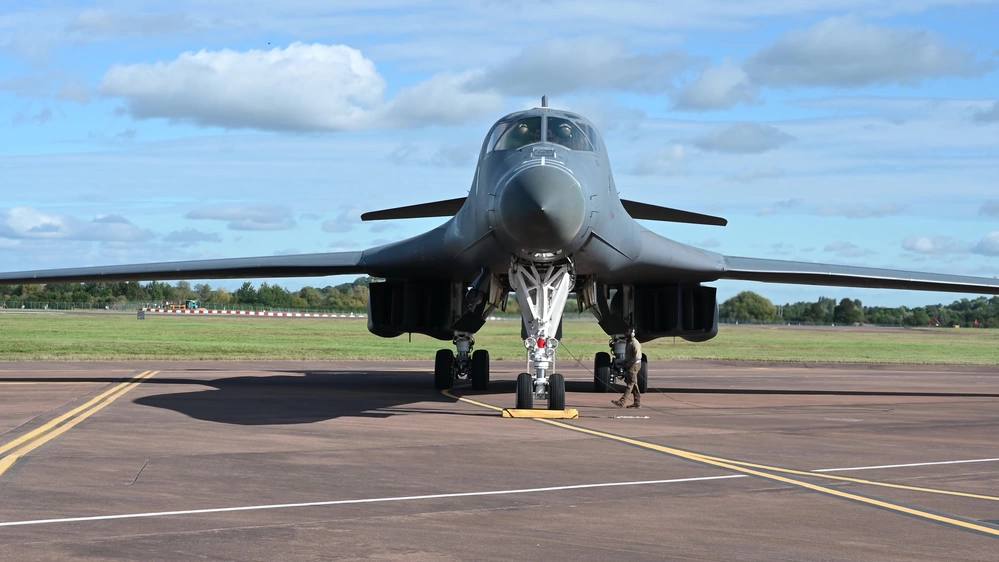
The United States Department of Justice on Tuesday, November 10, unsealed an eight-count superseding indictment in Manhattan federal court charging three men with terrorism-related offences for their alleged work for Iran's Islamic Revolutionary Guard Corps (IRGC) and Kata'ib Hizballah, including nearly 20 attacks and attempted attacks across Europe and the United States and a September 2026 plot against RAF Fairford, the British air base in western England where American bombers and troops were stationed.
Source: US Department of Justice
The defendants are Mohammad Baqer Saad Dawood al-Saadi, 32, a dual Iranian-Iraqi national; Mohsen Mohajeri, 48, an Iranian national; and Mohammad Ali al-Hassani, 35, an Iraqi national. Both the IRGC and Kata'ib Hizballah are designated by Washington as foreign terrorist organizations. Only al-Saadi is in custody, the Associated Press reported; he was arrested abroad on May 1 and has been in US federal custody since his transfer, and in June he pleaded not guilty to earlier charges of plotting at least 18 attacks in Europe.
"Anyone who plans a terrorist plot on a military base housing American servicemembers will be prosecuted by the United States government," said Attorney General Todd Blanche. US Attorney Jamie McDonald for the Southern District of New York said the defendants "helped orchestrate a campaign of terror on behalf of terrorist organizations affiliated with Iran" that targeted Jewish communities in Europe and the United States and RAF Fairford, "housing American service members." FBI Director Kash Patel said one subject was behind bars awaiting trial yet allegedly sent coded messages to assist in future acts of violence.
The Fairford plot, as alleged
According to the indictment, al-Hassani — who with Mohajeri was in Iran at the time — orchestrated the RAF Fairford plot through a network of contacts in the United Kingdom. On August 22 he allegedly paid an associate to carry out pre-operational surveillance of the base perimeter and received videos of the area. In September, associates allegedly procured vans and barrels of fuel, researched buying chemical accelerants including large quantities of potassium chloride, bought metallic objects that could be used as shrapnel, and fitted the vans with custom decals to make them look like a fuel-delivery business and a swimming-pool supply business.
On September 26, three vans — some later found to contain barrels of fuel — were driven toward the base; at least two hit a security roadblock and could not proceed. In the early hours of September 27, British authorities recovered the three white vans and arrested their occupants. Five men were detained that night on suspicion of explosives and terrorism offences, AP reported, and the United States withdrew all its B-1 bombers from Fairford days later. British prosecutors have separately charged two London men, who appeared at Westminster Magistrates' Court on October 27 and are due at the Old Bailey on November 20.
Awaaz Punjab reported the British side of this case when the two London men were charged last month: Two charged in UK over RAF Fairford case
Coded messages from a jail cell
Prosecutors allege al-Saadi, imprisoned in New York awaiting trial, coordinated with his co-defendants in the days before the Fairford plot by passing coded messages through phone calls with family members in Iraq — referring to Mohajeri by aliases including "Abbas" and describing terrorist activity as "work." On a September 24 call, told that al-Hassani ("Ali") had been moved to an "International Section," al-Saadi allegedly instructed his family to "give him money so we can do it." Three days later, the Fairford plot unfolded, the indictment says.
The wider alleged campaign in Europe
The indictment says the spring 2026 attacks in Europe were carried out in the name of Harakat Ashab al-Yamin al-Islamiya (HAYI), which prosecutors call a front for Kata'ib Hizballah and other designated groups. HAYI claimed 18 attacks in Europe, seven of them in the United Kingdom — arsons, explosives and, in one instance, a near-fatal stabbing of two Jewish men in London, one of them a dual US-British citizen. Prosecutors allege the three men directed at least one April 17 attack in real time over a FaceTime video call, and that al-Hassani directed an April 18 attack on a London synagogue, telling the attacker to "light it up like a Christmas tree." Al-Saadi also allegedly worked on attacks inside the United States, including targeting a synagogue in Manhattan.
The charges include conspiring to provide material support to Kata'ib Hizballah and to the IRGC (up to 20 years each), conspiring to provide and providing material support for acts of terrorism (up to 15 years each), conspiring to bomb a place of public use (up to life in prison), and — for al-Saadi alone — attempted acts of terrorism transcending national boundaries (up to life). The Justice Department stressed that a superseding indictment is merely an allegation and all defendants are presumed innocent until proven guilty. Iran has denied involvement in the Fairford episode. No trial date has been set for the new counts; what happens next is a first court appearance on the superseding indictment in the Southern District of New York, while the linked British case returns to the Old Bailey on November 20.
What is solid
- An eight-count superseding indictment was unsealed in Manhattan federal court on Tuesday naming al-Saadi, Mohajeri and al-Hassani
- Only al-Saadi is in custody; he was arrested abroad on May 1 and transferred to the US
- British authorities recovered three vans and arrested occupants near RAF Fairford in the early hours of September 27; two London men were charged in the UK on October 27
What is only claimed
- Every role in the Fairford plot and the nearly 20 attacks is a prosecution ALLEGATION in an indictment, not a proven fact; the defendants are presumed innocent
- Iran has denied involvement in the Fairford episode; no response from the three defendants or their lawyers to the new counts has been reported