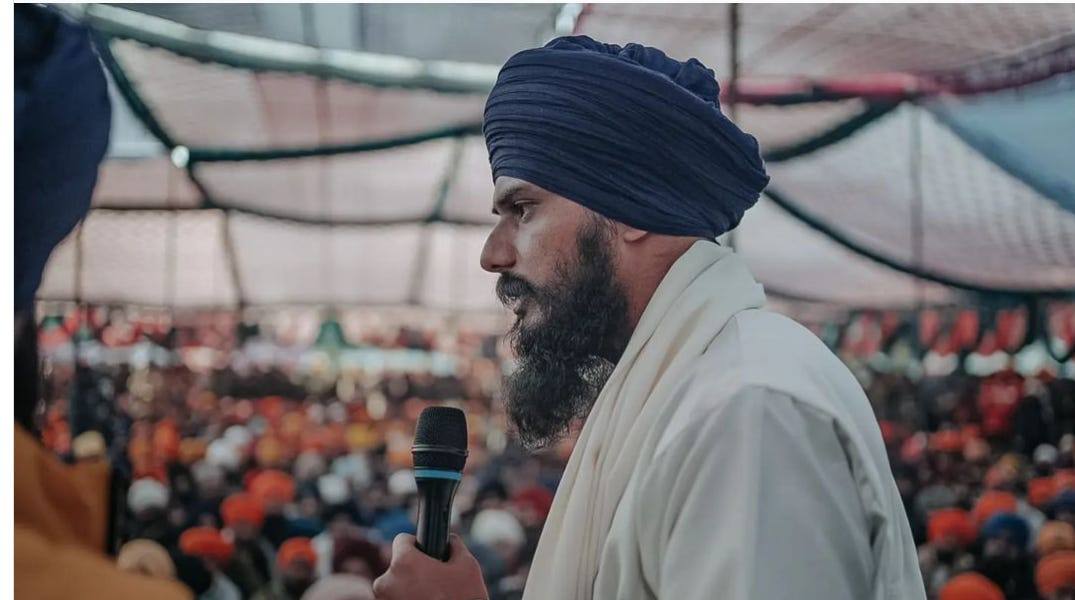
The Election Commission of India (ECI) has told the Delhi High Court that a “grave and serious” objection — described in its latest affidavit as “grave and highly sensitive” — continues to stand in the way of a final decision on registering Akali Dal (Waris Punjab De) as a political party, because the report of a comprehensive background inquiry ordered from the Chief Electoral Officer (CEO) of Punjab is still awaited despite reminders. The organisation, founded in 2021 and now headed by jailed Khadoor Sahib MP Amritpal Singh, plans to contest the Punjab Assembly elections due in early 2027 and has petitioned the court for an expeditious decision on its registration application.
Source: Bar and Bench
What the objection alleges — and what it is not
According to the ECI's affidavits, on July 9, 2026 it received a “very sensitive input” alleging that Waris Punjab De is “rooted in separatism”, was founded by individuals detained under the National Security Act (NSA), and “poses grave concerns regarding its allegiance to sovereignty and integrity of India”. These are allegations contained in an objection received by the Commission. They have not been tested or upheld by any court, and the Delhi High Court has expressed no view on their merits.
Source: Bar and Bench
What is solid
- Waris Punjab De applied for party registration on January 22, 2025; the ECI acknowledged it on February 6, 2025 (ECI affidavit).
- Punjab's CEO gave a positive verification report on April 27, 2026, after reminders on March 18 and April 20, 2026 (ECI affidavit).
- The ECI forwarded the objection to the CEO, Punjab, on July 14, 2026 for a comprehensive background inquiry; that report is still awaited (ECI affidavits of September 14 and November 3, 2026).
- Justice Saurabh Banerjee heard the case on November 4, 2026 and listed it next for January 11, 2027; the court has not ruled on the petition.
What is only claimed
- The objection's allegation that Waris Punjab De is 'rooted in separatism' and raises concerns over its allegiance to India's sovereignty and integrity — an untested input cited by the ECI, not a finding.
- Who is responsible for the delay: the ECI blames the applicant's late rectified documents (filed January 16, 2026 against a 30-day window from September 10, 2025) and the pending CEO inquiry; Waris Punjab De's petition seeks a time-bound decision and raises the risk of losing a common election symbol, which the ECI calls 'legally untenable'.
The timeline, from the ECI's own affidavits
Waris Punjab De submitted its registration application on January 22, 2025, acknowledged by the Commission on February 6, 2025. After scrutiny, the ECI issued a deficiency letter on September 10, 2025 pointing out defects in the application and gave the applicant 30 days to rectify them; the ECI says the rectified documents were submitted only on January 16, 2026. The Commission asked the CEO, Punjab, to begin verification on September 11, 2025, sent reminders on March 18 and April 20, 2026, and received a “positive verification report” on April 27, 2026, covering the organisation's premises and other aspects. While that report was under consideration, Waris Punjab De filed its writ petition in the High Court, and on July 9, 2026 the sensitive objection arrived; the ECI forwarded it to the CEO, Punjab, on July 14, 2026 with instructions for a comprehensive background inquiry and a detailed report, which has not yet been received.
Source: ANI
Why registration is not automatic: Section 29A
Party registration is governed by Section 29A of the Representation of the People Act, 1951. An applicant association must state in its memorandum or rules that it will bear true faith and allegiance to the Constitution of India and to the principles of socialism, secularism and democracy, and will uphold the sovereignty and integrity of India. The ECI told the court the Section 29A process is not a “perfunctory ministerial formality”, that it cannot be compelled by a writ of mandamus to bypass the ongoing inquiry, and that it denies any delay on its part. It has sought disposal of the writ petition. Senior Advocate Meenakshi Arora appeared for Waris Punjab De, with advocates Ashim Shridhar, Nanakey, Harjot Singh Mann, Vijay Singh and Gurpreet Singh Sandhu; the ECI was represented by its standing counsel Sanjay Vashishtha with advocates Siddhartha Goswami, Aditya Sachdeva and Richa Pandey.
Source: Bar and Bench
What happens next
In its latest affidavit, reported by ANI, the ECI said that once the CEO Punjab's background-inquiry report is received, further steps will follow in accordance with law: if the report is positive, the applicant will be required to publish public notices in two national and two local newspapers inviting objections from the public for 30 days, after which objections, if any, will be dealt with and the applicant heard before a final decision under Section 29A. The case itself returns to the Delhi High Court on January 11, 2027 — close to the expected February-March 2027 Punjab Assembly election, for which the Election Commission has not yet announced a schedule. Waris Punjab De was founded by actor-activist Deep Sidhu in 2021; it is now led by Amritpal Singh, the Khadoor Sahib MP, who ANI reported was earlier detained under the NSA (lifted in April) and remains in jail in connection with other charges. Sources: Bar and Bench; ANI; India Legal — all reporting the ECI's affidavits in Waris Punjab De v. Election Commission of India.
Source: ANI