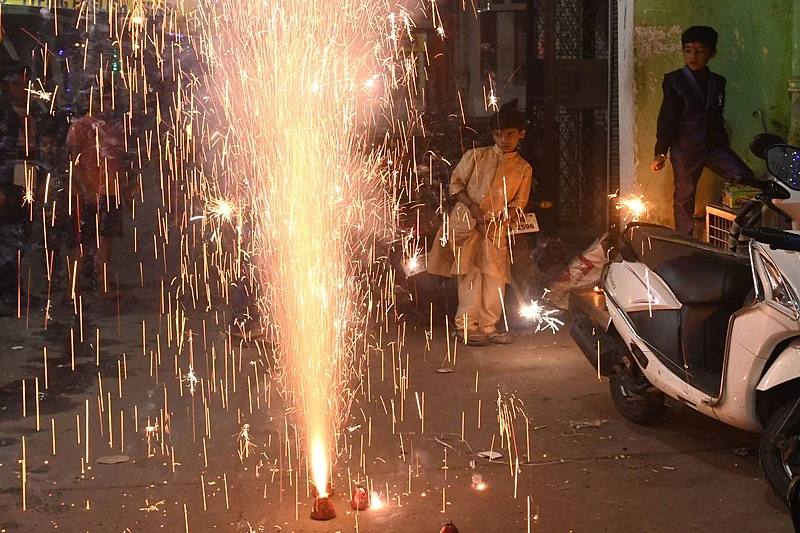
Diwali celebrations across the Chandigarh Tricity ended in a heavy night for hospital emergency departments, with more than 360 people requiring treatment for firecracker-related injuries between Sunday night and Monday morning at hospitals in Chandigarh, Panchkula and Mohali, Mirror Now reported on Tuesday (November 10). The figure is a slight decrease from the 363 injuries reported during the same period last year, the report said, but medical staff still dealt with severe injuries ranging from thermal burns to complex eye trauma, with children as young as six among the patients.
Source: Mirror Now
PGIMER: 15 eye surgeries, and most eye patients were only watching
The Post Graduate Institute of Medical Education and Research (PGIMER), Chandigarh, handled the most critical cases. Its Advanced Eye Centre performed 15 emergency surgeries on Sunday night. Dr Faisal Thattaruthody, an additional professor at the centre, said vision recovery remains uncertain for many patients and could take several months to assess fully, with some facing the risk of permanent sight loss, Mirror Now reported. PGIMER's plastic surgery department also treated seven patients for significant burns — four who suffered hand injuries when crackers detonated prematurely, and three with thermal burns covering 15 to 20 per cent of their bodies after their clothing caught fire.
In its official release dated November 9, PGIMER said that on the day of Diwali (November 8), 27 patients presented to the Advanced Eye Centre with firecracker-related eye injuries — 23 males and four females, including nine children, the youngest just six years old. A particularly concerning finding, the institute said, was that 20 of the 27 patients (74 per cent) were bystanders who were injured while watching or standing near firecrackers being burst by others; only seven were injured while bursting firecrackers themselves. Of the 27, 15 required surgical intervention and all underwent surgery, while the remaining 12 had closed-globe injuries and were managed accordingly.
Source: PGIMER official release via DevDiscourse
The PGIMER eye patients came from across the region — six from Chandigarh, seven from Punjab, nine from Haryana and the rest from other neighbouring states — and the injuries were caused by bombs (10 cases), sky shots (four), rockets (three), a phuljhari (sparkler), a wax lantern candle and a potash gun (one case each), among others, the release said. The institute had deployed a dedicated team on round-the-clock emergency duty from 8 am on November 8 to 8 am on November 11.
How the Tricity hospitals were loaded
The Government Multi-Specialty Hospital (GMSH) in Sector 16, Chandigarh, reported the highest volume of casualties, recording 87 burn cases and 29 eye injuries. At the Civil Hospital in Sector 6, Panchkula, medical staff treated 32 victims between 9 pm on Sunday and 6 am on Monday, among them 11 children between the ages of six and 15; the injuries included facial burns and eye trauma, and a head injury sustained by a 62-year-old woman. In Mohali, the Dr BR Ambedkar State Institute of Medical Sciences (AIMS) in Phase 6 handled 27 burn cases, including 10 eye-related injuries, and one patient in critical condition was transferred to the Government Medical College and Hospital (GMCH-32) in Chandigarh for specialised care.
What doctors are advising
PGIMER has launched dedicated helplines for residents experiencing hearing loss, ringing in the ears or a blocked sensation after exposure to loud firecracker noise, urging people to seek early intervention. In its release, the Advanced Eye Centre advised people to maintain a safe distance from firecrackers, keep children away from bursting areas and use appropriate eye protection, and said that in case of an eye injury, immediate medical attention should be sought and the injured eye should not be rubbed, treated at home or manipulated.