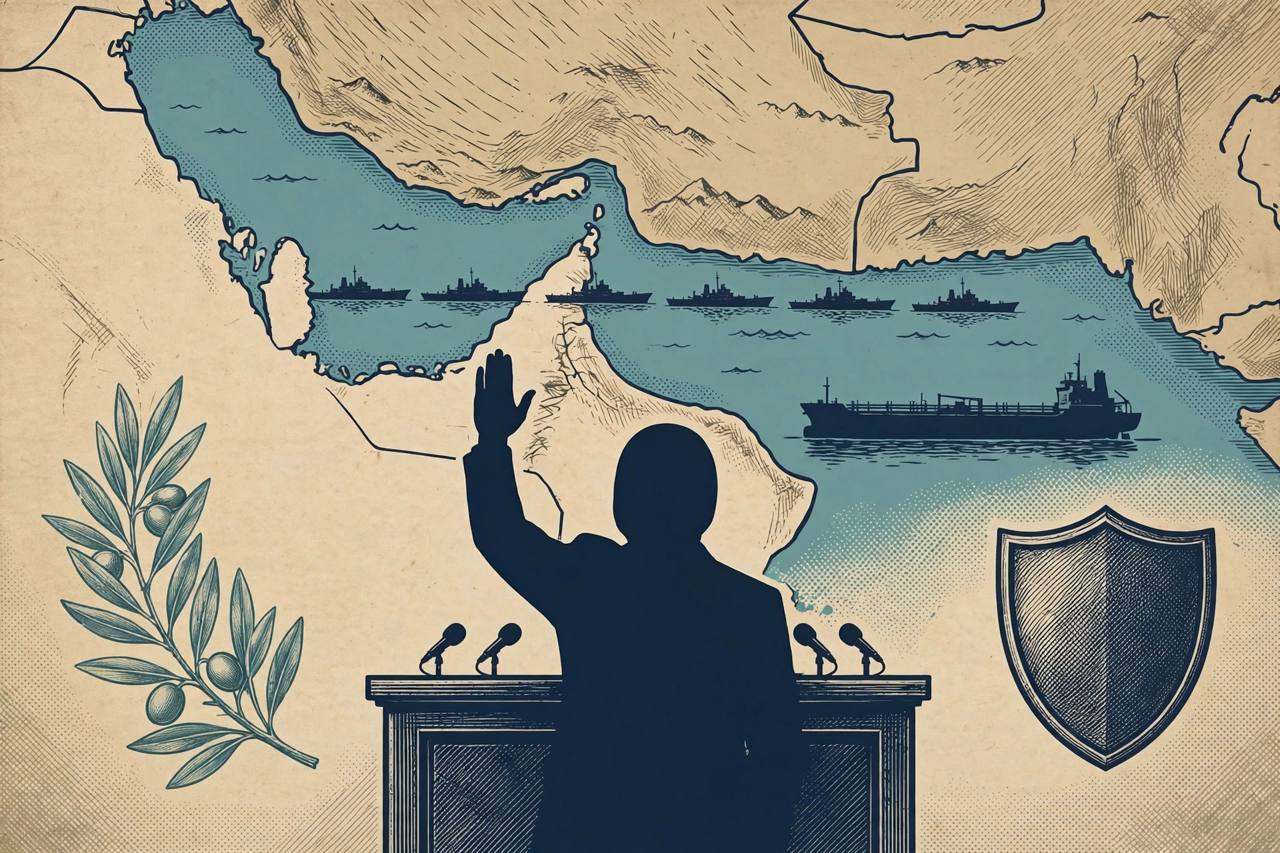
US President Donald Trump made a surprise appearance in the White House briefing room on Monday evening and declared that the war with Iran is, in his words, "militarily effectively over" — his most definitive statement yet that the United States does not intend to resume its bombardment of Iran. "Iran militarily is effectively over," Trump told reporters. "We're just keeping it the status quo."
Source: Associated Press via AAP News, Nov 9, 2026
This declaration came hours after the development Awaaz Punjab reported earlier on Monday, when Trump met Qatar's prime minister at the White House and said Gulf states wanted a peaceful end while US strikes stayed ready. Read the earlier story: Trump meets Qatar's prime minister on Iran
The briefing-room appearance followed Trump's closed-door meeting earlier on Monday with Qatar's prime minister and foreign minister, Sheikh Mohammed bin Abdulrahman bin Jassim Al Thani — the Gulf state's chief mediator in the war — and a separate meeting with Vice President JD Vance. The Associated Press described the remarks as some of Trump's most definitive comments about moving away from his threat to resume strikes on Iran after the US midterm elections had passed.
What Trump said: 'decapitated', but 'locked and loaded'
Trump said Iran had been "decapitated" but that he was still looking for a long-term solution to make sure Iran's nuclear programme is defanged, and he repeated that an Iranian nuclear weapon is non-negotiable. "The military action doesn't seem to be a very necessary thing, but we're locked and loaded, ready to go for any reason that changes," he said, calling renewed action "quite unlikely" for now. He also said the United States had identified infrastructure targets, including 38 bridges, that it would strike if military action resumed.
Trump defined the "status quo" he intends to keep: the US naval blockade of Iranian ports continues — "We're keeping it going. We have the greatest military blockade ever" — alongside the newly announced Task Force Iron Gate, which seeks to cut off Iran's trade by land and through the Caspian Sea. He said the status quo was being kept "really at the behest of countries that are their neighbours", naming Qatar, Saudi Arabia, the UAE, Bahrain and Kuwait as preferring that the blockade remain in place. Those positions are Trump's account; the Gulf governments have not publicly confirmed them.
Qatar's prime minister: 'grateful for the positive discussions'
Sheikh Mohammed was reported to have said after the White House meetings that he was "grateful for the positive discussions on reaching a deal and bringing peace to the region." Qatar has served throughout the war as the principal intermediary between Washington and Tehran, carrying proposals in both directions — including the reported interim proposal under which Iran would reopen the Strait of Hormuz and halt attacks on Gulf shipping in return for the US lifting its naval and economic blockade and releasing $8 billion (yaani about $8,000 crore in South Asian counting) in Iranian funds frozen in Qatar.
Iran rejects the claim: 'Stop manufacturing fake news about imaginary talks'
Tehran's response was blunt. Mohsen Rezaei, secretary of Iran's Supreme National Security Council, posted on social media on Monday: "The war on Iran has already wrecked the US government. But Washington flails like a desperate gambler. FOLD YOUR HAND. STOP manufacturing FAKE NEWS about imaginary talks. Stop denying the West Asian NEW ORDER. Time to SURRENDER to the seven conditions Iran has repeatedly set out." Iranian officials rejected Trump's description of the conflict and dismissed claims about negotiations as baseless.
Source: Press TV, Nov 10, 2026 (Rezaei statement); TBS News, Nov 10, 2026
Iran's seven conditions, first conveyed to Washington through Qatari and other regional mediators in September, have been only partly published. The three Rezaei has named publicly are an end to the war on all fronts, the release of frozen Iranian funds and an end to the US naval blockade; Press TV's account of the full list adds the lifting of sanctions, the withdrawal of US naval and air forces from the region, payment of war reparations and an end to threats. Tehran says it will not reopen the Strait of Hormuz to normal traffic until the conditions are met. Separately, Iranian President Masoud Pezeshkian said Supreme Leader Mojtaba Khamenei had requested a resolution to the state of "neither war nor peace", and that Iran was willing to negotiate under fair conditions but would not accept coercion.
Why the 'status quo' still matters — oil, Hormuz and Gulf workers
Nothing in Trump's declaration lifts the blockade, reopens the strait or ends sanctions: by his own description, all of that stays exactly as it is. Oil markets had already moved on the day's diplomacy before the briefing — Brent settled down 5.9% at $92.57 a barrel on Monday as hopes of a diplomatic end grew, Bloomberg reported. For the lakhs of Punjabi and Indian workers who live across the Gulf — in Qatar, Saudi Arabia, the UAE, Bahrain and Kuwait, the very states Trump named — the practical position is unchanged tonight: shipping through Hormuz remains restricted, the blockade continues, and the safety, jobs, flights and remittances questions the war created remain open even as Washington calls the fighting itself over.
What is solid
- Trump said in the White House briefing room on Monday that the war in Iran 'militarily is effectively over' and that the US is 'keeping it the status quo' — reported by the Associated Press and carried by AAP, The Hindu BusinessLine and The Guardian.
- Trump said the naval blockade of Iran continues, that military action does not currently seem necessary, and that US forces remain 'locked and loaded' if circumstances change.
- Iran's Supreme National Security Council secretary Mohsen Rezaei publicly rejected Trump's account of negotiations as 'fake news' about 'imaginary talks' and restated Iran's seven conditions.
What is only claimed
- Trump's claim that Iran is 'decapitated' and militarily finished is his characterisation; Iran disputes it and says the war damaged the US government instead.
- The positions Trump attributed to Qatar, Saudi Arabia, the UAE, Bahrain and Kuwait have not been publicly confirmed by those governments.
- No agreement, ceasefire text or timetable has been announced by either side; Secretary of State Marco Rubio said on Sunday he did not see an imminent breakthrough and called Iran's demands unacceptable.
What happens next
Trump declined to commit to any long-term ceasefire, so the declaration changes the rhetoric more than the reality on the ground: the blockade and Task Force Iron Gate stay in place, Iran's seven conditions stay on the table, and Qatar's mediation continues between two sides still far apart on the nuclear file. The next signals to watch are any formal Iranian government response beyond Rezaei's post, whether shipping through the Strait of Hormuz changes in practice, and Trump's expected three-way meeting with China's Xi Jinping and Russia's Vladimir Putin at the APEC summit in Shenzhen on November 18-19, where he has said ending the Iran war is on his list.