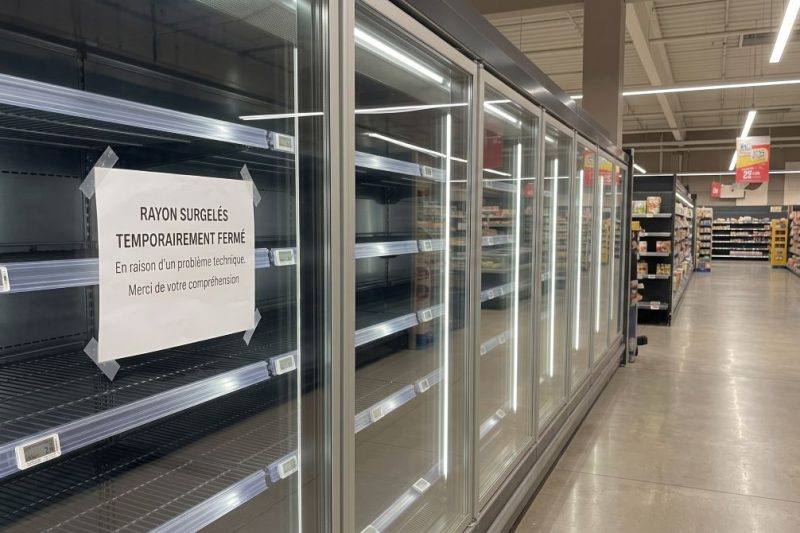
This story follows Awaaz Punjab's earlier report on the October 11 cyberattack that knocked out supermarket refrigeration across France. At the time, who was behind it was unknown. On Monday, November 9, France formally named Iran's Islamic Revolutionary Guard Corps as responsible, summoned Iran's ambassador, opened a judicial investigation, sought international arrest warrants and vowed European Union sanctions — a major diplomatic escalation. Read the earlier report: supermarket fridge cyberattack hits 700 French sites
French officials on Monday, November 9 accused Iran's Islamic Revolutionary Guard Corps (IRGC) of responsibility for the cyberattacks that knocked out commercial refrigerators and freezers across France last month, saying there would be consequences for Iran. Foreign Minister Jean-Noel Barrot said the Iranian ambassador had been summoned to France's foreign ministry to receive a very strong protest, and he threatened further European Union sanctions against Iran. The announcement came only minutes after Reuters revealed that French investigators privately suspected Iran of being behind the attacks.
Source: Reuters via SRN News, Nov 9, 2026
"This is an attack of unprecedented scale and aggressiveness," Barrot said, in remarks reported by Sky News after a G7 ministerial meeting in Paris. "It is the first large-scale cyber attack aimed at sabotage on French soil, and it represents a major threat to our national interests and the security of the French people. That is why it will not go unanswered." Barrot said France would pursue sanctions at the European level and take any other measures needed to respond and deter future attacks.
Source: Sky News via Fosse 107, Nov 9, 2026
Prosecutors open investigation, seek arrest warrants
Paris prosecutor Laure Beccuau said a formal judicial investigation was opened on Monday into suspected organised cybercrime with the aggravating circumstance of having been committed to serve the interests of a foreign power — in this case, Iran. The investigation targets Shahid Kaveh, described by French officials as an offensive cyber unit affiliated with the IRGC's electronic and cyber centre, and the Paris prosecutor's office said it had requested international arrest warrants against the unit's leader and his two deputies. A joint report by French spy and cyber agencies named three alleged associates — Hamid Reza Lashgarian, Mahdi Lashgarian and Reza Salarvand. Beccuau said investigators found the attackers had used Farsi and IP addresses linked to devices located in Iran. These are French allegations; the men have not been tried, and Reuters said it could not immediately locate contact details for them.
Source: Reuters via SRN News, Nov 9, 2026
How France says it linked Shahid Kaveh to the hacks
French officials said they linked Shahid Kaveh to the campaign by tying the incidents to the digital infrastructure used to sabotage the fridges, by matching the intrusion pattern to other hacks carried out by the unit, and by recovering traces of Farsi in the attack infrastructure. The French report said the hackers worked through numerous front groups masquerading as vigilante hackers, including "CyberAveng3rs" and "Cyber Isnaad Front." Microsoft had privately tied Iran to the October cold-storage sabotage at least two weeks before Monday's announcement, according to three people familiar with the matter cited by Reuters; Microsoft declined to comment. Reuters said it could not establish exactly how the French made their determination, and France has not published its full technical evidence.
Source: Reuters via EuropeSays, Nov 9, 2026
What the October 11 attack did
The October 11-12 attack overrode the temperature controls on commercial fridges in hundreds of establishments. The French agencies' report said a total of 700 commercial sites were targeted and at least 15 fires broke out as the hackers cranked up the heat. Most of those affected were supermarkets — chains hit included Carrefour, Monoprix, Intermarche and Cooperative U, around 700 of France's 10,000 supermarkets — but the hacking also hit small butcher shops, a slaughterhouse and factories processing food. Some refrigerators were turned up so high they caught fire; in the hours after the hack, supermarket employees carted boxes of perished meat and melted ice cream into giant trash containers, and one supermarket owner estimated the total cost could reach tens of millions of euros nationwide. Cybersecurity experts previously told Reuters the attack appeared easy to pull off, and the firm behind many of the stricken units said several were obsolete or running outdated firmware.
Source: Reuters via SRN News, Nov 9, 2026
Iran has not responded; the allegation is contested
Iran's mission to the United Nations did not return messages seeking comment on Monday, Reuters reported, and Iran routinely denies carrying out malicious cyber operations. No Iranian response to the French attribution or to the summoning of its ambassador had been reported by Monday evening. The attribution must therefore be read as France's formal allegation, backed by a joint report of its spy and cyber agencies, rather than as a conclusion independently verified by outside investigators.
Source: Reuters via SRN News, Nov 9, 2026
What is solid
- France formally attributed the October fridge attacks to Iran's Revolutionary Guards on Monday, Nov 9
- Iran's ambassador was summoned to the French foreign ministry and France vowed EU-level sanctions
- Paris prosecutors opened a judicial investigation and requested international arrest warrants for the Shahid Kaveh leader and two deputies
- The Oct 11 attack targeted 700 commercial sites in France and at least 15 fires broke out (French agencies' report)
What is only claimed
- Responsibility of Iran and Shahid Kaveh is France's allegation — Iran has not responded and routinely denies malicious cyber operations
- Reuters could not establish exactly how France reached its attribution; the full technical evidence has not been published
- Whether this month's second wave of fridge hacks in Europe and the August US military commissary incidents are linked to the same campaign is unestablished
Background: a wider alleged sabotage campaign in the Iran war
The hacks that struck French supermarkets were among the most disruptive cyberattacks of the Iran war that began on February 28, a conflict marked by scattered incidents of alleged digital disruption, Reuters reported — including hacks against the Los Angeles transit system in March, against US water treatment plants in July and against ships bound for the United States in August. The French attack was followed this month by a second wave that hit more than 100 establishments across Europe — supermarkets in Sweden, Belgium, Luxembourg, Ireland and Estonia were hit last week — and affected refrigerators used by French blood banks, forcing staff to move blood to different cold storage; a separate attack on French blood banks last week was intercepted before it could damage blood products, Sky News reported. Neither Barrot nor prosecutors said whether the second wave was connected to the October campaign. In August, refrigerators at at least six US military commissaries went out of commission; Pentagon investigators are treating those malfunctions as a suspected cyberattack, a person familiar with the matter said the Pentagon considers Iran a suspect while its investigation continues, and the Pentagon said on Monday it was "aware of speculation regarding a potential cyber incident" but could not comment further for security reasons.
Source: Reuters via EuropeSays, Nov 9, 2026
What happens next
France says it will push for sanctions at the European Union level against those it holds responsible and take other proportionate measures to deter similar attacks. The Paris judicial investigation is continuing under the national cybersecurity agency and prosecutors, and the requested international arrest warrants would be the next legal step against the three named men. Saher Naumaan, a senior threat researcher at the cybersecurity company Proofpoint, told Reuters the cold-storage sabotage was less a measure of Iran's cyber prowess than of "how exposed these systems are" — a warning US officials echoed this week, saying more such attacks could be coming. Awaaz Punjab will report Iran's response when Tehran issues one.