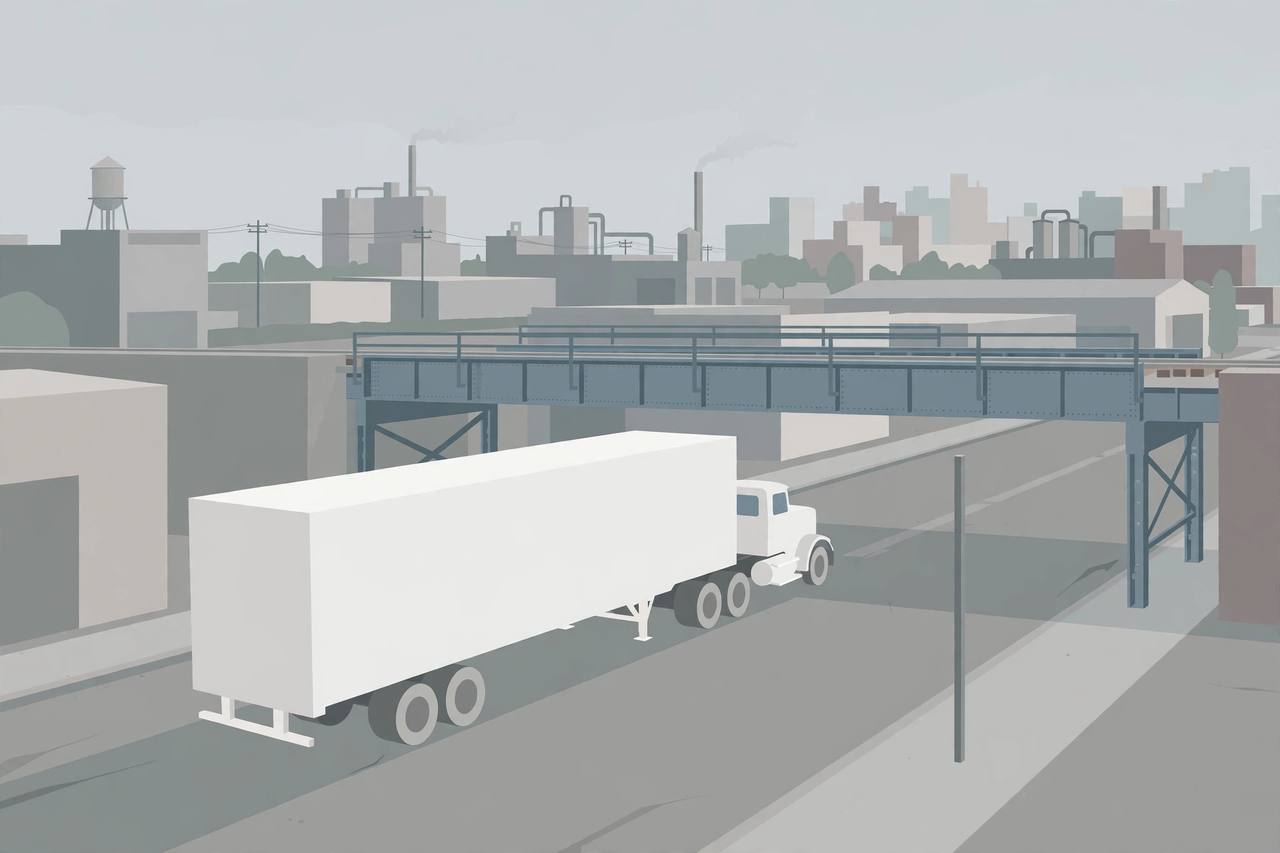
The Supreme Court of New Jersey has ruled unanimously that the City of Newark is liable for failing to post the warning signs the law requires at a low railroad overpass, reinstating a $562,500 jury verdict for a truck driver who crashed his rig into the unmarked bridge in 2015.
Source: New Jersey Monitor
What happened on Avenue P
David B. Wilson was driving his 13-foot-6-inch tractor-trailer through Newark in 2015 when he reached an intersection marked with a "truck route" sign. Trusting the sign, he turned onto Avenue P near Foundry Street — and drove straight into a railroad overpass with only 12 feet 2 inches of clearance. He suffered neck injuries in the crash. His wife joined him as a co-plaintiff in the lawsuit that followed.
The overpass carried no sign stating its clearance, and there was no warning sign at the last safe exit before the bridge, even though state law requires both. The court record shows the required sign had been replaced four times between 2011 and 2015 — workers put it back up five weeks before Wilson's crash — but by the time he drove under the bridge, only a bare pole remained.
The long road through the courts
A Superior Court jury found that the city had created a dangerous condition, that it knew or should have known about it, and that its conduct was palpably unreasonable. It awarded Wilson and his wife $562,500. The city appealed, and the Appellate Division reversed the verdict, holding that the city had discretion over where to place low-clearance signs and that the claim was barred by the immunity the Tort Claims Act gives public entities for failing to provide ordinary traffic signs.
On Thursday, November 19, the state's highest court reversed the Appellate Division and reinstated the jury's verdict. Writing for a unanimous court, Justice Rachel Wainer Apter held that the signs required by N.J.S.A. 27:5G-4 are not "ordinary" traffic signs within the meaning of the immunity law, because municipalities have no discretion about whether to post them. The court also held that plaintiffs in this kind of case do not need expert testimony to prove the city's conduct was palpably unreasonable.
Source: CIVL
"The statute dictates what needs to be done. There is no discretion." — Justice Rachel Wainer Apter, writing for the unanimous court in Wilson v. City of Newark.
Why the 1986 law matters
The law at the centre of the case, N.J.S.A. 27:5G-4, was passed by state legislators in 1986 specifically to guard against the kind of crash Wilson suffered. It requires municipalities to warn drivers about any bridge with less than 14 feet 6 inches of clearance — with a sign on or before the bridge itself, and another at the last safe exit or detour before it, so a driver has a chance to turn away.
The court also weighed the "truck route" sign that sent Wilson toward the bridge. The justices said the jury was entitled to conclude that the city had created a dangerous condition by posting an "actively deceptive" sign that "lulled [Wilson] into a false sense of security" that he could turn onto Avenue P without crashing into an unmarked, low-clearance bridge.
What it means for truckers
Low-clearance bridge strikes are one of the most feared hazards in trucking: a trailer wedged under an overpass can injure the driver, destroy the load, close a road for hours and leave the driver facing the bill. The ruling means every municipality in New Jersey must post — and keep posted — the low-clearance signs the 1986 law requires, and that a city cannot hide behind traffic-sign immunity when it fails to do so.
For the many Punjabi truckers who run New Jersey's corridors through Newark, Edison and Jersey City, the decision is a practical one: the signs that keep a 13-foot-6-inch rig out from under a 12-foot bridge are now backed by a unanimous Supreme Court ruling, and cities that let them fall down face the consequences in court.
What happens next
The verdict stands: Newark must pay the $562,500 the jury awarded Wilson and his wife. The ruling is the final word from New Jersey's highest court on the question, and it sets a precedent other injured drivers can cite. Cities across the state are now on notice to audit their low bridges, replace missing signs and check the last safe exit before each one — before the next truck arrives.