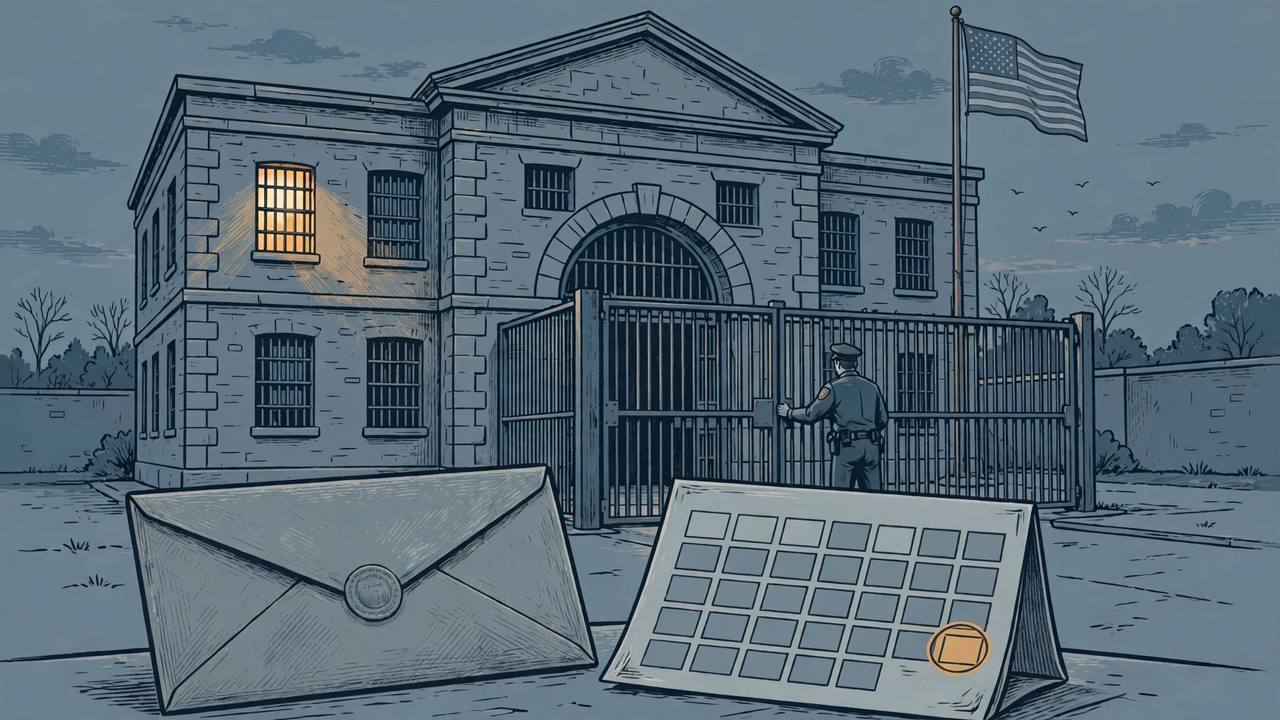
New York's counties now have 19 days to empty their jails of people held only for federal civil immigration violations. Attorney General Letitia James and Governor Kathy Hochul announced on Friday, November 6, that the Attorney General's Office of Immigrant Trust (OIT) has sent a letter to county executives and sheriffs across the state, giving them formal guidance on their legal obligation to end any agreement to house or detain people for federal civil immigration violations by November 25, 2026.
Source: New York Attorney General's Office
The Center Square reported that the warning letter went to 14 sheriff offices, telling them they should be “prepared to fully wind down any agreement that gives federal agents access to local jails” by the November 25 deadline, and warning that sheriffs who do not comply will face legal action from the state. The deadline comes from the Local Cops, Local Crimes Act, the state law passed by the New York legislature and signed by Hochul in May.
Source: The Center Square via Brushwood Media Network
The Local Cops, Local Crimes Act, signed on May 27, 2026, bars any local government or law-enforcement agency from entering into, modifying, renewing, extending or remaining in any contract, intergovernmental service agreement or other formal or informal agreement to house or detain people for federal civil immigration violations. An agency holding such an agreement must use its termination provision by November 25, 2026 — three months after the law's effective date. After that date, any such agreement is void and unenforceable under state law. If one agreement covers both criminal and civil detention, only the civil-immigration portion has to end.
“When I signed the Local Cops, Local Crimes Act into law, I made it clear that our local law enforcement should be focused on protecting New Yorkers and keeping dangerous criminals off our streets, not helping ICE carry out their aggressive deportation agenda,” Governor Hochul said. “Allowing ICE to utilize our local jails for civil immigration detention does not make our communities safer. Today's reminder ensures that counties across the state are prepared to fully wind down any agreement that gives federal agents access to local jails in New York.”
Attorney General James made the same point in enforcement terms. “Local officials should not be doing the work of federal immigration authorities,” she said. “New York passed the Local Cops, Local Crimes Act because taxpayer resources should be dedicated solely to keeping our communities safe. My office is providing guidance to help local officials understand their obligations under the law and ensure they meet the deadline.” Her office is not relying on voluntary compliance alone: the OIT is authorised to receive complaints, conduct investigations, issue subpoenas and bring civil actions to enforce the state's immigration-enforcement laws.
A federal judge has already refused to pause the law
The letter landed two days after the sheriffs lost a round in court. In a ruling on Wednesday, U.S. District Judge Mae D'Agostino rejected a request from sheriffs to block the provision of the law that requires them to nullify their ICE agreements, finding that the sheriffs had not proven they have the legal right to bring their constitutional claims against the state, and citing a New York law that restricts the ability of local governments to challenge state laws on constitutional issues, The Center Square reported. The sheriffs had sued in August, arguing in court filings that banning 287(g) agreements with ICE is an illegal overreach by the state that interferes with contractual agreements between counties and the federal government. They are expected to appeal Wednesday's ruling, and that lawsuit is still pending.
The state law reaches further than jail beds. According to The Center Square, the same law also bans ICE agents from wearing masks and restricts ICE's access to schools, churches, courthouses and other “sensitive” locations. The U.S. Department of Justice has sued New York over the law, a federal judge has temporarily blocked the mask ban while that fight plays out, and James has filed a countersuit to uphold the law. The jail agreements were also an election issue: Republican gubernatorial nominee Bruce Blakeman and his running mate, Madison County Sheriff Todd Hood, supported the ICE agreements and criticised Hochul over cooperation with federal immigration enforcement, before Blakeman was defeated in Tuesday's election as Hochul won another term.
What the law does not ban
Albany is drawing a line between civil immigration detention and criminal custody, and the letter spells it out. The law does not prevent a local agency from contracting for detention space for people facing pending federal criminal charges, as long as the agreement does not include detention solely for a federal civil immigration violation. It also does not stop any agency from complying with a state or federal court order or a judicial warrant. The letter asks every county executive and sheriff either to tell the OIT what steps they have taken to comply, or to confirm that they hold no prohibited agreements. New Yorkers who witness federal enforcement actions anywhere in the state can report them through the Attorney General's federal action portal at ag.ny.gov/federal-actions-form, and complaints about violations of the state law can be filed with the OIT online.
Why this matters beyond Albany: a civil immigration detainee is not serving a criminal sentence and has not been convicted of a crime — the person is being held so federal authorities can pursue a deportation case. County jail contracts have been one of the quiet mechanisms that let ICE hold such people close to where they were arrested instead of transferring them to distant federal facilities. New York is one of the largest Punjabi diaspora states in the country, and its immigrant families — including people picked up at workplaces, courthouses and traffic stops — are exactly the people whose detention location, and how quickly a family can reach them with a lawyer, turns on whether a county jail is allowed to hold them for ICE. After November 25, in New York, it will not be.
What happens next is a short, dated checklist. Counties have until November 25, 2026 to terminate the prohibited agreements; after that date the agreements are void under state law whether a county acted or not, and the Attorney General's office has said sheriffs who do not comply face legal action. The sheriffs' separate federal lawsuit continues, with an appeal of Judge D'Agostino's ruling expected, and the Justice Department's own suit against the state — including the temporarily blocked mask ban — remains before the federal courts.