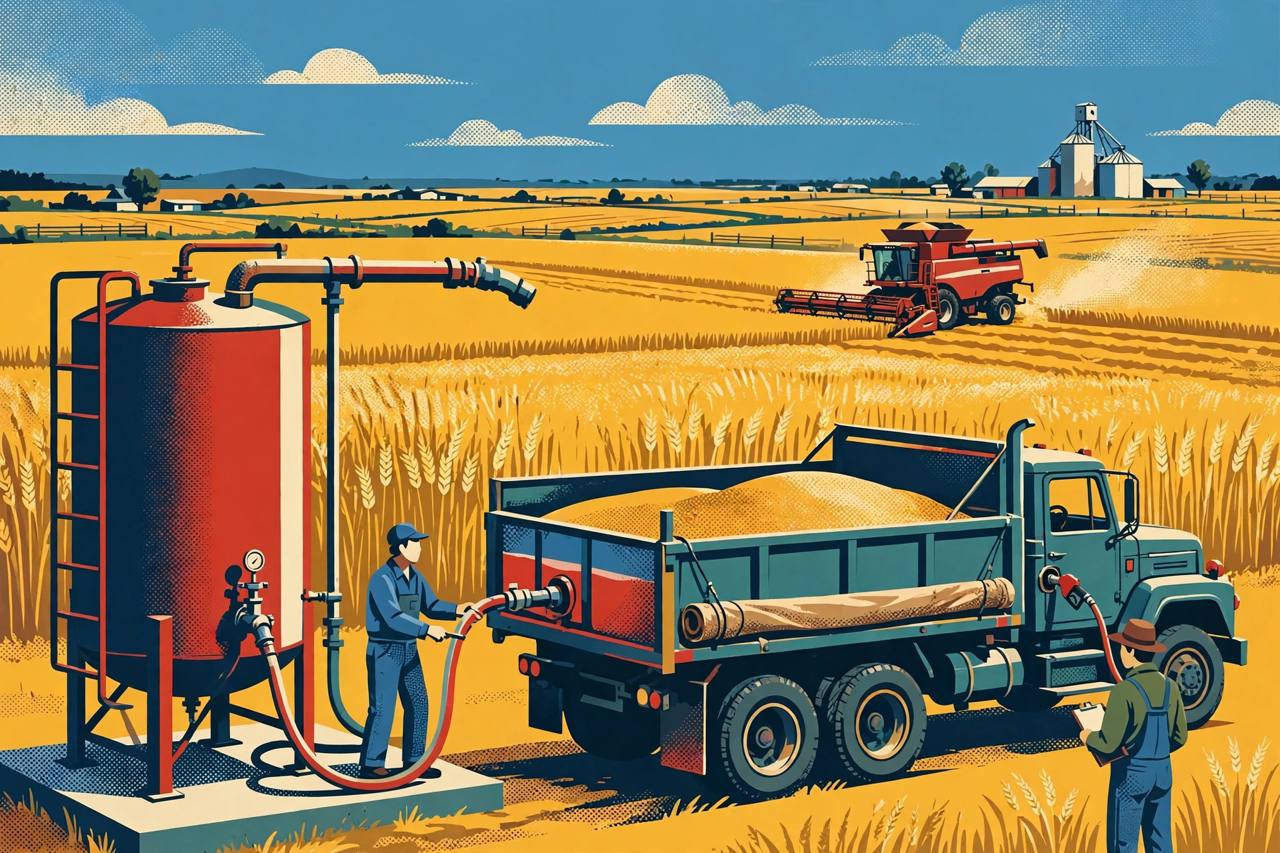
Moves meant to help farmers, truckers and others hit by high diesel prices are having only a limited effect in North Dakota, the North Dakota Monitor reported on Friday, November 6 — because the cheaper fuel at the centre of the relief can legally be burned on the highway for only a small slice of what a farm actually uses, and because the state next door never signed on at all.
Source: North Dakota Monitor
North Dakota announced on September 29 that it would allow expanded use of a lower-taxed diesel. The cheaper fuel, which is dyed red, is normally allowed only in tractors, combines and other off-road field equipment. Governor Kelly Armstrong's emergency order allows red diesel for hauling grain on highways and for other on-road agricultural jobs, the Monitor reported.
But highway use accounts for only about 5% to 15% of a typical farm's diesel use, said Matthew Gammans, an assistant professor in North Dakota State University's Department of Agribusiness and Applied Economics. Far more diesel is used in field equipment that could already use the cheaper fuel. “The issue is that the share of diesel that's actually used on the road relative to in the field is just so small that these policies are just not able to make a big dent,” Gammans told the Monitor.
Two states, two rulebooks
North Dakota charges a tax of 23 cents per gallon on regular diesel but only 4 cents per gallon on red-dyed diesel, potentially saving farmers 19 cents per gallon until the state order expires on November 30. President Donald Trump on October 5 issued a federal order allowing dyed diesel on highways and a deferment on federal diesel taxes for the rest of the year; the federal tax is 24 cents per gallon. But Minnesota has not signed on to the federal exemption, keeping the dyed-diesel ban on its roadways in place, the Monitor reported.
That border problem is personal for Ben Bakko, who farms at Walcott in southeast North Dakota but also farms land on the Minnesota side of the Red River. Bakko was already done harvesting soybeans by the start of October and had only a small number of acres of corn left. He did not want to risk a fine by using dyed diesel on Minnesota highways, so he kept clear diesel in his trucks until he finished harvesting sugar beets in Minnesota, then moved on to his North Dakota beets and was finally able to haul with the cheaper diesel. It takes more truckloads to haul a field of sugar beets than corn, he said, so he was grateful for the break — but it does not come close to making up for a price increase of more than $2 per gallon from last fall's harvest.
The average price for a gallon of diesel in North Dakota on Thursday was $6.04, about 22 cents below the national average but about $2.52 above a year ago, according to AAA figures cited by the Monitor. Bakko, who burns through about 30,000 gallons of diesel a year, mostly in the fall, is sceptical about any break in prices soon. “This diesel problem, these prices, are not going to go away by the end of the year,” he said. “I'm kind of wondering if they're just going to reissue all this again next year.”
Savings, losses — and the trucking warning
The tax breaks were spurred by a spike in diesel prices just as harvest was ramping up, in part because of an attack on a key Mideast pipeline in September, with the US war with Iran and other global conflicts restricting fuel shipments since February. North Dakota Tax Commissioner Brian Kroshus said the exemption would provide “a little bit of relief” but that the price of oil needs to come down to help farms with diesel and other energy-intensive expenses such as fertilizer and farm chemicals. “The real solution to this isn't through executive orders but seeing the price of oil moderate,” Kroshus told the Monitor. The state Department of Transportation receives about $5.4 million per month from diesel tax revenue, according to the Governor's Office, and Kroshus said his department had no forecast for how tax revenue might be affected.
Gammans, in an NDSU analysis published last month, estimated that corn and soybean farmers in the state could save up to $850,000 this fall because of North Dakota's emergency order — across roughly 4.5 million gallons if every eligible truck switched. The ceiling is structural: red-dyed diesel is usually delivered in bulk to on-farm tanks, and some farms cannot fuel both tractors and trucks from that storage, further limiting the benefit, the Monitor reported.
Source: NDSU Agriculture
For truckers, the relief comes with a warning label. The federal exemption applies to all trucks, not just those involved in farming, but how many truckers are switching to dyed diesel is unclear — normally, if a truck is inspected and the fuel is red, the operator faces a penalty. The North Dakota Motor Carriers Association advised its members that not all states may honour the federal enforcement exemption, noted that dyed diesel is not readily available, and warned the dye may linger in a truck's fuel system, potentially exposing the truck to enforcement of the red-dye ban when the order expires. The association also said that while it is unlikely, any deferred diesel taxes could still be collected.
North Dakota's order expires November 30, so eligible farm haulers have only weeks left of the 19-cent state saving — and any truck that crossed into a state that never signed on, like Minnesota, gets no protection there at all. Gammans expects a USDA announcement this month on how the $8 billion in Harvest Fuel Relief will be divided. Truckers should not treat the federal order as a blanket pass: state rules still decide what happens at the roadside.
The $8 billion question
The price surge prompted another round of aid under the federal Harvest Fuel Relief program: the US Department of Agriculture has made $8 billion available to compensate farmers for high diesel prices, but has not announced how it will be distributed. Gammans said the USDA could follow a formula similar to last year's farm bridge payments, or devise a new formula tied to average fuel consumption by crop. A fuel-based formula could mean more money for southern states growing rice and cotton and less for wheat states such as North Dakota, he said: “Cotton and rice are extremely fuel intensive, and they're not grown in North Dakota, right? So if you reward proportional to fuel, you're going to send a lot more money to the South.” He expects an announcement this month.
Calvin Benson, director of public policy for the North Dakota Farm Bureau, said the tax breaks are “not a world-changing thing,” but show that the governor and president are aware of the challenges farmers face, and argued the longer-term answer may be policies that bring more diesel refining to the United States. For Punjabi truckers running upper-Midwest and cross-border routes, the lesson of North Dakota's experiment is the same one Bakko learned at the Red River: in a patchwork of state orders and one federal deferment, the cheapest gallon is only legal on some roads, for some loads, until November 30.