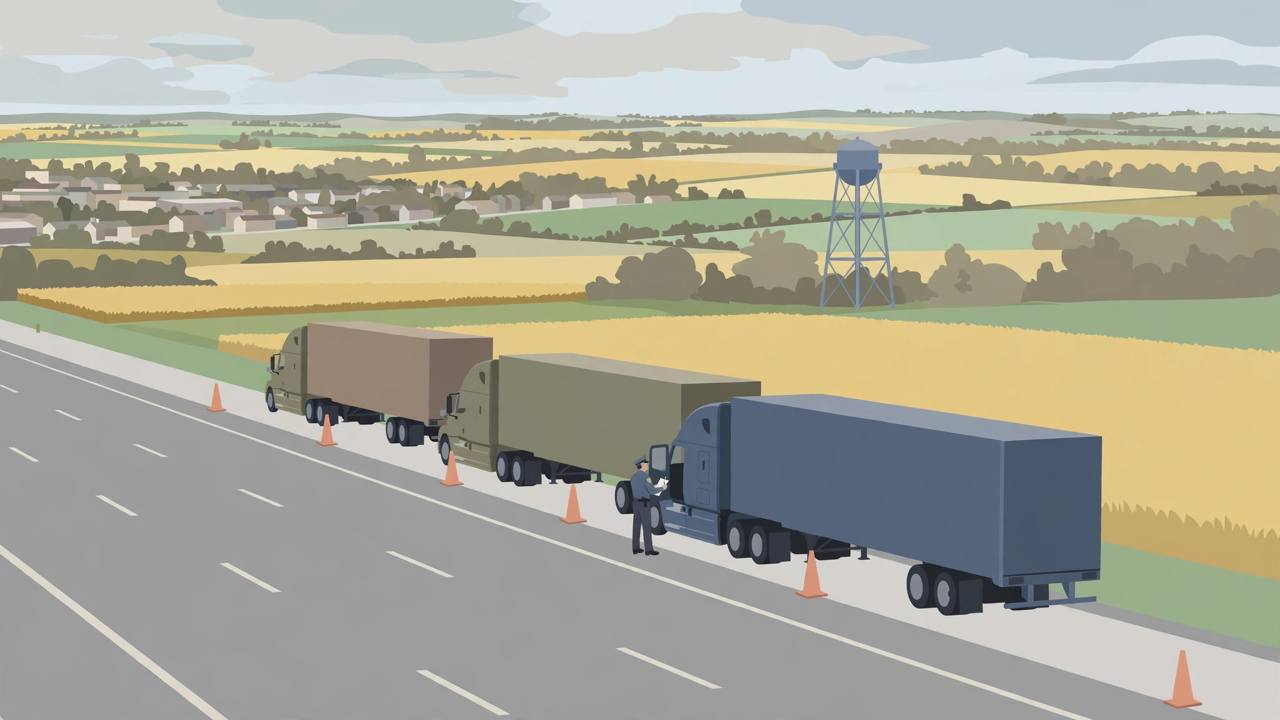
HAMILTON TOWNSHIP, Ohio — A five-day, multi-agency freight-enforcement operation in this Warren County township in southwest Ohio produced 561 traffic stops, 258 truck inspections, 423 citations, 73 vehicles placed out of service, 49 drivers placed out of service and 36 arrests, 31 of them on immigration-related charges, according to figures presented by Hamilton Township Police Chief Quillan Short. Fox News Digital published the numbers on Sunday, November 15, as Part 3 of its investigation into trucking fraud, public safety and community tensions in southwest Ohio, and Citizen Portal's account of the township's meetings carries the same enforcement totals.
The operation ran for five days, from October 19 to October 23, and was coordinated by multiple local agencies, Chief Short told township officials. Its focus was commercial motor-vehicle activity in and around Hamilton Township, a fast-growing community in Warren County, northeast of Cincinnati, where residents have complained at public meetings about the growth of commercial trucking operations, road safety and alleged freight fraud.
Numbers unveiled at township meetings
Citizen Portal reported that Chief Short first described the weeklong crackdown to township trustees on October 21, while the operation was under way, and that officials said similar quarterly enforcement efforts are planned, pending funding and staffing. Fox News Digital then attended a community meeting on November 4 at which dozens of Hamilton Township residents addressed the trustees directly, telling stories they linked to trucking growth in the area, and at which the enforcement data was again presented.
Hamilton Township Trustee Darryl Cordrey, in a statement to Fox News Digital, called the results of the crackdown “staggering,” especially considering it lasted only five days. “Hamilton Township residents have every right to be concerned about unsafe commercial vehicles, unqualified drivers on our roads, and other criminal issues that have stemmed from the substantial increase in commercial trucking operations in Hamilton Township,” Cordrey said. “Our residents should not have to bear the consequences of failures in immigration policy and commercial trucking oversight.” Cordrey said he is committed to working alongside local, state and federal agencies on the issue.
A state bill on CDL testing in English
Ohio Republican state lawmaker Michelle Teska, who attended the November 4 meeting, is pushing a bill to strengthen commercial-driver licensing requirements in Ohio, including a measure requiring driver examinations to be administered in English. “We have a community that's being inundated with people from a certain area and how they got here is through the trucking industry, and they got here because, again, in the state of Ohio, you can get a CDL and a driver's license in 10 different languages,” Teska told Fox News Digital. She framed the bill as a safety measure: “This is a safety issue. This is not a partisan issue in any way, shape, or form.”
The federal backdrop: a nationwide CDL crackdown
The township operation sits inside a much larger federal campaign. According to Fox News Digital, the U.S. Department of Transportation and the Federal Motor Carrier Safety Administration (FMCSA) have over the past year placed roughly 34,000 drivers out of service for failing basic English-language proficiency requirements, revoked or cancelled more than 31,000 illegally issued commercial driver's licenses, and shut down or purged nearly 10,000 noncompliant driving schools from the federal registry. Federal enforcement against nondomiciled CDLs — licenses issued to drivers who are not U.S. citizens or permanent residents — has become one of the defining trucking stories of 2026, and it is being litigated in federal courts, including a Second Circuit ruling this month in New York's favour over a $73.5 million highway-funding penalty.
Fox's investigation also pointed to individual companies. In nearby Middletown, it visited a former restaurant building that is abandoned and in disrepair but is registered as the active headquarters of a trucking company, UAG Express, which Fox said has more than two dozen recorded violations, including vehicle maintenance, unsafe driving, a suspended CDL and an hours-of-service violation. Fox News Digital said it reached out to UAG Express, owned by Aziz Ishanov, for comment and did not receive a response.
The local debate sharpened after the July 5 death of Tobias “Toby” Forsythe, a 21-year-old from Ohio who played goalkeeper for the University of Massachusetts Lowell men's soccer team. Authorities say a semi-truck driven by 42-year-old Uzbek national Bekhzod Asrarov struck Forsythe; the allegation against the driver is a matter for the courts, and Fox's series has treated the crash as the event that exposed wider concerns about so-called “chameleon carriers” — companies that reappear under new names after enforcement action.
The community response from the other side
On Friday, the Islamic Center of Maineville — a mosque project in the township that has itself drawn objections from some residents — posted a statement on its Telegram channel on behalf of the Hamkor Uzbek Cincinnati Association, acknowledging residents' concerns and asking for dialogue. “We believe that mutual respect, open communication, and understanding are the best ways to address these issues,” the message said. “Our Uzbek community is willing to listen to local residents, understand their concerns, clear up any misunderstandings, and work together to find practical solutions.” Fox cited 2024 Census data showing roughly 1,500 people born in Uzbekistan live in Greater Cincinnati and about 3,800 across Ohio, while Uzbek community leaders estimate roughly 4,000 Uzbek families live in southern Ohio, including U.S.-born children.
The figures Chief Short presented measure what officers found and charged during one concentrated week of stops; arrests are charges, not convictions, and the totals do not by themselves establish crash rates or long-term crime trends. Similar quarterly operations are planned in the township, pending funding and staffing.
What happens next
Three tracks now run in parallel. In Hamilton Township, officials say quarterly enforcement weeks will follow if funding and staffing allow. In Columbus, Representative Teska's CDL bill — including English-only examinations — must move through the Ohio legislature before it changes any licensing practice. And at the federal level, the DOT and FMCSA crackdown on English proficiency, nondomiciled licenses and noncompliant schools continues, with court challenges still working through the appeals system. For Punjabi and other immigrant truckers who run Ohio corridors — I-71, I-75 and the Cincinnati-area interstates among them — the practical lesson from Hamilton Township's week is the one officers applied at the roadside: a valid, correctly issued CDL, working English for inspections, and a truck that passes a full inspection are what kept drivers moving.