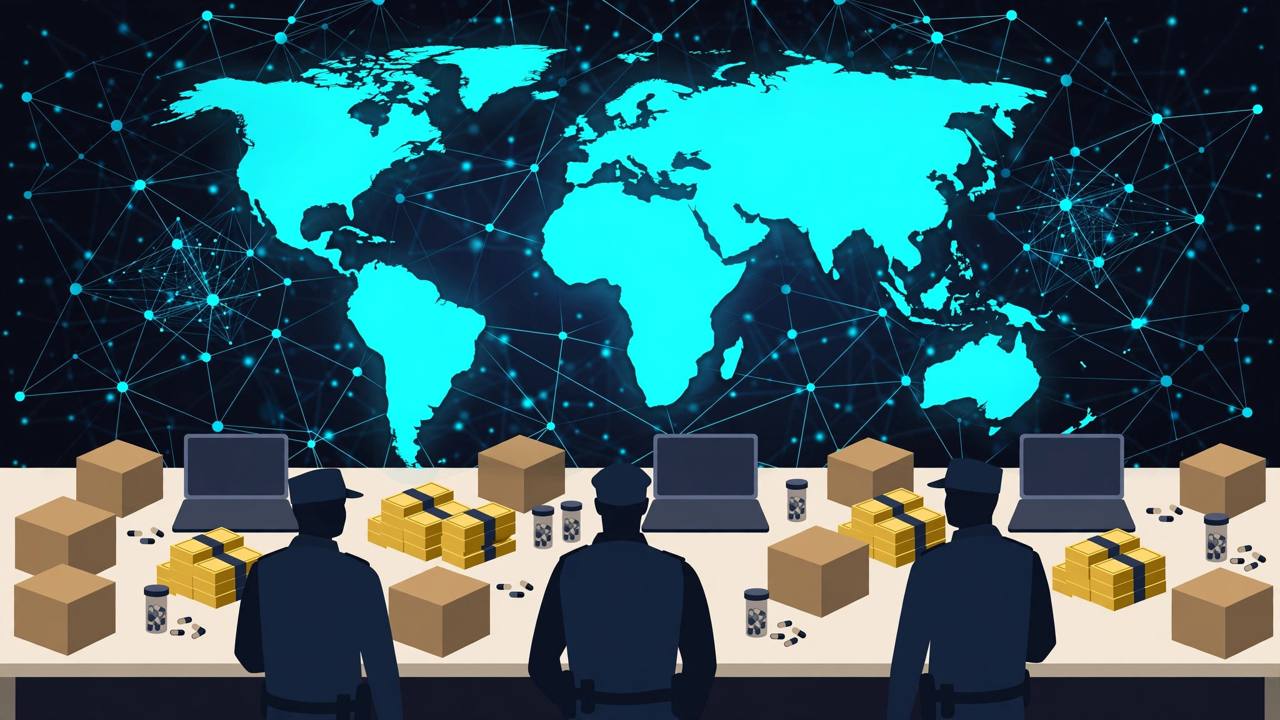
The U.S. Department of Justice on Thursday, November 12, announced the results of Operation TorNado, the largest internationally coordinated takedown of Dark Web drug vendors and buyers ever carried out — 354 arrests worldwide, including 132 in the United States, and seizures of more than $234 million in cash and virtual currency, about 5.7 metric tons of illicit drugs, 38 pill presses and 209 firearms.
Source: U.S. Department of Justice
The announcement was made in Washington by the Justice Department's Joint Criminal Opioid and Darknet Enforcement team, known as JCODE, together with Europol. The operation ran for roughly 18 months, from May 2025 to October 2026, and targeted criminal enterprises that used Dark Web markets to traffic fentanyl, opioids and other illicit drugs into communities across the United States, Europe, Australia and New Zealand. It is the sixth — and by far the most extensive — internationally coordinated JCODE action since the team was created in 2018, building on last year's Operation RapTor.
The numbers, country by country
After the United States, the largest arrest totals were recorded in the United Kingdom (59), Hungary (45), Germany (41), France (23), New Zealand (13), the Netherlands (12), Slovenia (11), Austria (6), Ireland (5), Czechia (4), Australia (2) and Finland (1). The Justice Department said the people arrested had engaged in tens of thousands of sales of illicit goods and services, and that a number of investigations are still ongoing to identify the individuals behind Dark Web accounts. The vendors and buyers were active on prominent Dark Web drug markets seized by law enforcement, including Archetyp, Bohemia, Nemesis, Kingdom and Tor2Door, as well as DrugHub and others.
"Nothing will stop the Trump Administration from identifying and dismantling drug trafficking networks," Attorney General Todd Blanche said. "Thanks to our partnerships with state, federal, and international law enforcement through the Joint Criminal Opioid and Darknet Enforcement (JCODE) team, Operation TorNado crippled Dark Web market vendors and will bring alleged drug traffickers to justice." FBI Director Kash Patel called TorNado "the largest interagency takedown of Dark Web drug vendors and buyers to date" and said it showed that "criminals cannot hide behind technology or geography — no matter where you operate, justice will find you."
The Florida brothers and the 'BarbaraWhite' pill operation
Among dozens of federal prosecutions unsealed or advanced under the operation, prosecutors highlighted the case of Stanislav Chernyshov, 30, a Russian national who the Justice Department says was illegally residing in the United States, and his brother Vladislav Chernyshov, 35, a naturalized U.S. citizen. Both were arrested in Florida for allegedly operating the Dark Web vendor "BarbaraWhite," which authorities say sold counterfeit oxycodone M30 pills laced with nitazenes — synthetic opioids that can equal or surpass fentanyl's potency. According to the department, lab analyses, covert purchases and surveillance tied the brothers to a clandestine pill-manufacturing and nationwide mailing operation allegedly responsible for more than one thousand parcels shipped across 49 states, with multiple fatal and non-fatal overdoses identified among recipients. They are charged with conspiracy to distribute Schedule I synthetic opioids in the Eastern District of Virginia and each faces a maximum penalty of 20 years in prison if convicted. The charges are allegations, and both men are presumed innocent until proven guilty.
A Bakersfield vendor, a North Carolina network and a New Jersey cell
In California, Jonatan Gonzales, 35, of South Bakersfield was arrested after investigators identified him as the alleged Dark Web vendor "SpeedyPharma," accused of shipping methamphetamine, black tar heroin, cocaine and K2 paper to addresses in western Pennsylvania and to all other 49 states. Agents who searched his residence seized 48 pounds of methamphetamine, 588 grams of cocaine, 386 grams of black tar heroin, 3.5 grams of fentanyl, 2.8 grams of carfentanil and $40,565 in cash, the department said. Gonzales is charged in the Western District of Pennsylvania with possession with intent to distribute 50 grams or more of methamphetamine and faces a maximum penalty of life in prison if convicted.
Alexander Green, 32, of Jacksonville, North Carolina, was arrested in June for allegedly operating the STARLABS cyber-enabled drug trafficking organization on the Monero-only Dark Web market DrugHub; the Justice Department says the organization distributed a wide array of narcotics, including fentanyl, and has been linked to two overdose deaths in the Southern District of Ohio. About 200 grams of methamphetamine and more than two kilograms of counterfeit pharmaceutical pills with fentanyl present were seized. Green is charged in the Southern District of Ohio and faces up to 20 years in prison if convicted.
In New Jersey, five men — Michael Morales, 25, and Thomas A. Crisafulli, 27, both of Bergenfield; Naudy Oviedo, 21, and Jayshawn Eyamazememba, 22, both of the Bronx, New York; and Ethan Lara, 25, of Lodi — were arrested for their alleged roles in a New York/New Jersey distribution cell accused of moving counterfeit Xanax, MDMA, ketamine and other controlled substances through a nationwide mail-based network. Search warrants led to the seizure of approximately 300 kilograms of counterfeit Xanax, MDMA, ketamine and other substances from a residence in Lodi, a storage unit in Lawrence Township, and other locations in Bergenfield and Englewood, the department said. The Bergen County Prosecutor's Office is handling that prosecution, and the men face up to 20 years in prison if convicted. In a further case, Eric Turner, 30, of Lizella, Georgia, and Jose Smith, 29, of Valrico, Florida, were arrested in June for allegedly running a Dark Web operation selling bulk heroin and fentanyl under the names Postmates and FuegoPacksXpress; agents seized 4.5 kilograms of heroin, 22 grams of fentanyl, MDMA and alprazolam tablets and 25 firearms, and both men face up to life in prison if convicted in the Middle District of Florida. All of these charges are allegations only.
Why this matters — fentanyl by mail, and what happens next
Operation TorNado was a collaborative effort across an unusually wide span of agencies: the Justice Department, FBI, Drug Enforcement Administration, Homeland Security Investigations, IRS Criminal Investigation, the U.S. Postal Inspection Service, the Food and Drug Administration's Office of Criminal Investigations, the Bureau of Alcohol, Tobacco, Firearms and Explosives, Customs and Border Protection, Army Criminal Investigation Division, the Naval Criminal Investigative Service, and Treasury's FinCEN and OFAC, alongside Europol, Eurojust and police forces in every participating country. Officials stressed the postal and financial trails: drug networks may operate across borders and behind anonymous accounts, IRS-CI Chief Jarod Koopman said, but "they cannot operate without money." For American families — including Punjabi diaspora communities in California's Central Valley, New Jersey, New York and other states where counterfeit pills have driven overdose deaths — the cases underline the warning health officials repeat: a pill bought online or through social media may be a counterfeit laced with fentanyl or the even more potent nitazenes, and a single pill can kill.
Federal prosecutions arising from Operation TorNado are being conducted in more than 20 federal districts, including all four California districts, the District of New Jersey, the Southern District of New York, both Texas districts named in the announcement and districts across Florida, Georgia, Illinois, Ohio, Pennsylvania and elsewhere. The Justice Department emphasized that an indictment and criminal complaint merely allege that crimes have been committed, and that every defendant is presumed innocent until proven guilty beyond a reasonable doubt in a court of law. Further arrests are expected as investigators continue working to identify the people behind remaining Dark Web vendor accounts.
Every person named in the Operation TorNado cases has been charged, not convicted. The Justice Department states that an indictment or complaint is an allegation only, and all defendants are presumed innocent until proven guilty in court.