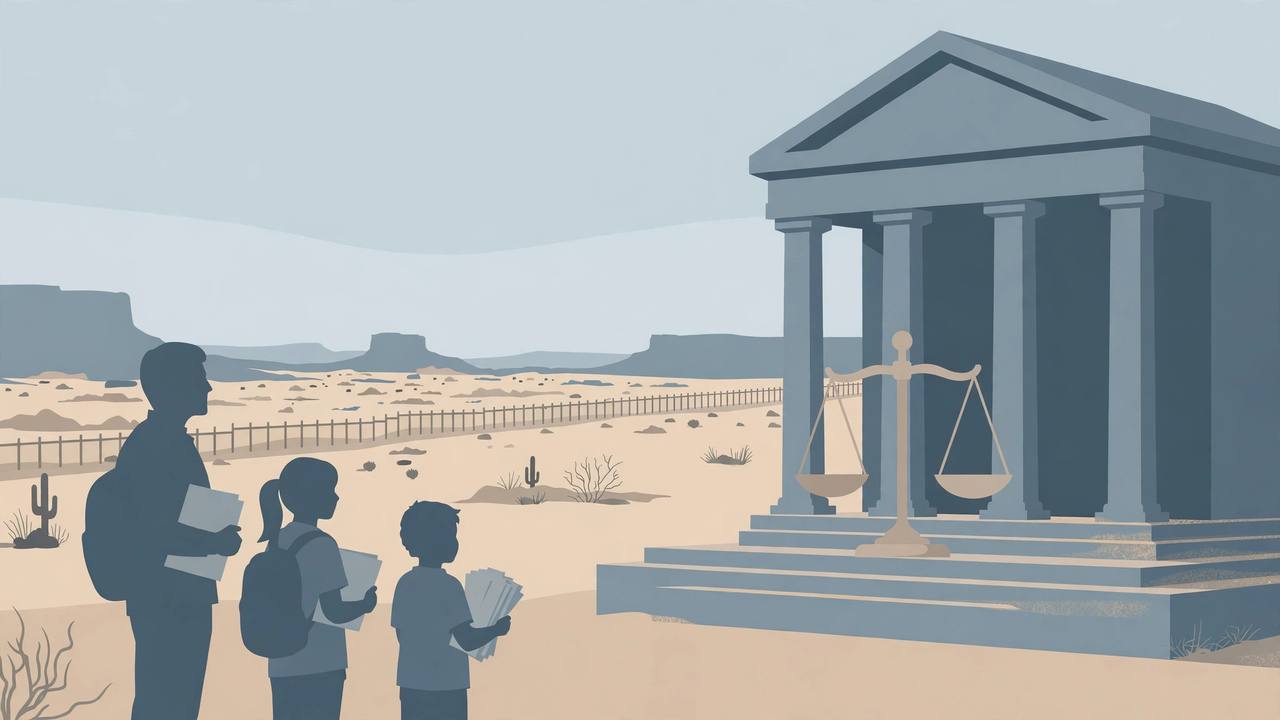
WASHINGTON — The Supreme Court will meet in private conference on Friday, November 6, to decide whether to hear the government's appeal over the border asylum ban — the proclamation that, since January 20, 2025, has barred people crossing the southern border from applying for asylum at all. Two lower courts have held that the policy is unlawful. If the justices take the case, it will be the term's defining test of how far a president's emergency entry powers can go against a statute written by Congress.
Source: Immigration Analytics
The case is Mullin v. Refugee and Immigrant Center for Education and Legal Services, No. 26-239 — known from its plaintiff side as RAICES v. Mullin. The question at its core is stark: can a president suspend entry at the southern border and, in the same stroke, bar people already on US soil from applying for asylum and related protection? The asylum statute, 8 U.S.C. 1158(a)(1), says any noncitizen "who is physically present in the United States or who arrives in the United States (whether or not at a designated port of arrival)" may apply.
Timing matters for everyone with a case in the system. If the justices grant review at Friday's conference, the order would most likely appear on the Court's Monday, November 9, order list — and a case granted this early in the term is normally argued and decided by the end of June 2027. A denial would leave standing the D.C. Circuit's ruling against the policy, the broadest judicial rejection yet of the administration's effort to use emergency entry powers to override the asylum statute. The Court may also relist the petition for a later conference, or grant review on only some of the questions.
How the ban reached the justices
Proclamation 10888, "Guaranteeing the States Protection Against Invasion," was signed on January 20, 2025 — President Trump's first day back in office — and published at 90 Federal Register 8333. Relying on Sections 212(f) and 215(a) of the Immigration and Nationality Act and on Article IV of the Constitution, it suspended entry of people crossing the southern border and barred them from invoking provisions of immigration law that would allow them to stay, including asylum. According to the Center for Gender and Refugee Studies (CGRS), co-counsel for the plaintiffs, the proclamation makes no exceptions for families, survivors of human trafficking, or children, and states that the suspension stays in place until the president determines the "invasion" has concluded.
Source: Center for Gender and Refugee Studies (UC Law SF)
The legal challenge was filed on February 3, 2025, in the US District Court for the District of Columbia by three organisations that provide legal services at the border — RAICES, Las Americas Immigrant Advocacy Center and the Florence Immigrant & Refugee Rights Project — together with individual plaintiffs, represented by CGRS, the ACLU Immigrants' Rights Project, the National Immigrant Justice Center, the Texas Civil Rights Project and others. After argument on April 29, 2025, the district court on July 2, 2025 vacated the proclamation as unlawful, enjoined the government from implementing it, and certified a class of the people subject to it.
The appeals court then split the difference while the case moved up. On August 1, 2025, the D.C. Circuit partly stayed the judgment: claims for withholding of removal and protection under the Convention Against Torture (CAT) must still be considered, but the asylum part of the ruling was put on hold. The court heard argument on the merits on November 3, 2025, and on April 24, 2026 it affirmed the district court, holding the proclamation and its implementing guidance unlawful insofar as they supplant the INA's removal framework with extra-statutory procedures that block noncitizens from seeking asylum and other protection. The government petitioned for rehearing en banc on June 8, 2026; that was denied, and on July 27 the appeals court held its mandate while the government sought Supreme Court review — so the partial stay remains in effect today. Solicitor General D. John Sauer filed the certiorari petition on August 24, 2026; the ACLU, representing the plaintiffs, filed its opposition on September 23.
The three questions — and why the second may decide it
The petition presents three questions. First, legality: whether the proclamation and its guidance are lawful. The government leans on Trump v. Hawaii (2018), where the Supreme Court endorsed a broad reading of Section 212(f) entry-suspension power. The plaintiffs lean on the asylum statute's text, and the D.C. Circuit sided with them, reasoning in part that Section 212(f) addresses entry, not removal. Second, classwide relief: whether 8 U.S.C. 1252(f)(1) bars the relief the district court granted to the whole class. In Garland v. Aleman Gonzalez (2022), the Court held that provision generally bars lower courts from issuing classwide injunctions against the operation of key removal provisions — so the government could win much of what it wants on this narrower ground, without any ruling on presidential power, leaving protection to individual cases. Third, class definition: whether the certified class satisfies Article III and Federal Rule of Civil Procedure 23.
The two sides' accounts of the policy's effects differ completely, and both are attributed here as their filings present them. The government's petition tells the justices that border encounters fell 93% after the proclamation took effect, to the lowest levels since the 1960s, citing its appeals-court filings; it also cites the proclamation's own finding that at least 8 million people were encountered at the southern border in the four years before it was issued. Those figures, as the analysis of the petition notes, measure how sharply crossings fell — not how many people the asylum bar itself turned away, which the petition does not quantify. A group of states led by Iowa, the Federation for American Immigration Reform and two other organisations filed friend-of-the-court briefs supporting the government.
The plaintiffs' side describes a system switched off. CGRS says immigration officers have told the people its clients serve that asylum "does not exist," that informational flyers about the asylum process were torn down from facility walls, and that people have been deported without an opportunity to speak to a family member, friend or attorney — including, it says, a Nicaraguan activist who presented herself at the border and was told that by "order of President Trump, no one could pass through or request asylum," and one family sent to Panama, a country they are not from. CGRS argues that for more than 40 years the government's own position was that Section 212(f) does not affect the ability to apply for asylum, and that seeking asylum is legal under the laws Congress passed. These are the plaintiffs' allegations and arguments in the litigation, presented as such; the government disputes the proclamation's unlawfulness.
Why this reaches far beyond the border
For the Punjabi diaspora and other immigrant communities across the United States, Friday's conference is not only about the southern border. The ruling the Court eventually delivers will define the boundary between presidential emergency powers and the immigration statute itself — the same statute under which family sponsorships, work visas and protection claims, including asylum claims by Punjabis who reach the US border, are all decided. Under the partial stay in force today, a person at the border still has no access to asylum, but withholding-of-removal and CAT claims must be considered — a narrower, harder-to-win form of protection that does not allow a person to remain permanently in the same way asylum can.
The case also joins a crowded immigration docket: the Court has already agreed to hear the government's third-country removal appeal, a bond-hearing case on mandatory detention, and an asylum-eligibility case under the terrorism bar, while immigration courts completed a record number of cases in fiscal 2026. And because the incoming Congress, seated January 3, 2027, will be Democratic-led, a legislative rewrite of the asylum statute is unlikely in either direction — which makes the Court's answer, if it gives one, the operative law for years.
Watch the Court's order list on Monday, November 9: it is the first chance for a grant or a denial. Three details will signal how big this becomes — whether the petition is granted at all; whether the grant is limited to one or two of the three questions (a limit to the classwide-relief question alone would point to a narrower ruling); and whether the petition is instead relisted, which usually means at least some justices want more time. Meanwhile the partial stay stays in place while review is pending, so the asylum-related parts of the lower-court judgment will not take effect in the meantime. This report is general information about a court case, not legal advice.
Friday's conference is closed and no vote is announced in the room; the country learns the outcome from the order list. What is already clear is the shape of the choice: affirm the D.C. Circuit by silence, or take the case and decide, by June 2027, whether a proclamation can close a door that Congress wrote into law in the words "physically present in the United States." (Sources: Supreme Court docket No. 26-239 and the certiorari petition, as analysed by Immigration Analytics, November 5, 2026; Center for Gender and Refugee Studies case record; Federal Register, Proclamation 10888, 90 Fed. Reg. 8333.)