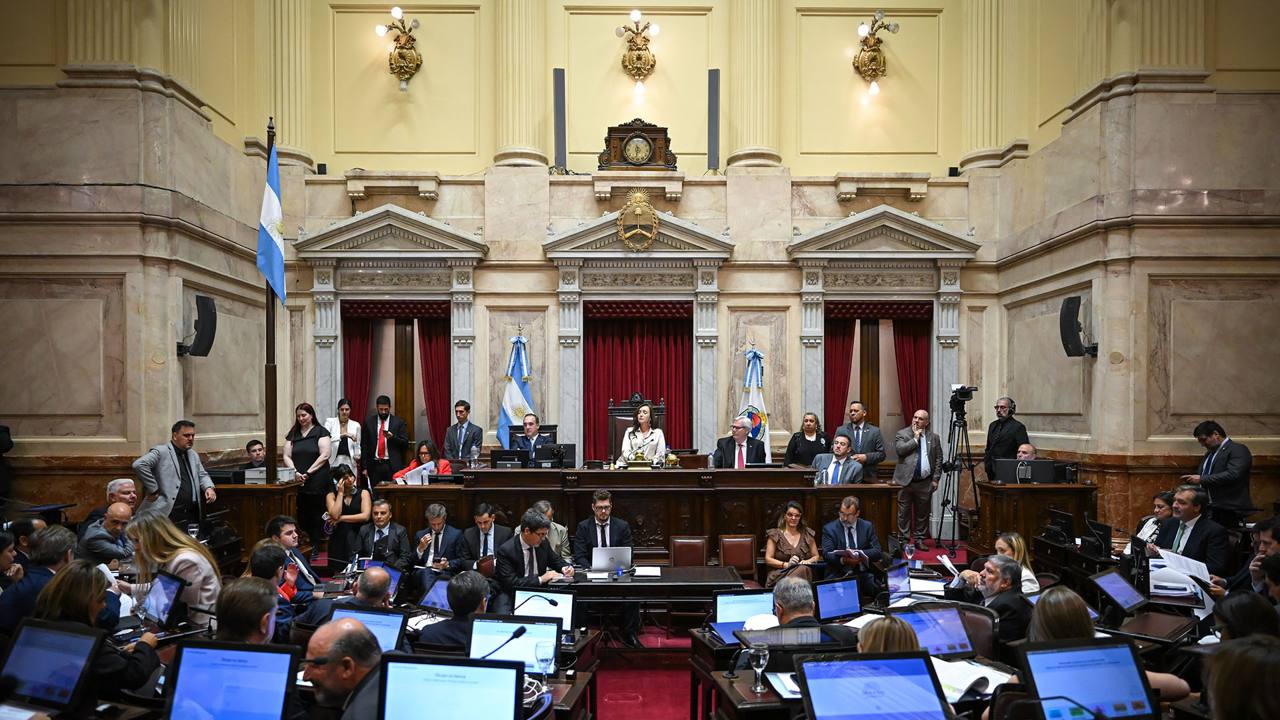
Argentina's Senate voted 43 to 29 on Thursday, November 26, to approve an electoral reform bill suspending the country's primary elections for 2027, handing President Javier Milei a closely watched win as he prepares to seek re-election next year.
Source: Reuters
The bill still needs approval from the Chamber of Deputies, the lower house, to become law. But Senate passage alone was expected to show Milei's ability to build congressional support even without a majority in either house, analysts said.
What the reform does
The bill suspends the PASO primaries — the Primarias Abiertas, Simultáneas y Obligatorias, the open, simultaneous and compulsory votes in which parties choose their candidates — for the 2027 national elections only. The system, created in 2009, is not abolished: parties and alliances would choose their 2027 candidates under their own charters and internal rules.
It also cuts public financing for political parties, writes the Ficha Limpia rule into law — barring candidates whose criminal convictions have been confirmed at second instance — adds a full list box to the single paper ballot, suspends the election of Argentine representatives to the Mercosur Parliament, and removes the obligation to hold a presidential debate before the first round. After a change accepted on the floor, the debate remains obligatory in a second round.
How the vote broke down
The bill was backed by 21 senators from Milei's La Libertad Avanza, 10 from the Radical Civic Union, three from PRO and a group of provincial senators, several of them aligned with governors. It needed 37 votes to pass. The Senate's Constitutional Affairs Committee had cleared the measure on November 18 with the signatures of 11 of its 19 members, and former president Mauricio Macri's PRO party said it would back the reform.
Opponents, led by Peronist senators, warned the change weakens transparency and public scrutiny. Jorge Capitanich said it could advantage an incumbent facing falling approval ratings, while José Mayans, who leads the Justicialista bloc, dismissed the reform as a fabrication and one more improvisation from the Milei administration. Ruling-party strategists believe scrapping the primaries will leave the divided Peronist movement without a mechanism to settle on a single candidate, splitting the opposition vote ahead of Milei's re-election bid.
Why markets are watching
Investors see the suspension as improving Milei's re-election prospects by eliminating an early nationwide test of voter sentiment that has historically shaped market expectations and, in some cases, triggered sharp financial volatility. Milei has already declared his candidacy for re-election in the general election scheduled for October 2027, which he would win outright in the first round with 45 percent of the vote, or with at least 40 percent and a lead of more than 10 points; otherwise the top two go to a run-off.
The vote comes as the economy likely entered a technical recession in the third quarter and Milei's approval ratings hover around 36 percent, near the lowest of his presidency, according to Bloomberg.
What happens next
The bill now passes to the Chamber of Deputies, where it will need at least 129 votes to become law. It is expected to be taken up in extraordinary sessions in December. Patricia Bullrich, who leads Milei's bloc in the Senate, has said she is confident it will pass.
On the same day, the lower house gave final approval to Milei's new charter for the Central Bank, which in effect bars the bank from financing government spending — a second major win for the president's economic agenda.
The Senate approved the text article by article after the general vote, completing its passage. If deputies approve the same text, the suspension applies to the 2027 cycle only.