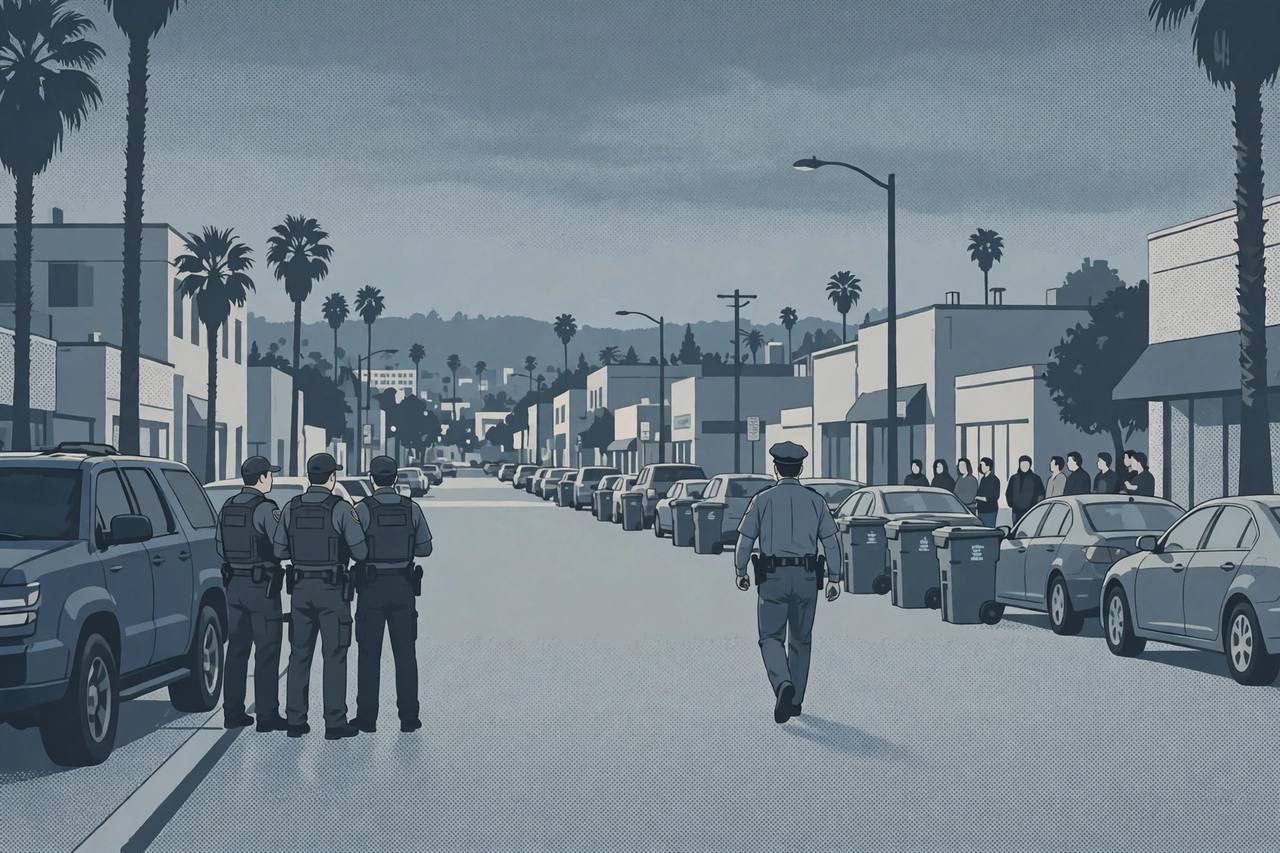
The US Department of Homeland Security has blasted California’s sanctuary policies after body-camera footage showed a Long Beach police officer telling federal immigration officers they were on their own as an angry crowd surrounded them during an arrest. Homeland Security Secretary Markwayne Mullin called the footage “truly disturbing” and accused California politicians of putting federal agents in danger.
Source: US Department of Homeland Security
Awaaz Punjab reported on October 20 that US citizen Ricardo Gonzalez was injured in the same October 17 Long Beach ICE incident, and that California lawmakers later demanded an independent probe into the use of force. Read our earlier report
The confrontation happened on October 17, when officers from Immigration and Customs Enforcement’s Enforcement and Removal Operations unit in Los Angeles carried out a targeted operation in Long Beach to arrest a Mexican national whose criminal history, according to DHS, includes a felony charge of inflicting corporal injury on a spouse, cohabitant or date. DHS said the Long Beach Police Department had previously declined an ICE detainer request for the man.
According to DHS, people at the scene blocked the ICE vehicles’ exits with their own cars and trash receptacles. Two people were arrested for damaging government vehicles — and one of them escaped after another person opened the door of the government vehicle she was being held in.
In body-camera footage captured by an ICE officer, a Long Beach police officer approaches the federal agents and says: “We’re being ordered to pull out. So you guys are going to be on your own. I’m sure you’re used to it. Good luck.” The officer later adds that the agents were on their own “according to our watch commander.”
“The footage of what happened to our ICE officers in California is truly disturbing,” Mullin said in the DHS statement. “As they were surrounded by an angry mob and being harassed and obstructed just for doing their job and going after dangerous criminals, the local police in Long Beach, California, were ordered to stand down and stop assisting them, leaving them to fend for themselves.”
Mullin went further, blaming California’s sanctuary politicians for the confrontation: “This is the end goal of the hateful rhetoric from sanctuary politicians in California and across the country. They want to see our ICE officers harmed in the line of duty, or worse. But even despite all the attacks, the patriots of ICE are committed to doing their duty and protecting the American people. The Trump Administration will always stand with our ICE officers, and will never apologize for putting the safety of the American people first.”
Long Beach police give a different account
The Long Beach Police Department has given a different account of the same night. In a statement in October, reported by CNN and NBC Los Angeles, the department said officers responded to an emergency call from ICE about vehicle vandalism and a person needing medical aid. Officers found an injured man, Ricardo Gonzalez, removed his handcuffs and handed him to paramedics. City police officials insisted “officers were not involved in any immigration enforcement and LBPD personnel did not make any arrests.”
Source: Fox News
According to the same reporting, after Long Beach police left the scene, some ICE agents followed officers into a secure police station parking lot and were ordered to leave — though police said the agents were told they could call dispatch if they wanted an officer to respond. The DHS statement released on November 25 did not include a response from the city or its police department, and none had been located in the reporting reviewed.
The two accounts may describe different moments of the same standoff, and the order of events that night is now the central factual question. What is not in dispute is that the October 17 incident left US citizen Ricardo Gonzalez with a broken arm, that four California lawmakers asked the DHS Inspector General to investigate ICE’s use of force in Long Beach, and that the city’s mayor sought an independent probe.
The detainer dispute behind the clash
At the heart of the clash is a disagreement over detainers. An ICE detainer under federal regulation 8 CFR 287.7 is, by the regulation’s own terms, a request that a jail notify ICE before releasing someone and hold the person briefly so agents can take custody. California’s SB 54, the California Values Act, goes further and largely prohibits local agencies from holding people on detainers — and bars them from using local resources to investigate, detain or arrest people for immigration enforcement purposes.
DHS says Long Beach police had already declined a detainer for the man ICE came to arrest on October 17. The department’s statement frames the pull-out as the consequence of that policy. Long Beach police, for their part, say their officers were never part of the immigration operation at all. Neither account, on its own, settles what the watch commander ordered or why.
Part of a wider DHS campaign
The Long Beach statement is the latest in a run of DHS statements naming sanctuary cities and states. The same release noted that ICE arrested Jose Luis Rosales Ayala, an El Salvador national described by DHS as an MS-13 gang member, in San Mateo, California, in November. DHS has also publicly denounced other cities and states for limiting police cooperation with ICE, and the department says its officers will keep carrying out enforcement operations despite local resistance.
What it means for immigrant communities
Long Beach sits in Los Angeles County, home to one of the largest immigrant and Punjabi communities in the United States. For mixed-status families, the fight over detainers and local cooperation is not abstract: it decides whether a call to local police can lead to a federal immigration arrest, and whether local officers will stand beside federal agents during an operation. The Gonzalez injury — a US citizen hurt in an ICE operation — and the lawmakers’ demand for an independent probe show why these street-level encounters draw scrutiny from both sides.
What happens next
The four California lawmakers’ request for a DHS Inspector General investigation is pending, and there has been no word on any charges over the police pull-out or the damaged vehicles beyond the two arrests on the night. DHS says enforcement will continue, and the department’s statement signals more public pressure on sanctuary jurisdictions. Long Beach police have not responded publicly to the November 25 statement in the reporting reviewed. The body-camera footage is now public, but the order of events on October 17 — and who ordered what — remains disputed.
DHS says Long Beach police were ordered to abandon federal officers mid-arrest. Long Beach police say they answered an emergency call about vandalism and an injured man, and never took part in immigration enforcement. The body-camera audio is now public — but the order of events that night is still disputed.
What is solid
- On October 17, ICE officers carried out a targeted arrest operation in Long Beach; DHS says the Long Beach Police Department had previously declined an ICE detainer for the man.
- Body-camera footage released on November 25 shows a Long Beach officer telling ICE officers they were being ordered to pull out and were “on your own.”
- US citizen Ricardo Gonzalez was injured in the same October 17 incident and was taken to hospital; California lawmakers asked the DHS Inspector General to investigate.
- Two people were arrested on the night for allegedly damaging government vehicles; one escaped custody.
What is only claimed
- Whether Long Beach police abandoned ICE officers mid-arrest, as DHS says, or responded only to a separate emergency call about vandalism and a man needing medical aid, as the police department says.
- DHS describes the crowd as an “angry mob” and the people at the scene as “rioters”; that characterisation is the department’s own wording.
- The man’s immigration status and criminal history as described by DHS — the department says he is a Mexican national with a felony domestic-violence charge; no court record has been published in the reporting reviewed.