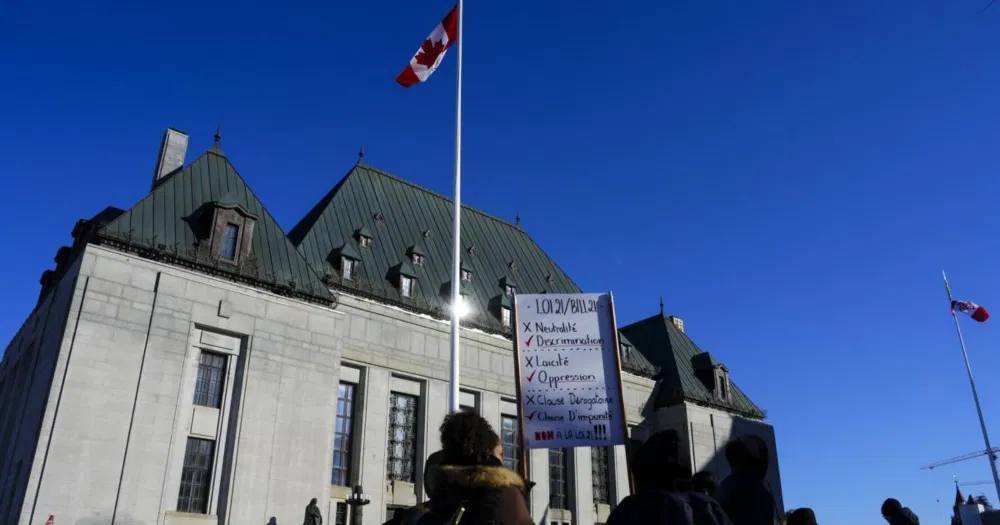
Canada's Supreme Court on Friday largely upheld Quebec's controversial secularism law, Bill 21, ruling that the province validly used the Constitution's notwithstanding clause to shield the ban on public servants wearing religious symbols at work. The decision, 2026 SCC 41 in English Montreal School Board v. Quebec (Attorney General), keeps the ban in place for teachers, police officers, government lawyers and other public employees in positions of authority — including Sikh turbans, Muslim hijabs, Jewish kippahs and Christian crosses.
The court made one exception: section 8 of the law, which bars members of Quebec's National Assembly from wearing a face covering, infringes the democratic rights in section 3 of the Canadian Charter of Rights and Freedoms — the right to run for public office — which the notwithstanding clause does not cover. That provision was struck down as it applies to elected members of the legislature.
The notwithstanding clause stands
At the heart of the case was section 33 of the Charter, the notwithstanding clause, which lets a legislature override certain Charter rights for renewable five-year periods. A majority led by Chief Justice Richard Wagner held that Quebec had validly used the override power in section 33 of the Canadian Charter and section 52 of Quebec's Charter of human rights and freedoms, and that the exercise of that power is not subject to any limit other than those set out in the provision's own text. In other words, a province may invoke the clause in advance to shield a law from Charter challenges before a court has ruled on it.
The court also held that judges still have the power to declare whether a law is consistent with Charter rights even when the notwithstanding clause has been invoked — but the majority declined to make such a declaration in this case.
Two other challenges failed. The court held that Bill 21 cannot be invalidated because of section 28 of the Charter, which says rights apply equally to men and women, and that the law does not infringe the rights of Quebec's English-speaking minority in education under section 23.
Who is affected — and why it matters for the diaspora
The ruling directly affects religious minorities working in Quebec's public sector. Sikh teachers cannot wear turbans in the classroom, Muslim women cannot wear the hijab, and Jewish and Catholic public servants cannot wear the kippah or the cross while on duty. The challenge was brought by groups including the English Montreal School Board and female Muslim, Sikh and Catholic teachers, who argued the law violated their fundamental rights. Civil liberties groups say the law is discriminatory and falls hardest on Muslim women, forcing them to choose between some public-sector jobs and their faith.
For Canada's large Punjabi and Sikh community — one of the biggest diaspora populations in the country — the decision settles, for now, a question that has hung over Quebec since 2019: whether a turban-wearing teacher, police officer or government lawyer can work in the province without removing a core article of faith. The answer from the country's highest court is no, as long as the notwithstanding clause is in force.
Reactions and what happens next
The ruling is a political win for Quebec's sovereigntist government, whose premier, Paul St-Pierre Plamondon, had opposed any invalidation of the law. It could also complicate Prime Minister Mark Carney's efforts to unify the country as Canada faces a trade war and annexation threats from US President Donald Trump, Reuters reported. The National Council of Canadian Muslims and community partners were set to speak on Parliament Hill in Ottawa on Friday morning in response to the ruling.
Bill 21 was passed in June 2019 and renewed in 2024. Quebec's Court of Appeal upheld most of it in February 2024, sending the case to the Supreme Court. With the law now confirmed as valid, it stays in force — and the court's finding that judges can still declare Charter inconsistencies, even without striking a law down, leaves the door open to future challenges on other laws.
What is solid
- The Supreme Court largely upheld Bill 21 on November 27, 2026
- Quebec validly used the notwithstanding clause
- The face-covering ban for National Assembly members was struck down
What is only claimed
- Critics say the law discriminates against religious minorities, especially Muslim women
- Quebec says the law protects the secular character of the state