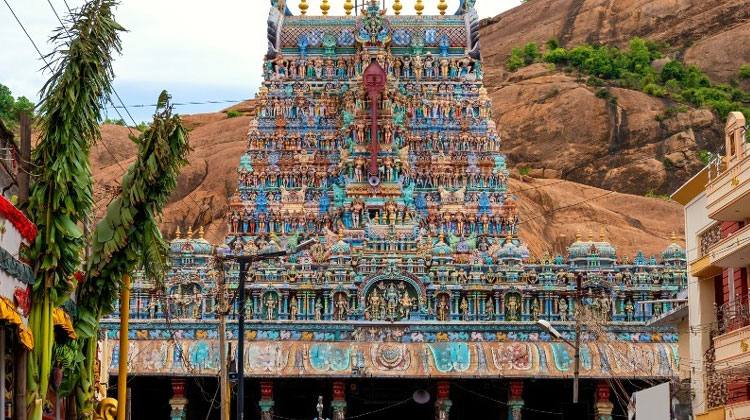
The Supreme Court on Friday, November 27, took strong exception to the State of Tamil Nadu and Madurai district officials for failing to comply with its November 20 order to light the Karthigai Deepam at the disputed stone pillar known as the Deepathoon on Thiruparankundram hill in Madurai.
A bench of Justices Aravind Kumar and Vipul Pancholi suspended the current board of trustees of the Uchipillaiyar Temple for defying the court's directions. The bench appointed retired Justices Vaidyanathan and Parthiban as receivers of the temple trust and directed that the Karthigai Deepam be lit at the Deepathoon on Saturday, November 28.
In a departure from its November 20 order, which had permitted only a small team to light the lamp, the court said every devotee can light the lamp at the disputed site at least 50 metres away from the nearby Dargah on all sides. The Central Reserve Police Force (CRPF) was directed to protect the Dargah and to ensure that devotees visiting it are neither obstructed nor prevented from offering prayers.
The court issued contempt of court notices to the Tamil Nadu Chief Secretary, the Director General of Police, the Hindu Religious and Charitable Endowments (HR&CE) Secretary and Commissioner, the Madurai District Collector, the Commissioner of Police, the Superintendent of Police, the temple authorities and others. The Chief Secretary was ordered to file a comprehensive affidavit detailing emails, telephone calls and messages exchanged between officials over the lighting of the lamp and the November 20 order, and to remain personally present before the court on the next date of hearing.
"The chain of events that has unfolded in the instant case would indicate that the executive authorities seem to have acted at the dictates of their political bosses," the Supreme Court said, adding that non-compliance reflected administrative chaos in the state, or at least in Madurai district.
"Time has come to deal with such situations with an iron hand, as otherwise it will lead to constitutional chaos," the bench said. "An order of this Court is not an invitation to negotiate. It binds the State, its officers and every statutory or religious institution functioning under the State's law until this Court itself modifies it."
What happened on November 24
On November 20, the bench had permitted a small team authorised by the temple administration to light the Karthigai Deepam at the Deepathoon on November 24 as a one-time measure, and had put the Madurai District Collector in charge of supervising the arrangements. The lamp was lit that evening at the customary Deepa Mandapam near the Uchipillaiyar Temple, but the Deepathoon itself remained unlit.
The temple administration said its trustees had unanimously resolved to follow the temple's established practices, under which the lamp has to be lit at the Uchipillaiyar Temple and not at the Deepathoon, which the state maintains is only a survey stone erected by the British. The Tamil Nadu government told the Supreme Court on Wednesday that its November 20 order could not be complied with. District Collector Nishant Krishna filed an affidavit saying he had tried his best to ensure compliance but the temple administration did not permit it.
At least two contempt petitions were then filed before the top court. Solicitor General Tushar Mehta, appearing for the Archaeological Survey of India (ASI), called it a case of aggravated contempt and said the ASI team had been halted by local police at 3 pm and was not permitted to go near the lamp. Senior Advocate J Sai Deepak, appearing for another contempt petitioner, argued that the state had deliberately disobeyed the order so the issue could be pushed to next year's festival.
Tamil Nadu had apologised to the Supreme Court over the unlit lamp and blamed the temple trustees. This order is the court's response to that non-compliance. Read the earlier report
The court said executive authorities in Tamil Nadu cannot arrogate to themselves the power to decide whether judicial orders deserve to be obeyed, and that wilful defiance by officers entrusted with implementing judicial orders was a flagrant breach of constitutional duty that "obstructs the administration of justice and strikes at the very root of the rule of law".
What happens next: the court-appointed receivers must ensure the lamp is lit at the Deepathoon on November 28, the Chief Secretary must file the detailed affidavit on communications between officials, and the Chief Secretary must appear personally before the court at the next hearing. The Deepathoon stands close to the Sikandar Badusha Dargah, and the nature of the pillar remains disputed, with the state maintaining it is a survey stone and not connected to the temple.