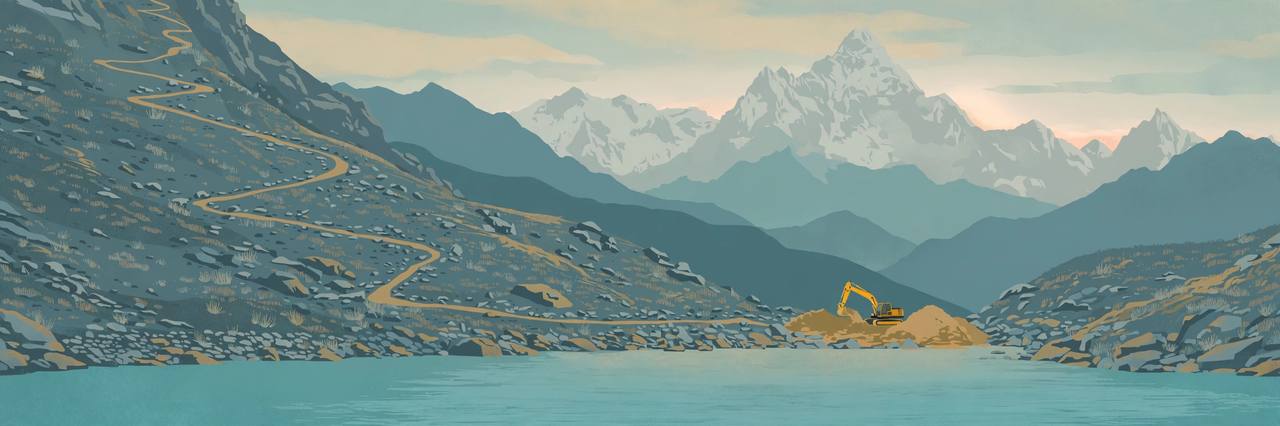
A video of excavators moving mounds of earth on the shore of Sheshnag lake has sparked a political row in Jammu and Kashmir, with opposition leaders questioning road-widening work on the Amarnath pilgrimage route and the government insisting the lake is safe. The lake sits at an elevation of 3,590 metres (11,780 feet) on the Pahalgam–Amarnath cave trek, in an ecologically fragile stretch of the Himalayas.
PDP chief Mehbooba Mufti raised the issue at a press conference at the party headquarters on Thursday, linking the possible effects of the digging to the Shivling at the Amarnath cave and calling it “very disturbing to see this turn of events” so close to the holy site. She asked whether an environmental impact assessment had been conducted before the work was cleared — and if so, why it had not been made public — and said the issue was “not merely religious but existential”.
Ms Mufti also questioned the Omar Abdullah-led Cabinet’s clearance of the road project in January and the memorandum of understanding signed with the Border Roads Organisation (BRO), which is carrying out the work. She asked how the excavators had reached Sheshnag, who authorised their movement, and why people were being stopped from visiting the site. She said she had tried to visit Sheshnag on Tuesday but was stopped by security personnel.
Senior Congress leader Karan Singh joined the protest, saying in a statement: “I join my voice with those who are protesting about this and would urge those concerned not to use heavy equipment on this route.” He added: “We do not have to make every pilgrim route into a motorable road, just for the convenience of tourists. Genuine pilgrims will not mind walking or riding towards this great shrine.” Mr Singh, a former Sadr-i-Riyasat of Jammu and Kashmir, said two-lane roads were enough for pilgrims. The Indian Express reported him as saying the road-widening involved extensive use of dynamite that severely damages the comparatively young Himalayas, and he cited the Kedarnath disaster. His son Vikramaditya Singh also called the use of excavators on the Chandanwari–Amarnath route “deeply concerning”.
The Jammu and Kashmir government has dismissed the allegations. Forest Minister Altaf Kaloo said the work was routine post-Amarnath Yatra repair of tracks, that the BRO had “not fiddled with the track” along Sheshnag, and that “not a grain of soil has gone into the Sheshnag lake”. He said the machinery was operating 200–300 feet away from the lake and at a higher elevation, and that a team of 12 officials had been sent to the site after the videos surfaced. “What the department apprised me is that Sheshnag is completely safe,” he said.
Why Sheshnag matters
In Hindu tradition, Lord Shiva left his serpent at Sheshnag before proceeding to the Amarnath cave, and the 12th-century chronicle Rajatarangini mentions the lake as the abode of a Naga deity. The area is ecologically sensitive, which is why the presence of heavy machinery there has sharpened the concern.
The PDP has demanded that the government allow a joint team of politicians and environmentalists to visit the lake for an independent assessment, and that the agreement with the BRO be made public. An online petition demanding an immediate halt to the excavation and road-widening work crossed 16,000 signatures on Thursday. Activist Raja Muzaffar Bhat said the young nature lover who started the petition, Zarqua Banday, had sent a “distressing SOS” and alleged she was being harassed, claiming the cyber police had called her family. Mirwaiz Umar Farooq, former MP Aga Syed Ruhullah Mehdi, J&K Congress president Tariq Hameed Karra and communist leader M. Y. Tarigami are among the other leaders who have raised concerns over the work in the past week. No halt to the work or inquiry has been reported so far.