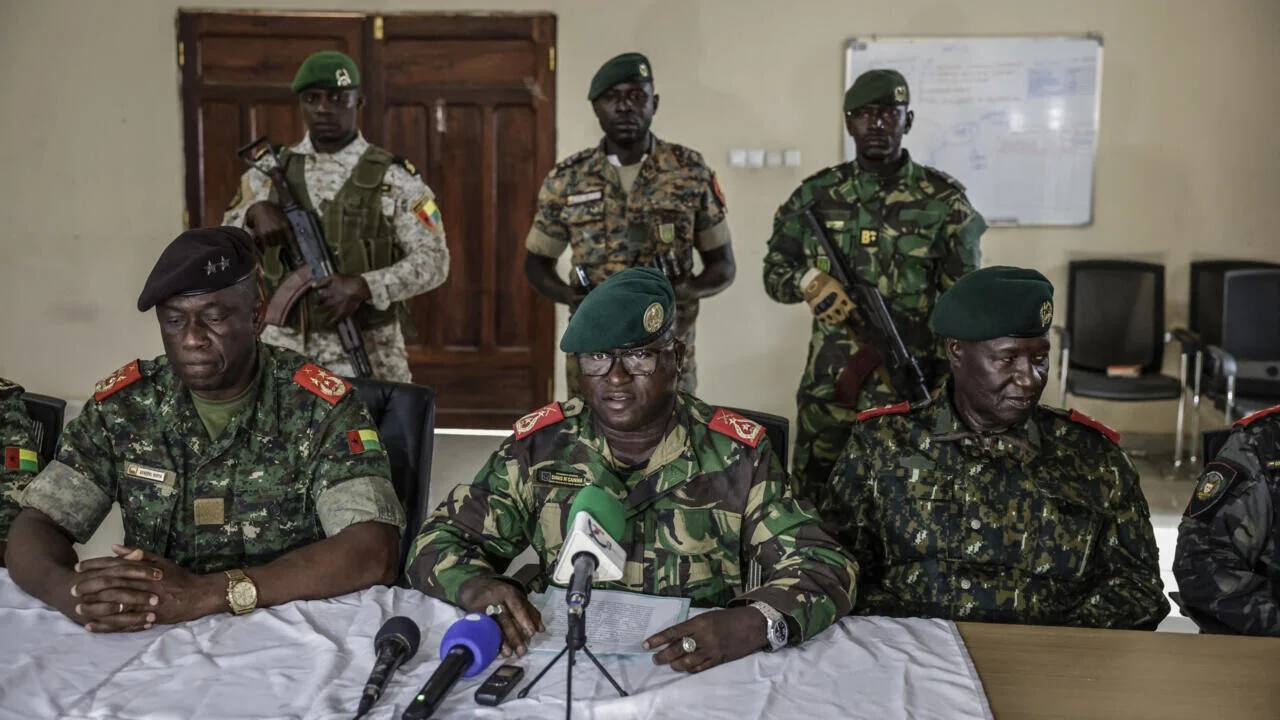
BISSAU — Guinea-Bissau's military government on Thursday postponed presidential and legislative elections until November 2028, extending its promised year-long transition to civilian rule by roughly two years.
Source: Associated Press
A decree issued by the transitional president, General Horta Inta-a, said the elections initially scheduled for December 6 would instead take place on November 26, 2028. The decree said there was 'an insufficiency of the technical, material and financial conditions' necessary to hold the vote.
The decision came on the first anniversary of the coup. The army seized power on November 26, 2025, three days after general elections, ousting President Umaro Sissoco Embaló — who was seeking a new term — and interrupting the electoral process before official results were announced.
Three years of military rule
The coup installed former army chief of staff Inta-a as head of the military government, tasked with overseeing a one-year transition back to civilian rule. Thursday's decree means the military-led administration will stay in charge for roughly three years in total if the November 2028 date holds.
Guinea-Bissau, a small Portuguese-speaking country on West Africa's Atlantic coast, has a long history of military coups and political instability since independence from Portugal in 1974. The November 2025 takeover was the latest in a series of power seizures that have repeatedly interrupted democratic rule.
The delay comes amid a wave of military takeovers across West Africa in recent years, with juntas also in power in Mali, Burkina Faso, Niger and Guinea. Regional bloc ECOWAS sent a mission to Bissau in January, led in part by Senegal's President Bassirou Diomaye Faye, to help resolve the political crisis.
The country has also long been described by the United Nations as a transit point for cocaine heading from Latin America to Europe, and its fragile institutions have struggled to contain the trade.
No date has been set for a return to the transition timetable beyond the new November 2028 date, and it is not yet clear what conditions the military government says must be met before a vote can be held.
What happens next
Attention now turns to whether regional and international partners accept the extended timetable, and whether the junta publishes a concrete plan for voter registration and election preparations. For now, the December 6 vote is off, and Guinea-Bissau's return to civilian rule is at least two years away.