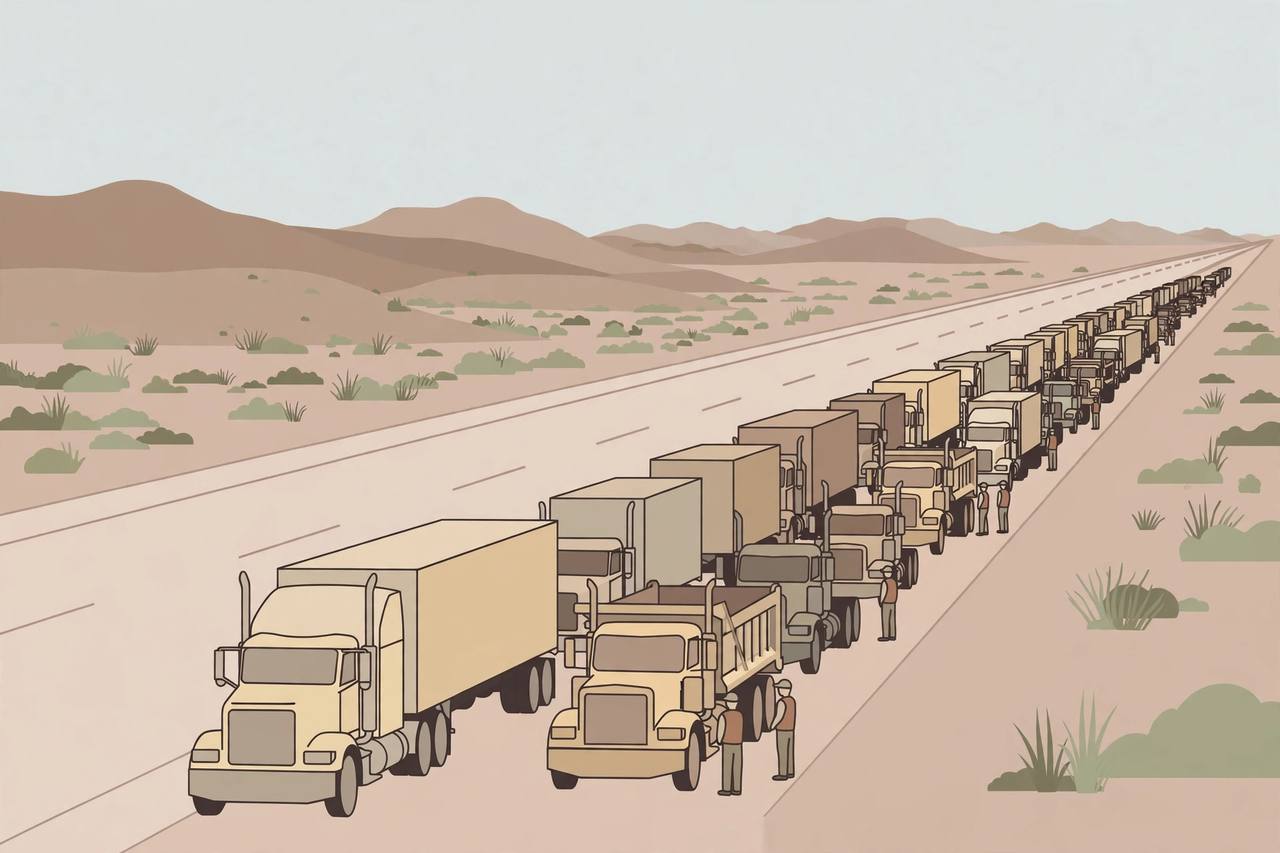
Iranian truck drivers entered a fifth day of strikes on Thursday, with their union saying drivers in 18 cities were refusing to haul freight at rates that have stayed flat while the cost of keeping a truck on the road has climbed.
Source: Iran International
The strike began on Sunday, 22 November, as the US naval blockade and soaring inflation squeezed drivers' earnings. Read our earlier report on how the stoppage started. Read the earlier story
The Union of Truck Drivers and Trucking Associations Across Iran named Isfahan, Kermanshah in the west and Kazerun in the southern province of Fars among the cities, in a message to drivers on Telegram. Truckers in Shiraz stopped work on Sunday, the day the strike began.
The opposition National Council of Resistance of Iran (NCRI) said the strike had spread to 14 provinces, listing Tehran, Mashhad, Shiraz, Isfahan, Qazvin, Kermanshah, Bam, Sirjan, Dezful, Bandar Abbas, Gachsaran, Chabahar, Divandarreh, Zabol, Jiroft, Ahvaz, Shushtar, Kazerun, Khorramabad and Malayer.
Why drivers stopped
Drivers say freight rates have not moved while fuel, tyres, insurance and maintenance costs keep rising. One driver quoted in Iranian social-media reports said the price of an oil change had risen more than 30% in a year, and the cost of new tyres by more than 30% — costs that now outpace what a load pays.
The drivers are protesting their living conditions, rampant inflation and the authorities' failure to answer their demands, the NCRI said. Iran's rial has hit record lows and inflation has surged as the US naval blockade, in place since April, chokes the economy.
The strike is spreading beyond trucking. On 25 November, pensioners of the Homa airline rallied in front of the Ministry of Roads and Urban Development, and on 24 November postal workers in Baharestan County stopped work over wages in their new contracts, halting mail distribution.
What it means
Trucks move most of Iran's food, fuel and goods between cities and ports. A stoppage across 14 provinces, if it holds, would squeeze supplies and prices in a country already under a wartime blockade — and it is the most visible sign yet of economic distress inside Iran since the US-Iran war began in February.
For Punjab's own trucking community — thousands of Punjabi drivers work the roads of North America and the Gulf — the strike is a reminder of how quickly a driver's maths can break: when diesel, tyres and repairs rise and rates do not, the truck stops paying for itself.
What happens next
The union has not announced an end date, and there has been no public official response to the drivers' demands. The strike could widen to more cities — or face security pressure, which the NCRI said drivers were already facing. Awaaz Punjab will follow the strike as it develops.
What is solid
- The strike began on Sunday, 22 November 2026
- Drivers in 18 cities are refusing to haul freight, the truckers' union said
- The strike has reached 14 provinces, the NCRI said
What is only claimed
- The exact number of cities and drivers on strike — the union says 18 cities; the NCRI lists 20 cities across 14 provinces
- Whether the authorities will negotiate — no official response to the drivers' demands has been reported