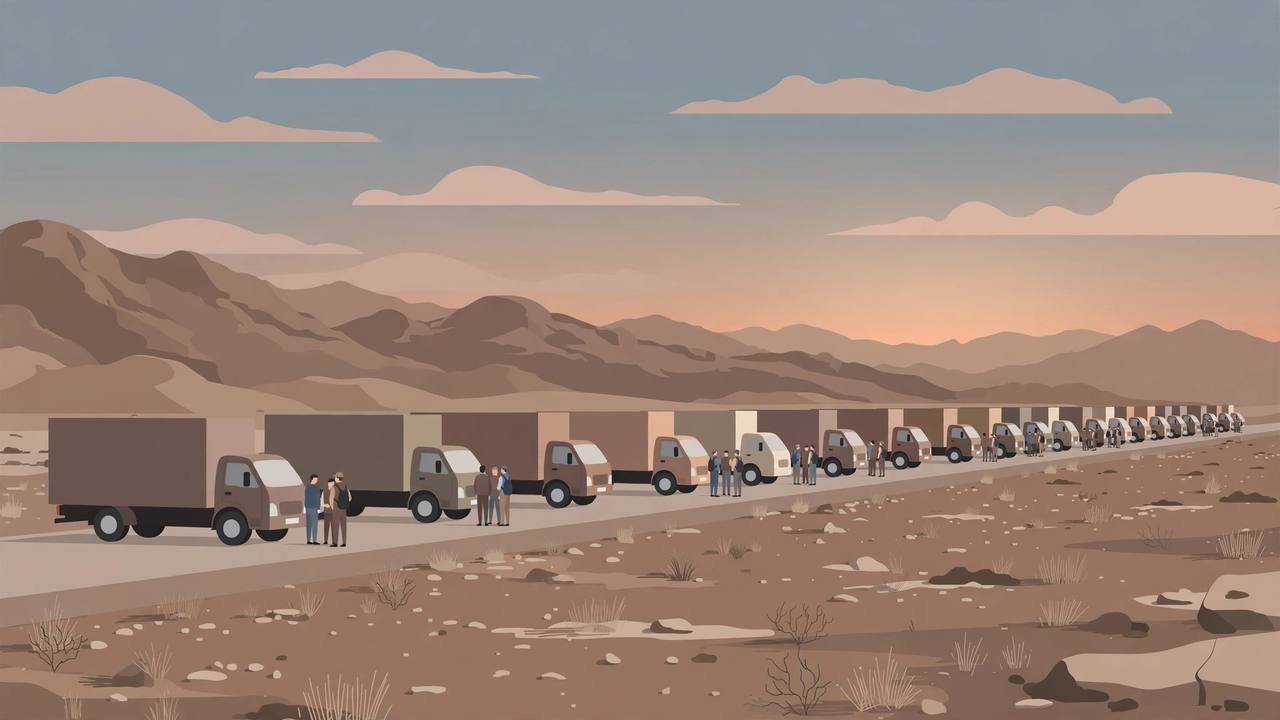
Truck drivers across Iran stopped work on Sunday, launching a nationwide strike over freight rates that no longer cover the soaring cost of fuel, tyres, insurance and repairs — the latest sign of economic distress inside the country as the US naval blockade grinds on.
Source: Iran International via Hasbara
The strike, called by the Union of Truck Drivers and Trucking Associations Across Iran, entered its second day on Monday, with drivers reported stopped in Shiraz, Tehran, Qazvin, Bam, Sirjan, Dezful, Bandar Abbas, Isfahan, Chabahar and Divandarreh.
Source: Iran Focus
In a statement, the union called the strike "a cry of protest from drivers who have spent years struggling under the weight of rising prices, injustice and neglect and can no longer endure these unbearable conditions."
Costs that no longer add up
Drivers say a 22% increase in freight rates is nowhere near enough to cover operating costs that have risen several times over. The price of a single tyre has reached about 3.5 billion rials — roughly $1,300 — while some spare parts cost as much as four times more than before. One driver told the union that 40 litres of engine oil and five filters cost 620 million rials, about $230 at the free-market exchange rate. A worker's monthly wage barely reaches $100.
Source: Iran Focus
The strike matters because truck drivers move Iran's food and fuel. Past stoppages have shown that when drivers park their vehicles, supply and distribution chains across the country seize up — and monitors say this one could become a serious challenge to the transport system if it spreads.
An economy under strain
The Institute for the Study of War, in its November 23 update, said Iranian officials and media are increasingly concluding that the economic situation makes ending the blockade necessary — including by launching military operations if the United States does not agree to Iranian demands in negotiations. The blockade has cut Iran's oil exports, pushed up inflation and worsened a fuel crisis, the institute said.
Source: Institute for the Study of War — Iran Update, November 23, 2026
President Masoud Pezeshkian admitted on Saturday that the economic battle facing the country is "far more difficult" than one fought with missiles, as the US campaign to isolate Tehran tightens its grip.
Figures from Iran's Central Bank-affiliated Monetary and Banking Research Institute, cited in reports, say the economy contracted about 5.2% in the summer after a 12.1% contraction in the spring. The oil sector shrank 31.7%, industry and mining fell 10% and services fell 1%; only agriculture grew, by 6%.
Retirees protested on Sunday in Tehran, Isfahan and Shush over inadequate pensions and soaring prices, while electricity-sector employees demonstrated outside the Energy Ministry. Planned power restrictions began on November 22, and reports from inside the country put the daily natural-gas deficit at 430 million cubic metres.
US Treasury Secretary Scott Bessent has said Iran's economy will shrink by more than 25%, and has urged Iranians to stop paying taxes and stockpile fuel, according to a report by Iran International.
What is solid
- Truck drivers in at least ten Iranian cities stopped work on Sunday, November 22, in a strike called by their national union.
- Drivers cite freight rates that have not kept up with fuel, tyre, insurance and repair costs.
- The strike entered its second day on Monday, November 23.
What is only claimed
- How many drivers are taking part — no official tally of the strike's reach has been published.
- How far supply disruption will spread if the strike continues — monitors warn of disruption, but the scale is not yet measured.
What happens next
No end date has been announced for the strike. If it spreads, food and fuel distribution across Iran could be hit hard — and the unrest adds pressure on a government already squeezed by the blockade. For the lakhs of Indian and Punjabi workers in the Gulf, the blockade and the shipping disruption around the Strait of Hormuz already weigh on trade, flights and remittances. On Monday, US Vice President JD Vance and Secretary of State Marco Rubio met Qatar's prime minister in Washington as Doha pushes to revive stalled talks — but there is no sign yet of an understanding.
Earlier: Iran vowed to counter the US naval blockade 'by all available means' as Trump signalled new strikes after the new year. Read the earlier story