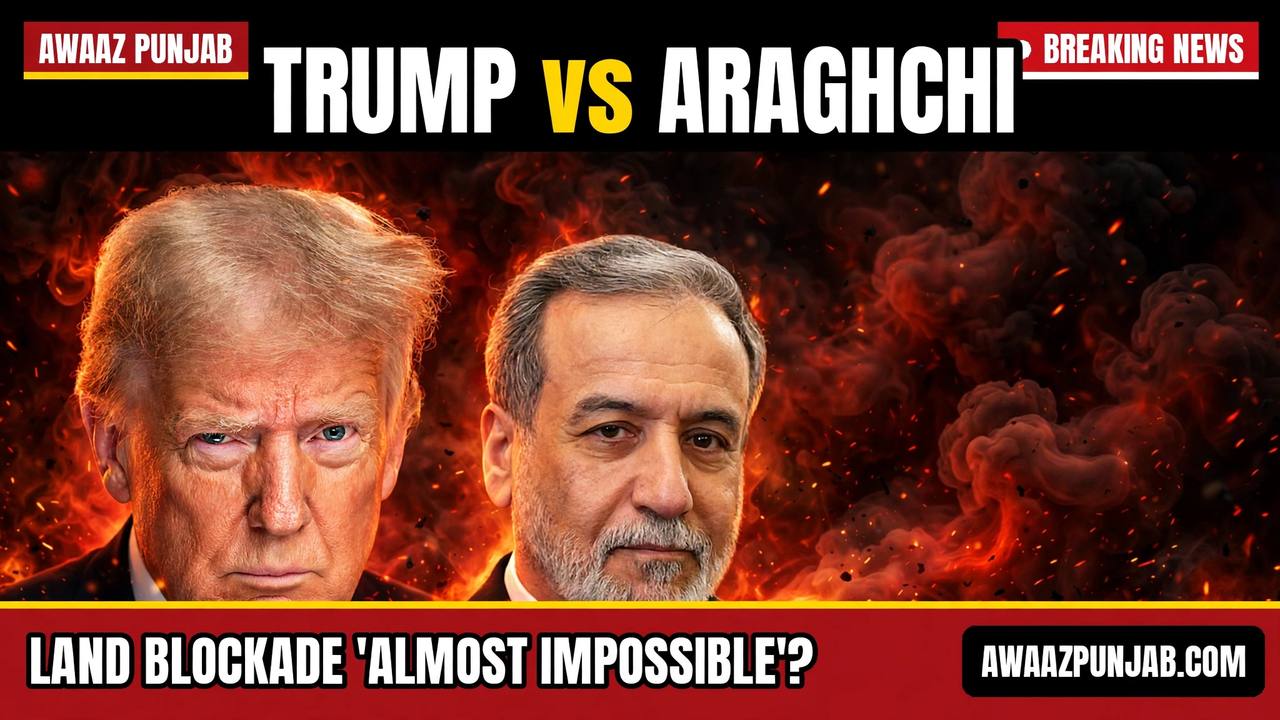
US President Donald Trump has declared that Task Force Iron Gate — the American military's new effort to choke off Iran's land and Caspian Sea supply routes — is “in full force and effect”, telling reporters that “nothing comes in by land”. Iran's foreign minister, Abbas Araghchi, hit back within days, saying a land blockade of Iran is “almost impossible”.
Source: Fox News Digital
Awaaz Punjab reported on November 7 that US Central Command had created Task Force Iron Gate to extend its naval blockade of Iran to the country's land borders and the Caspian Sea. Read the November 7 report
Mr Trump made the declaration on Sunday, in a post on his Truth Social platform and in remarks to reporters. “We have Operation Iron Gate that just went into effect. That means nothing comes in by land,” he said, adding that the existing naval blockade was already stopping supplies by sea. The president also claimed Iran's inflation had reached 300 per cent and that its government was struggling to pay its personnel — figures he offered without evidence and which have not been independently verified.
Source: Fox News Digital
What Iron Gate is — and what it is not
Task Force Iron Gate is a team of about 20 civilian and military personnel based at US Central Command headquarters in Tampa, Florida, set up under CENTCOM commander Admiral Brad Cooper. Its job, according to CENTCOM, is to coordinate with other US government agencies to stop the movement of advanced weapons systems, dual-use technologies, sanctioned materials and illicit revenue across Iran's land borders and the Caspian Sea. It is a coordination and intelligence cell, not a force deployed to border crossings — a point the command itself has stressed.
Source: CENTCOM statement, via Al Jazeera
The scale of the task is the heart of Tehran's rebuttal — and of the doubts voiced by independent analysts. A Reuters investigation found that military-linked Iranian agencies imported at least $2 billion in hardware, explosives and heavy-duty trucks through non-port routes between January 2025 and June 2026, using intermediaries and triangular trade to evade controls. Farzin Nadimi, a senior fellow at the Washington Institute for Near East Policy, told Fox News Digital the task force's immediate role was likely to be gathering intelligence on activity along Iran's borders and building cooperation in the region.
Source: FairsOnline, citing Reuters
Iran's answer: ‘almost impossible’
Iran's Foreign Minister Abbas Araghchi dismissed the idea that Iran's land routes could be sealed, calling a land blockade “almost impossible”, in remarks reported this week as the US tightened restrictions. His comments came as the US measures took aim at the ground transit routes and the Caspian Sea that Tehran uses to move restricted materials. Araghchi's ministry has not detailed how Iran would keep the routes open, and the claim itself — like Washington's — has not been independently verified.
Source: NewKerala / IANS
Iran's neighbours are also pushing back, or at least hedging. Iraq has declined a US request to close all but two of its crossings with Iran, according to Iraqi officials cited in reporting on the task force — though Baghdad did shut its Al-Sheeb crossing with Iran in October. Washington has also pressed Turkey, Pakistan and Iraq to curtail ground-based connections with Tehran, according to regional reporting.
Source: CEPA
The politics behind the escalation
The Iron Gate announcement is President Trump's first escalation of the Iran war since Republicans were trounced in last week's midterm elections — a defeat Mr Trump himself acknowledged was partly caused by the war and the economic turmoil around it. The war was a crucial factor in the House vote for 34 per cent of voters, according to the Fox News Voter Poll, while about six in ten said the US had made the wrong decision to take military action against Iran. Four days after the election, CENTCOM's task force was the administration's answer: more pressure without new strikes.
Source: Fox News Digital
The president has sent mixed signals since the vote. On November 10 he said the war “militarily is effectively over” and that new major strikes were highly unlikely, after meeting Qatar's prime minister at the White House. But by Thursday he was again saying the US no longer needs a deal with Tehran, and warning that the military is “locked and loaded” and watching Pickaxe Mountain, a facility linked to Iran's nuclear programme. He has also told the New York Post that his war effort is “funded” through the end of January, when Democrats take control of Congress — and that he hopes they will not bring the conflict to what he called a premature end.
Source: Associated Press, via DailyFoxNews
Global oil prices, which have fallen sharply since the midterms, dipped further after Mr Trump's November 10 remarks — Brent crude was more than 1 per cent lower at about $91.50 a barrel in Asian trading, according to market reports. A tighter squeeze on Iran's trade could push prices back up, which is why Gulf producers and importers are watching Iron Gate closely.
Source: BBC
Why it matters for the Gulf — and for Punjabi and Indian workers there
Lakhs of Punjabi and Indian workers live and work in Saudi Arabia, the UAE, Qatar, Kuwait, Oman and Bahrain, and their jobs, remittances and flights all run through a Gulf already disrupted by eight months of war. There is no report so far of any new disruption to civilian flights, shipping schedules or worker movement linked to Iron Gate, and the task force has no troops at border crossings — but any widening of interdiction around Iran's borders with Iraq, Turkey and Pakistan touches the overland trade routes that feed Gulf markets, and any fresh escalation would hit the region's workers first.
What is solid
- CENTCOM announced Task Force Iron Gate on November 7, directed by Admiral Brad Cooper, based in Tampa with about 20 personnel (CENTCOM statement, via Reuters and Fox News Digital).
- President Trump said on Sunday that Iron Gate is “in full force and effect” and that “nothing comes in by land” (Truth Social post and remarks to reporters, via Fox News Digital).
- Iran's Foreign Minister Abbas Araghchi called a land blockade of Iran “almost impossible” (reported this week, via IANS/NewKerala).
- Iran shares land borders with seven countries spanning roughly 6,000 km (Washington Institute / Fox News Digital).
- Iraq declined a US request to close all but two of its crossings with Iran, though it shut the Al-Sheeb crossing in October (Iraqi officials, via regional reporting).
What is only claimed
- CENTCOM's estimate that the naval blockade has blocked more than $25 billion of Iranian crude exports is the command's own figure and has not been independently verified.
- Mr Trump's claim that Iran's inflation has reached 300 per cent is his own assertion, offered without evidence.
- The Reuters finding of at least $2 billion in Iranian imports through non-port routes is the news agency's investigation, not an official figure.
- Mr Trump's statement that the war is “funded” through January is his own characterisation of congressional funding, and Democrats have threatened to halt it.
What happens next
The next signals to watch are whether any of Iran's neighbours agree to enforce land-route restrictions, whether the Qatar-mediated contacts between Washington and Tehran survive a further tightening of the blockade — and what Mr Trump says next week, when he travels to the Philippines and then to Shenzhen for an unprecedented three-way summit with China's Xi Jinping and Russia's Vladimir Putin, where Iran and the three powers' nuclear stockpiles are expected to be discussed.
Source: Associated Press, via DailyFoxNews
US envoy Jared Kushner has confirmed meetings with Iranian officials as the diplomacy track continues. Read: Kushner confirms meetings with Iranian officials