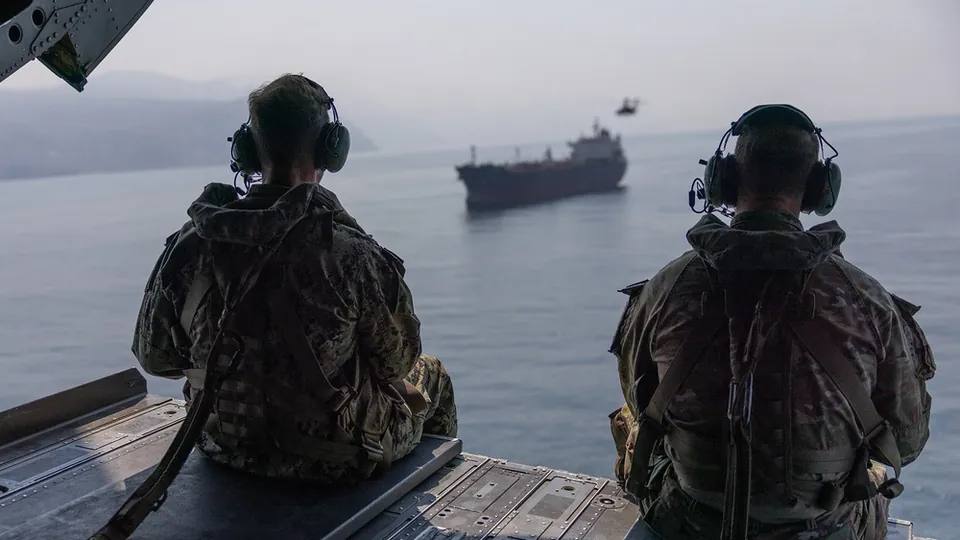
WASHINGTON / TAMPA — The United States military is widening its pressure campaign against Iran from the sea to the land. US Central Command (CENTCOM) announced on Saturday, November 7, that it has created Task Force Iron Gate, a new unit tasked with restricting Tehran's movement of advanced weapons systems and other sanctioned material across Iran's land borders and the Caspian Sea, Reuters reported, after seeing the CENTCOM statement ahead of its release.
Source: Reuters
According to CENTCOM's statement, the task force was established on November 7 under the direction of CENTCOM commander Admiral Brad Cooper. It will comprise approximately 20 civilian and military personnel based in Tampa, Florida, and will coordinate with other US government agencies. CENTCOM described the unit as a team focused on monitoring, detecting and disrupting illicit movements — a coordination and planning cell working with interagency partners, rather than a newly deployed field force.
What Iron Gate will target
CENTCOM said the task force will focus on the movement of advanced weapons systems, dual-use technologies, sanctioned materials and what it called illegal revenue streams across Iran's land borders and the Caspian Sea. Iran shares land borders with Turkey, Iraq, Pakistan, Afghanistan, Turkmenistan, Armenia and Azerbaijan, and a Caspian coastline shared with Russia, Kazakhstan, Turkmenistan and Azerbaijan — the routes Washington now says it wants to squeeze, alongside the sea lanes its warships already patrol.
"The establishment of Task Force Iron Gate reinforces the success of our ironclad blockade against Iran at sea," Admiral Cooper said in the statement. "Strengthening CENTCOM's collaboration with US interagency partners will further constrain Iran's ability to finance terrorism, rebuild weapons factories, and replenish their military," he added. Those characterisations are Washington's; Iran has repeatedly rejected US accusations that it finances terrorism.
The blockade it extends
The naval blockade Iron Gate extends was announced in July and, according to CENTCOM, covers Iranian ports along the Arabian Gulf and the Gulf of Oman, aiming to prevent imports and exports to and from Iran except humanitarian aid, with strict enforcement continuing against all ships entering or leaving Iranian ports. CENTCOM estimated the blockade has prevented Iran from exporting more than $25 billion in crude oil in recent months. That figure is the command's own estimate and has not been independently verified.
The announcement lands a day after President Donald Trump confirmed that US forces carried out what he called minor strikes on an Iranian air-defence position on Qeshm Island in the Strait of Hormuz, and while Qatar-mediated contacts between Washington and Tehran continue. Iran's government had not issued a direct response to the Iron Gate announcement in the CENTCOM release, and Tehran has not commented on it in the reports available at the time of publication.
The Iron Gate announcement follows Friday's confirmed US strikes on Qeshm Island, the latest turn in the Hormuz confrontation. Read: Trump confirms US strike on Qeshm air defence
Iran's answer the same day: 'we export weapons now'
Hours around the same announcement, Iran's Islamic Revolutionary Guard Corps (IRGC) Aerospace Force used its commemorative week to stress self-reliance. Its spokesperson, Brigadier General Hossein Mohebbi, said Iran's defence industry had been transformed from an importer of military equipment into an exporter of aerospace products, citing the Arman missile, the 358 loitering munition and the Khordad-3 air-defence system as domestically produced examples, Iran's semi-official Mehr News Agency reported, via ANI. Mohebbi's remarks were a general claim about Iran's defence production, not a direct reply to Iron Gate, and his exporter claim has not been independently verified.
What is solid
- CENTCOM announced Task Force Iron Gate on November 7, directed by Admiral Brad Cooper, based in Tampa with about 20 personnel (CENTCOM statement, via Reuters and DVIDS reporting).
- Its stated focus is advanced weapons, dual-use technology, sanctioned material and revenue streams moving across Iran's land borders and the Caspian Sea.
- A US naval blockade of Iranian ports, announced in July, remains in force, according to CENTCOM.
What is only claimed
- CENTCOM's estimate that the blockade has blocked more than $25 billion of Iranian crude exports is the command's own figure and has not been independently verified.
- The IRGC's claim that Iran is now a defence-equipment exporter (Mehr, via ANI) is Tehran's claim and has not been independently verified.
- Iran has given no direct response to the Iron Gate announcement in the material published so far.
Why it matters for the Gulf — and for Punjabi and Indian workers there
A tighter US net around Iran's trade raises the stakes across the Gulf, where lakhs of Punjabi and Indian workers live and work in Saudi Arabia, the UAE, Qatar, Kuwait, Oman and Bahrain, and through whose ports and roads much of the region's fuel and goods move. Any widening of interdiction around Iran's borders with Iraq, Turkey and Pakistan also touches overland trade routes that feed Gulf markets. There was no report on Saturday of any new disruption to flights, shipping schedules for civilian cargo, or worker movement linked to the announcement; the practical effect will depend on how the task force operates with neighbouring states, which CENTCOM's statement did not detail.
What happens next
CENTCOM's statement gave no details on where Iron Gate personnel will operate beyond Tampa, what legal authorities it will use, or how it will work with the countries that border Iran. The next signals to watch are any Iranian government response, any comment from Iran's neighbours on land-route enforcement, and whether the Qatar-mediated track — which US and Iranian officials have both publicly linked to a possible wider agreement — survives a further tightening of the blockade. Awaaz Punjab will update this story as those responses come in.
Diplomacy is running in parallel with the blockade: Qatar's prime minister said this week a good US-Iran agreement is possible. Read: Qatar PM on a possible US-Iran agreement