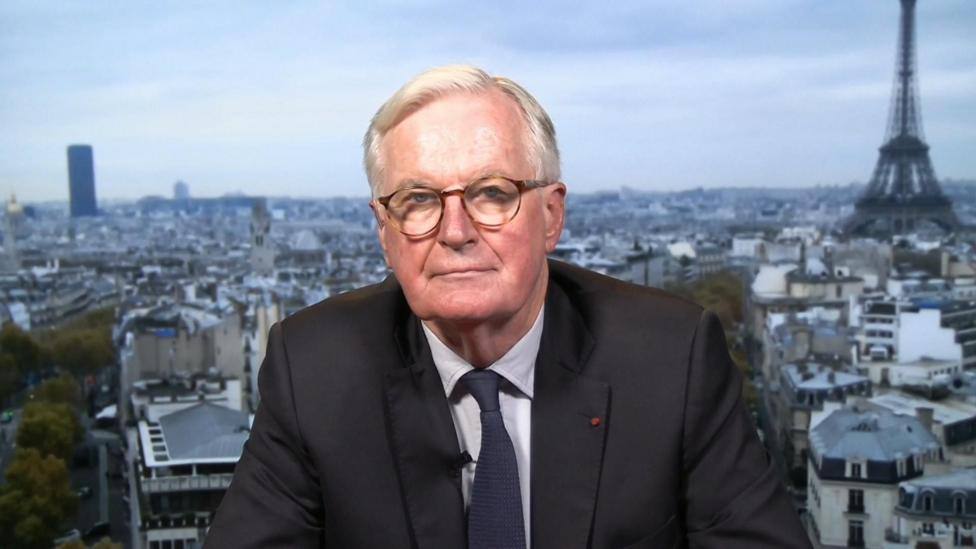
Britain will not be able to pick and choose which elements of the European Union's single market it wants if the country moves closer to the bloc, the EU's former chief Brexit negotiator Michel Barnier has warned. Speaking to the BBC's Sunday With Laura Kuenssberg programme, in an interview to be broadcast in full on Sunday, Barnier said EU member states would insist the UK adopt measures such as the free movement of people if it wants closer trade alignment in future, the Press Association reported.
There is not a 'single market a la carte' from which the UK could pick and choose what elements it will adopt, Barnier said. Single market membership would require compliance with EU rules on the circulation of goods, services, capital and people — the so-called 'four freedoms' of EU membership. 'There will be no possibility to have one freedom and not the other. The four freedoms are clearly the four conditions to be inside a single market,' he said. He added that the 'door is open' for the UK to rejoin the EU as a full member.
Source: Press Association via Glasgow Times, Nov 7 2026 — Barnier interview remarks
What Burnham is weighing — and the summit ahead
The warning follows comments by Prime Minister Andy Burnham, who became prime minister in July and has said he wants to explore closer economic ties with Europe, including rejoining the bloc's internal market among the options he could pursue, BBC reporting summarised by World Right Now said. Burnham has suggested options including rejoining the bloc could be put to the public in future, though he has ruled out any major changes before an election, PA reported, and he recently said he would not re-establish free movement of people without a referendum — prompting Downing Street to clarify that he was not advocating its return at this point.
Both sides are looking ahead to the EU-UK summit on November 20 in Brussels, which will focus on breaking down post-Brexit trade barriers on food and farming, working more closely on emissions trading, and making it easier for young people from the UK to work, live and study in Europe and vice versa, PA reported. Burnham has said he wants to lay out different options for the relationship at the summit before seeking public consensus on a new relationship.
Source: Press Association via Glasgow Times, Nov 7 2026 — summit agenda and date
The rebate is gone too, and Farage fires back
In a further sign of the challenges on any path back, Leo Varadkar, the Irish former premier who helped secure the 2019 Brexit agreement with Boris Johnson, warned that Britain would be unlikely to get its £5 billion annual rebate from the EU again if it rejoined. 'The rebate was at a particular point in time. Back in the 1980s, it was Thatcher who negotiated that,' Varadkar said, according to The Times newspaper, as quoted by PA. 'I think it would be very difficult to make the case for that.' Barnier likewise predicted EU countries would reject reinstating the British rebate, first negotiated in 1985, BBC reporting said.
Source: Press Association via Glasgow Times, Nov 7 2026 — Varadkar on the rebate, quoting The Times
Barnier also compared Reform UK leader Nigel Farage to the French politician Marine Le Pen, describing the two as sharing the same populism, the same lies and the same false promises, and pointed to the Vote Leave campaign's claim that Britain sent £350 million (yaani 35 crore pounds) a week to the EU as a claim that was not true, BBC reporting said. Farage, who led a separate Leave campaign and was not part of Vote Leave, responded by calling Barnier arrogant, out of touch and a bully, and said the former negotiator vindicated the decision to leave every time he spoke.
Source: BBC via World Right Now, Nov 7 2026 — Farage exchange and the £350m claim
What is solid
- Barnier said there is no 'single market a la carte' and that all four freedoms are the conditions of single market membership — reported by both PA and the BBC from the same interview.
- The EU-UK summit takes place on November 20 in Brussels and covers food standards, emissions trading and youth mobility — PA; the full Barnier interview airs on the BBC on Sunday.
What is only claimed
- Barnier is a former negotiator speaking in a personal capacity in a broadcast interview, not an EU official setting current negotiating terms; whether member states would in practice insist on every element is a political question the summit process has not yet tested.
- The £350 million-a-week figure remains disputed: Vote Leave's Boris Johnson defended it in his 2024 memoirs as a gross-contribution figure, while critics note it ignored the UK's rebate and EU spending in Britain.
Free movement and youth mobility are the live wires in this debate: any UK move back toward the single market runs through people's right to live and work across borders — the same rules that shape study and work routes into Britain for young people from Punjab, India and the wider diaspora. The November 20 summit's youth-visa talks are the first concrete test of how far that door reopens.
What happens next: Barnier's full interview airs on Sunday, and Burnham is expected to set out his options for the future relationship around the November 20 Brussels summit, where the two sides hope to unveil agreements on food standards, youth visas and reconnecting British industry to the EU's carbon trading regime. Free movement remains the most politically sensitive of the four freedoms — it was a key issue in the 2016 referendum, and Burnham's predecessor Keir Starmer ruled out re-establishing it in Labour's 2024 election manifesto.