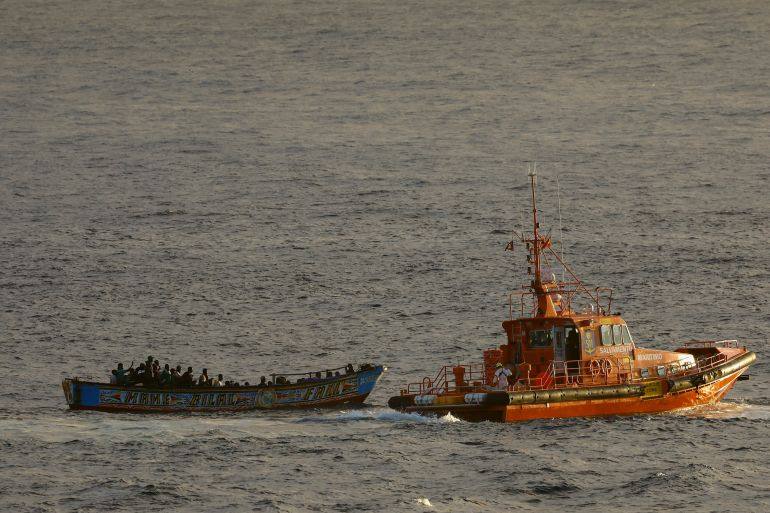
Spain's maritime rescue service brought 1,488 people ashore from 14 wooden fishing boats in the Canary Islands on Saturday, the highest number of arrivals in a single day on the Atlantic route since 2020, the EFE news agency reported on Sunday, citing Salvamento Marítimo and quayside assistance teams. Twelve of the boats, carrying 1,235 people, landed on El Hierro, the smallest of the main Canary Islands, with one boat reaching Gran Canaria and another Tenerife.
Source: Reuters
The tally passes the previous one-day record of 1,461 people rescued on November 7, 2020, maritime rescue services said. EFE and the Spanish radio network Cadena SER described Saturday's figure as the highest daily total in the 32-year history of the route, and Al Jazeera's Bernard Smith, reporting from El Hierro, said the arrivals had set a record in the 32 years since statistics have been collected. The count is provisional and does not include two rescue operations that were still open in the early hours of Sunday, EFE said.
Source: Al Jazeera via St. Lucia Chronicle
A full day of rescues on an island of 11,400 people
The first boat reached La Restinga, the fishing port on El Hierro, at 04:01 on Saturday, carrying 148 people from Kayar in Senegal aboard the rescue vessel Navia, according to EFE's timeline. The largest single boat arrived at 17:26 with 240 people on board, including 12 women and 36 children; authorities said it had spent six days at sea after leaving Gunjur in The Gambia. Other boats included one with 171 people from M'Bour in Senegal and another with 214 from Thiaroye-sur-Mer. EFE counted at least 108 women and 167 minors among Saturday's arrivals in total. Six Salvamento Marítimo vessels and two Guardia Civil patrol boats worked the arrivals through the day.
The Gran Canaria boat brought 203 people into Arguineguín around midnight after a rescue about 100 miles south of El Hierro; 17 people were taken to hospital. At Los Cristianos in Tenerife, 50 people landed around midday and one person was taken to hospital. Most of those rescued were from Senegal, Gambia and Guinea-Conakry, and assistance teams said the crossings had lasted between four and seven days. El Hierro itself has only about 11,400 residents, so a single day's arrivals equalled more than a tenth of the island's population.
Saturday followed another heavy day: on Friday, eight boats carrying 843 people had landed, taking the two-day total to 2,331 people on 22 boats, EFE reported. More than 9,000 people have arrived in the Canary Islands since the start of November, Al Jazeera reported, and the record day came days after Madrid declared a migratory emergency for the archipelago. On Tuesday the government approved €15.18 million in emergency funding — yaani about €1.52 crore — plus €1 million for the Red Cross, though no timetable has been published for compensating affected local businesses.
Why the surge is happening now
Arrivals on the Atlantic route usually pick up in the autumn, when sea conditions are generally calmer, Reuters noted. The surge is a sharp rebound rather than a year-long trend: arrivals between January and October 31 were down 5.5% from the same period last year, government data show. Demócrata reported that Senegalese authorities acknowledged that security deployments for the Youth Olympic Games in Dakar, which ended on Friday, had temporarily reduced coastal surveillance at some departure points — a claim reported by the newspaper and not independently confirmed.
The Atlantic crossing from West Africa to the Canary Islands remains one of the world's deadliest migration routes. The International Organization for Migration recorded at least 450 deaths on the Western African Atlantic route in the first 10 months of 2026. The record arrivals also land in a changed European policy climate: the European Union's new Pact on Migration and Asylum officially came into force on June 12, 2026, and EU states remain under pressure to do more to control migration from Africa, Al Jazeera reported — yet the new rules have not stopped the flow to Spain.
The record day extends a November surge this desk has been tracking, including the emergency declaration after 7,432 arrivals in ten days. Read: Canary emergency after 7,432 arrivals in ten days
What is solid
- 1,488 people were rescued from 14 boats on Saturday, per Salvamento Marítimo figures reported by EFE and Reuters
- 12 boats landed on El Hierro, one on Gran Canaria and one on Tenerife
- Territorial Policy Minister Ángel Víctor Torres was due to visit El Hierro on Sunday
What is only claimed
- The 1,488 tally is provisional and excludes two rescue operations still open early on Sunday, so the final figure may rise
- Reuters frames the day as the highest since 2020, while EFE and Cadena SER call it the highest in the route's 32-year history
What happens next: Spain's Territorial Policy Minister Ángel Víctor Torres was due at the port of La Restinga at 13:00 local time on Sunday to discuss the surge with island authorities. New arrivals are processed at the port in El Hierro and moved to a reception centre before being sent on to other Canary Islands or the Spanish mainland, Al Jazeera reported, and arrivals had continued into Sunday afternoon. Whether Madrid adds reception capacity on El Hierro — and whether the autumn departure window from Senegal, Gambia and Mauritania stays open — will decide if Saturday's record stands alone or becomes the new normal.