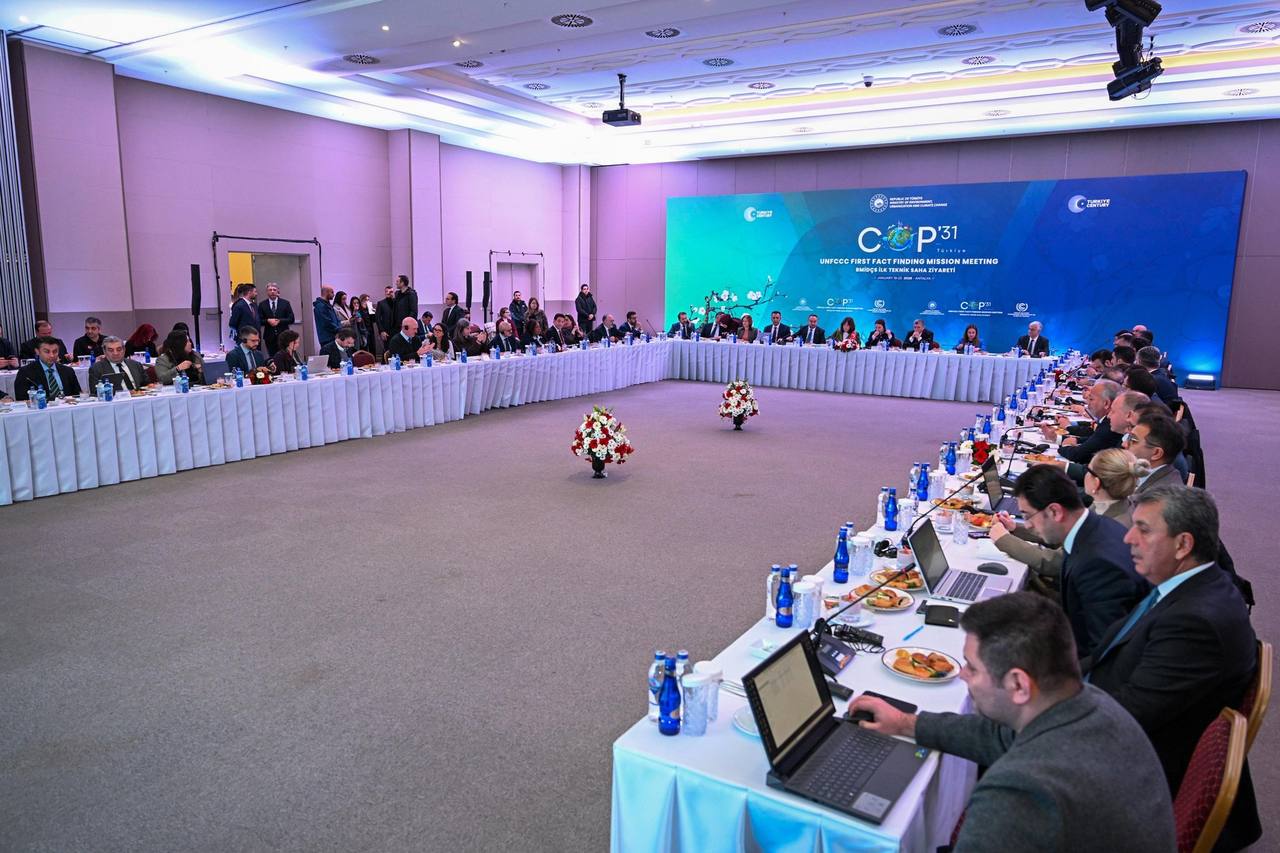
UN climate talks in Antalya collapsed on Sunday after nearly two weeks of negotiations, with the COP31 presidency admitting there was no consensus on a final deal. COP31 president Murat Kurum told the closing plenary that the decisions had not been adopted, ending the summit without the political declaration countries had spent a fortnight trying to agree.
Source: Reuters
The summit, co-hosted by Türkiye and Australia and attended by delegations from nearly 200 countries, had been due to end on Friday, 20 November. Instead it ran two days into overtime, and the final text — a ten-page, 94-paragraph draft published in the early hours of Sunday — contained no mention of the words “fossil fuels”, “oil”, “coal” or “phase out” anywhere in it.
Hours before the collapse, the COP31 presidency published its third draft deal text and sent it to the closing plenary for a decision on Sunday morning. Read our earlier report on the third draft
Why the EU said no
The European Union led the rejection. Ireland's climate minister Darragh O'Brien, speaking for the EU presidency, told the plenary: “We will not endorse a cover decision that does not even mention fossil fuels, which is the key driver of climate change.”
France went further, calling the draft a “backward” step, and EU climate commissioner Wopke Hoekstra had warned during the talks that an inadequate outcome would be worse than failing to reach consensus at all.
What the draft did — and did not — say
The text's only reference to fossil fuels worked by pointing backwards: it “recalled” the agreement reached at COP28 in Dubai three years ago “in its entirety” — the deal in which countries agreed to transition away from fossil fuels — without repeating the commitment or setting out any roadmap to reduce the use of oil, gas and coal.
What the draft did offer was a single headline energy goal: raising electricity's share of total final energy consumption from about 21 per cent today to 35 per cent by 2035, a target backed by some 90 countries and championed by Türkiye. But the target carries no requirement that the extra electricity come from renewable sources, so power generated by burning coal and gas could count towards it.
The draft also set a goal of one billion tonnes of carbon capture and storage, a technology backed by the oil industry and criticised by several delegations as expensive and unproven at scale. It was the first COP text to acknowledge that the world will overshoot the 1.5°C limit set by the Paris Agreement, and it reaffirmed a commitment to triple adaptation finance by 2035 — but with no explicit baseline against which the tripling would be measured.
On finance, the draft was thinnest where developing countries needed it most. An earlier version had dropped a proposed target of $120 billion a year in adaptation finance for developing countries by 2035 — yaani 120 arab dollar saalana — and developing nations expressed anger at its removal.
Why it matters
The collapse comes in a year of the most destructive impacts of global warming: extreme heat across Europe and glacial floods in Nepal. October 2026 was 1.8°C warmer than the mid-1800s, according to Berkeley Earth, and the draft itself expressed deep concern that global temperatures could breach the 1.5°C threshold within years.
The failure to agree a political declaration does not wipe out the obligations agreed at previous summits, or erase the technical and legal frameworks governing multilateral action against climate change. But it leaves the central question — whether the world will name the cause of warming and act on it — unanswered, and the next round is now set for Addis Ababa, Ethiopia, which will host COP32 in 2027.
What is solid
- COP31 ended on Sunday, 22 November, with no deal adopted — COP31 president Murat Kurum confirmed there was no consensus.
- The final draft contained no mention of “fossil fuels”, “oil”, “coal” or “phase out”.
- The EU, led by Ireland's Darragh O'Brien, refused to endorse the text.
- The summit was due to end on Friday, 20 November, and ran two days into overtime.
What is only claimed
- Whether “no deal” is better than a weak deal — EU commissioner Wopke Hoekstra argued an inadequate outcome would be worse than no consensus.
- Civil society criticism: Power Shift Africa's Mohamed Adow called COP31 the “worst COP ever” — an opinion, not a measured fact.