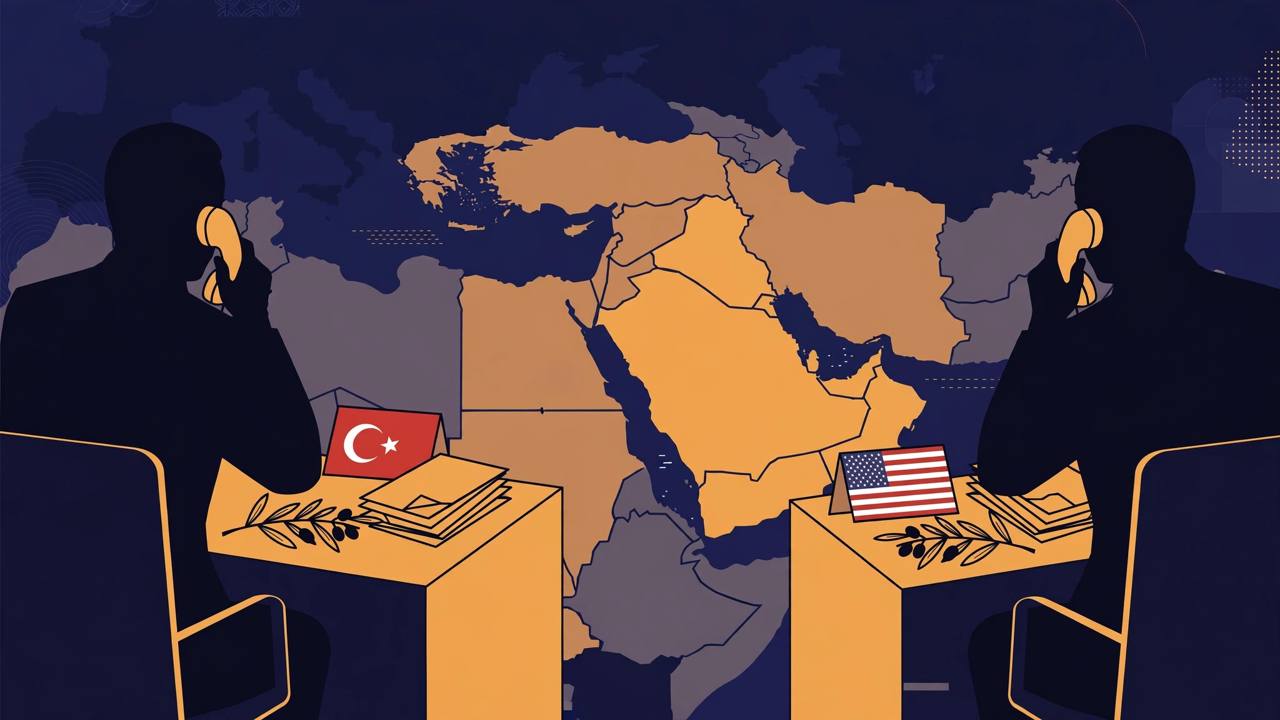
ANKARA — Turkish President Tayyip Erdogan told US President Donald Trump by phone on Saturday, November 7, that Ankara would continue its peace efforts and that tensions between Iran and the United States should be resolved through diplomacy, Erdogan's office said, in a readout reported by Reuters.
Source: Reuters via DevDiscourse (Nov 7)
The call also covered the war in Ukraine and efforts to strengthen relations between Ankara and Washington, according to a statement from Turkiye's Directorate of Communications. Erdogan expressed hope that intensified diplomatic efforts to end the Russia-Ukraine war would produce results, said Ankara would continue contributing to those efforts, and emphasised the importance of increasing contacts with both Moscow and Kyiv. On bilateral ties, he expressed confidence that cooperation between Turkiye and the United States would continue expanding, and he thanked Trump for his support for the Organization of Turkic States summit.
Source: Turkiye Directorate of Communications readout via Eastora News (Nov 7)
The Turkish presidency did not disclose Trump's responses to the proposals and announced no specific agreement from the conversation. The call is a presidency readout of what Erdogan said; Washington had not published its own account of the conversation at the time of reporting.
The call came a day after Trump confirmed that US forces had carried out limited strikes on Iran, destroying an Iranian air-defence installation on Qeshm Island in the Strait of Hormuz — the first strikes since Tuesday's US midterm elections. Read the earlier report: Trump confirms US strike on Qeshm air defence
A war in its ninth month, and a crowded mediation table
The United States and Israel opened the current war on Iran on February 28, 2026. Shipping through the Strait of Hormuz — the waterway that normally carries about one-fifth of the world's oil and liquefied natural gas — remains heavily restricted, with both a US naval blockade of Iranian ports and Iran's refusal to fully reopen the strait without concessions keeping flows far below normal and Brent crude near $100 a barrel after a steep weekly fall on deal hopes. Trump said on Friday that the United States was talking to Iran and claimed the strait was opening, while also repeating that he may have to resume larger strikes; Iran, for its part, has sent a nuclear proposal through Qatar but says discussion depends on its seven conditions, including an end to the blockade and sanctions relief.
Erdogan's call lands on a mediation table that is already crowded: earlier on Saturday, Qatar's prime minister said a good US-Iran agreement was still possible through mediation. Read: Qatar PM says a good US-Iran agreement is possible
US reporting on Saturday described a split inside Trump's circle over what comes next: the Wall Street Journal reported that Defence Secretary Pete Hegseth and CENTCOM chief Admiral Brad Cooper backed a return to major combat operations, while Vice President JD Vance and envoy Steve Witkoff favoured diplomacy — accounts of internal deliberations that no side has confirmed on the record. The Washington Post's David Ignatius, citing a US official, reported that Treasury Secretary Scott Bessent had asked Beijing to use its influence with Tehran to help end the war, and that China relayed the message. Those reports are attributed deliberations, not decisions.
Why Turkey is pushing, and why it matters beyond Ankara
Turkey is a NATO member that borders Iran, has kept channels open to Tehran, Moscow and Kyiv throughout both wars, and has repeatedly offered itself as a mediator — including hosting earlier rounds of Russia-Ukraine contacts. A wider US-Iran escalation would hit Turkey directly through energy prices, trade and regional security, and the same shock would land on the Gulf states, where lakhs of Punjabi and Indian workers live and work: their safety, flights home and remittances all depend on the Strait of Hormuz staying open and the war not spreading. That is why a diplomatic call from Ankara, even without an announced breakthrough, is watched closely in the Gulf and in Punjab's worker households alike.
What is solid
- Erdogan told Trump by phone on Saturday, November 7, that Turkey will continue its US-Iran peace efforts and that US-Iran tensions should be resolved through diplomacy, according to Erdogan's office (Reuters; Turkish Directorate of Communications readout).
- The call also covered the Russia-Ukraine war — Erdogan said contacts with Kyiv and Moscow should be intensified — and bilateral ties, including Trump's support for the Organization of Turkic States summit (presidency readout).
- No agreement was announced from the call, and the Turkish presidency did not disclose Trump's responses.
What is only claimed
- Reports of a split among Trump's advisers — Hegseth and CENTCOM's Cooper for renewed major strikes, Vance and Witkoff for diplomacy — rest on US media reporting of internal deliberations and have not been confirmed on the record by the White House.
- Trump's claim that the Strait of Hormuz is 'opening' is contested by shipping data showing transits still far below pre-war levels; Iran says the strait reopens fully only if its seven conditions are met.
What happens next
Watch three things: whether the White House publishes its own readout of the Erdogan call or acts on Turkey's offer; whether the Qatar-mediated track — Iran's nuclear proposal and its seven conditions — produces a meeting or collapses back into strikes, with US reporting suggesting a strike decision could come within days; and whether Turkey's push on Ukraine feeds into the Abu Dhabi trilateral talks on November 10-11. Until one of those moves, Erdogan's call is a signal of where a NATO ally stands — for diplomacy, on the record — not a deal.