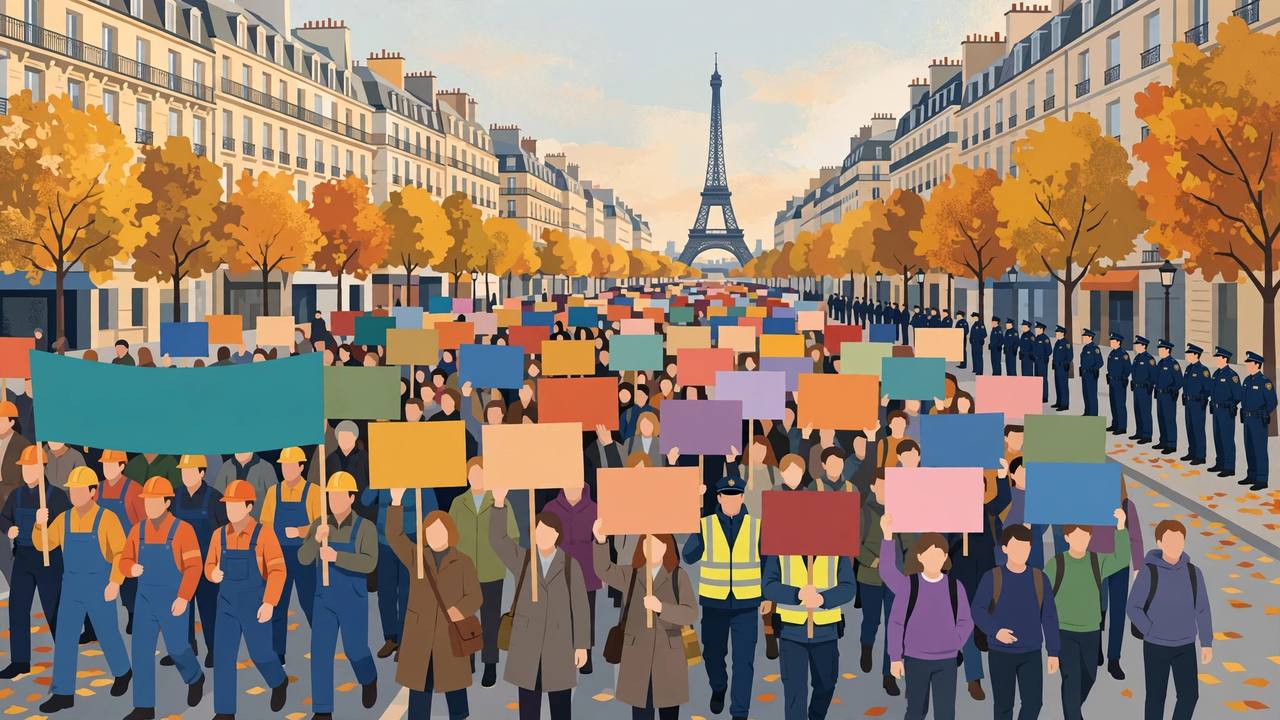
Hundreds of thousands of French workers, teachers, students and pensioners struck and marched across France on Thursday in a nationwide day of action over wages, pensions and the cost of living — and by the end of the day the government estimated at least 600,000 people had taken part, while the CGT union confederation claimed almost 1.6 million, The Guardian reported. The turnout figures are the first actual results of the strike day Awaaz Punjab previewed this morning, when unions were still only forecasting crowds and 70,000 police were being deployed.
Source: The Guardian, Nov 5
This morning's preview set out what was expected — up to 700,000 marchers outside Paris, 70,000 police deployed and one in six primary teachers set to strike. Thursday's action is what actually happened. Read: France's nationwide strike day arrives
An official close to Interior Minister Laurent Nuñez said that by early afternoon around 270,000 people had joined the union action in 180 rallies outside the capital, and that most of them were peaceful, the Associated Press reported. The Paris march, from République to Nation, was still to come in that count. The CGT separately said more than 250,000 protesters had turned out in almost 70 towns and cities by early afternoon, RFI reported.
Source: Associated Press, Nov 5; RFI, Nov 5
Five union confederations combined forces across the public and private sectors, announcing more than 250 separate actions in a campaign for higher wages and to protect public services, The Guardian reported. France's main unions warned the country is on the brink of recession and that layoff plans are multiplying: "Fuel, food products, rent, gas, electricity … everything's going up except wages and pensions," they said in a joint statement. In particular the unions are seeking a rise in the minimum wage, currently 12.31 euros an hour, and the head of the CFDT, Marylise Léon, said workers were asking for a net increase of 100 euros a month.
Source: Associated Press, Nov 5; The Guardian, Nov 5
The disruption was real but uneven. About a third of France's high schools were closed or unable to operate, some because teachers were on strike and some because students blocked them, the AP reported. Around 16 percent of teachers nationwide were on strike, the Education Ministry said, and official figures showed nearly 10 percent of central government employees, 4.6 percent of local government workers and 3.93 percent of public hospital staff joined the stoppage, RFI reported. Rail unions, including SUD-Rail, joined the action and regional and some Paris-area services were disrupted.
Source: Associated Press, Nov 5; AFP via France 24, Nov 5; RFI, Nov 5
Fabien Villedieu, national secretary of the SUD-Rail union, told the AP at Paris's Gare de Lyon station: "When the government is not reasonable, when the head of the SNCF is not reasonable — bosses in general are not reasonable — and when they're not reasonable, we simply do what we've always done in France, which is to go on strike." CGT general secretary Sophie Binet had told France 2 television ahead of the day: "We want two things: wage increases everywhere … and a revision of the government's draft budget which, as it stands, is catastrophic for the country."
Source: Associated Press, Nov 5; RFI, Nov 5
The day was largely peaceful, but not everywhere: police fired tear gas as violence and vandalism broke out in some cities, AFP reported. In Lyon, more than 25,000 people were reported to have joined the march, according to organisers, Euronews reported. Interior Minister Laurent Nuñez had announced on Wednesday that 70,000 police officers and security forces would be deployed, promising a very firm response to any violence.
Source: AFP via France 24, Nov 5; Euronews, Nov 5
A movement that began in one school
The movement began in September with a protest over staff shortages at a single high school southeast of Paris and spread nationwide, the AP reported. It drew in students demanding more education funding — overcrowded classrooms and deteriorating buildings are central complaints — and workers seeking better pensions and help with soaring fuel prices and other costs. The student protests merged in October with wider anger over living costs and inequality, in what became the worst civil unrest France has seen in years, and Thursday was the first day since September to bring private-sector employees, civil servants and pensioners out together, RFI reported.
Source: Associated Press, Nov 5; RFI, Nov 5
The politics are tight. The government is struggling to pass a belt-tightening budget through a divided parliament while public debt approaches 120 percent of economic output (yaani — France owes roughly 1.2 euros for every euro its economy produces in a year), The Guardian reported, and the strike comes six months ahead of elections to replace President Emmanuel Macron, with the far right leading in opinion polls, AFP reported.
Source: The Guardian, Nov 5; AFP via France 24, Nov 5
What is solid
- A nationwide strike and marches took place across France on Thursday, called by five union confederations over wages, pensions, public services and the cost of living (AP; Guardian; AFP)
- An official close to Interior Minister Laurent Nuñez put early-afternoon turnout at about 270,000 people in 180 rallies outside Paris, mostly peaceful (AP)
- 70,000 police and gendarmes were deployed; about a third of high schools were closed or unable to operate (AP; Interior Ministry)
What is only claimed
- Total turnout is disputed: the government estimated at least 600,000 took part, while the CGT claimed almost 1.6 million (The Guardian) — neither figure is independently verified
- The day's character is described differently across reports: the Guardian called the rallies largely peaceful, while AFP reported police firing tear gas amid violence and vandalism in some cities
What happens next
No new government concessions had been reported by Thursday afternoon. The Yellow Vest movement, which has joined the mobilisation, has called for strikes and blockades to continue on Friday, November 6, followed by further demonstrations on Saturday, RFI reported — which would make this the movement's fourth weekend of action and keep the pressure on Macron's government as the budget fight continues in parliament.