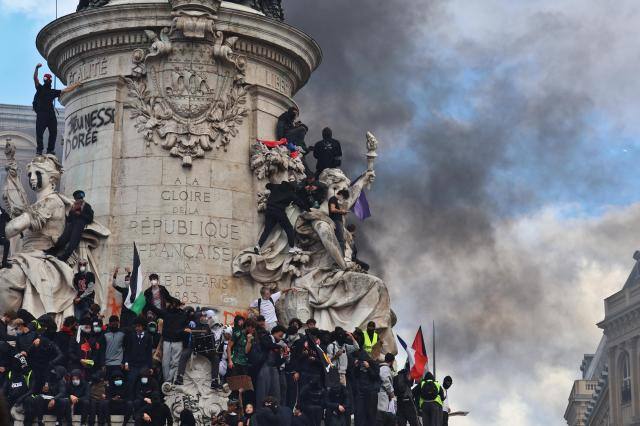
This is the strike day itself. On November 1 this site reported that student unions had called school and university blockades for November 3 and 5, alongside a national interprofessional strike and workers' march called by the unions for November 5. That day has now arrived, with the unions' own turnout and disruption figures beginning to come in. Read: French students call school and university blockades for November 3 and 5
PARIS — France's nationwide day of strikes and demonstrations is under way on Thursday, in a fresh test for President Emmanuel Macron after weeks of unrest over living costs, public services and education that Reuters described as the worst civil unrest France has seen in years. Hundreds of thousands of protesters are expected to march through French cities while public workers strike across hospitals, schools, railways, ports and air traffic control. "We need to turn up in big numbers on the streets today," CGT head Sophie Binet told LCI TV.
Source: Reuters via BusinessWorld, Nov 5
What the unions want — and what is disrupted
Five union confederations — the CGT, CFDT, Workers' Force (FO), UNSA and the FSU — called the November 5 walkout to demand higher wages and pensions, better-funded public services and changes to the government's draft budget for 2027, which contains about 43 billion euros (yaani roughly 43 arab euro) in public spending savings. The unions are seeking a higher minimum wage and higher taxes on wealth, inheritances and company dividends, and say the savings would weaken services and household incomes already squeezed by fuel, food, housing and energy costs. More than 200 street demonstrations were planned outside Paris, according to the CGT.
Source: Aju Press, Nov 5
All four main unions at state railway operator SNCF joined the strike: high-speed services face limited disruption, while regional trains and commuter routes around Paris — including the RER B line to Charles de Gaulle Airport — are harder hit; the Paris metro, buses and trams were expected to operate normally. The strike had already contributed to France's nuclear output being reduced by 2.4 gigawatts early on Thursday, Reuters reported, and French power unions at state utility EDF were expected to join. Many schools may close or offer only basic childcare, hospitals will maintain emergency services, and dock workers warned of disruption at French ports.
Source: Reuters via BusinessWorld, Nov 5 / Aju Press, Nov 5
Macron's security council and the policing argument
Mr. Macron convened a defence and security meeting on Wednesday ahead of the protests. Authorities have sought to lower tensions after riots and looting on October 17 caught security forces off guard. "The goal in the coming weeks is to get the river that overflowed back into its bed and to launch the presidential election in the calmest possible conditions," an official close to Mr. Macron said, five months ahead of a presidential election. The government has defended police tactics while saying any abuses would be investigated; student Irma de Banville, 19, told Reuters some young people were holding back because they were "afraid of police violence".
Source: Reuters via BusinessWorld, Nov 5
The Guardian reported that rights groups and union leaders have criticised restrictions pushing demonstrations out of city centres in cities such as Rennes, Toulouse and Lyon. CGT leader Sophie Binet called it a dangerous authoritarian drift; CFDT head Marylise Léon said the principle of a demonstration is its visibility. Students have continued blockading schools over overcrowded classes and dilapidated buildings — the government said 51 of France's 184 universities and higher education institutions were disrupted on Tuesday morning — and a fourth consecutive Saturday of nationwide protests is planned. The walkout follows weeks of demonstrations: about 320,000 people marched on October 31, according to the Interior Ministry, and police arrested 779 people that day.
Source: The Guardian via World Right Now, Nov 5 / Aju Press, Nov 5
What happens next: turnout figures from police and unions are expected later on Thursday, and the unions have not said whether they will call further national action. Politically, the day is a measure of both the depth of discontent and the government's room to manoeuvre as it tries to pass a belt-tightening budget through a divided parliament, with public debt approaching 120% of economic output and the 2027 presidential contest already taking shape.
What is solid
- Five union confederations (CGT, CFDT, FO, UNSA, FSU) called the November 5 national strike over wages, pensions, public services and the draft 2027 budget
- About 70,000 police are deployed and 17.5% of public primary teachers were expected to strike — French authorities' and Education Ministry's figures reported by Reuters
- Nuclear output was reduced by 2.4 gigawatts early Thursday, Reuters reported
What is only claimed
- The 500,000–700,000 turnout figure is an intelligence-service expectation reported ahead of the marches, not a counted turnout — police and union counts, which usually differ, were still due later Thursday
- How much of France actually stops — rail, ports, air traffic and schools — will only be clear as the day's disruption reports come in