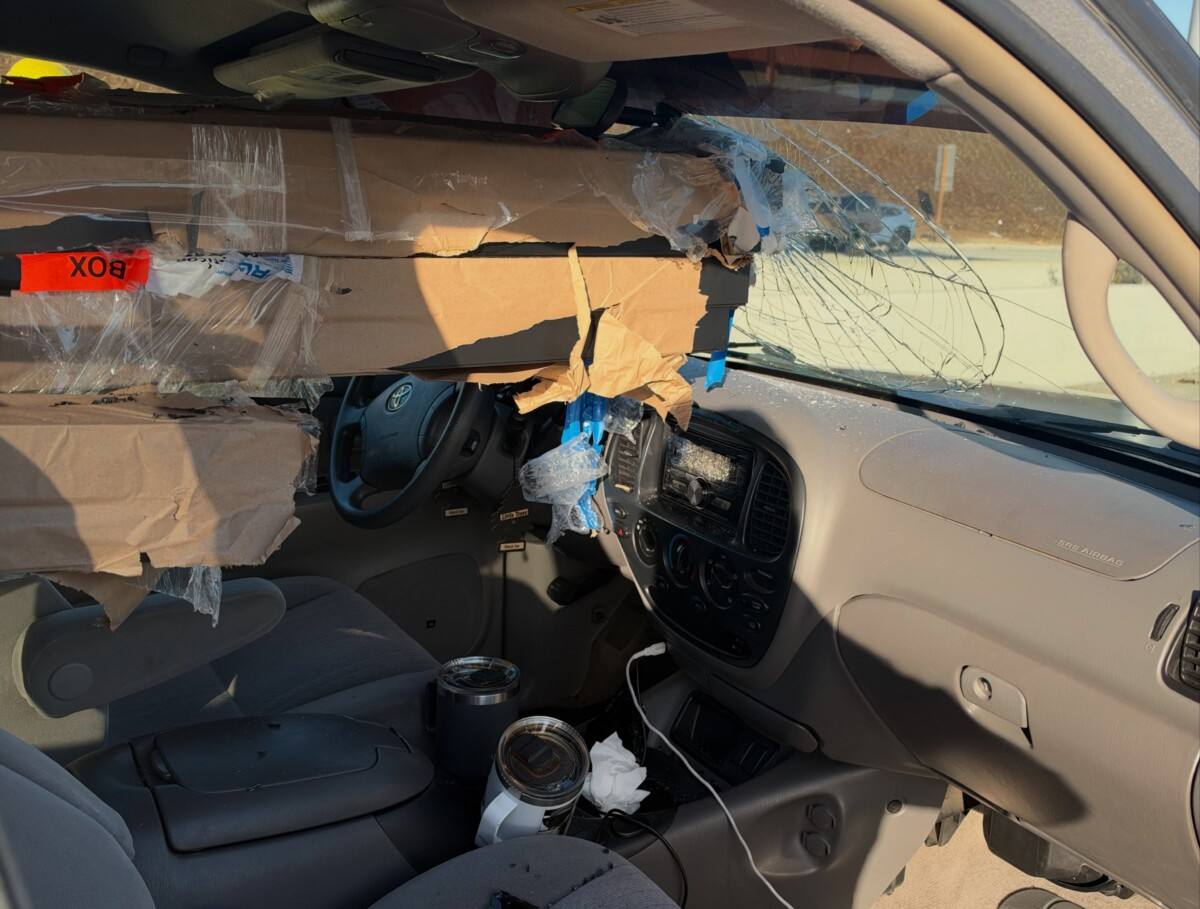
The California Highway Patrol is using a frightening close call on the Interstate 405 freeway in Westminster, in Orange County, to warn every driver who hauls anything — from professional truckers to a pickup owner carrying a ladder — that an unsecured load can become a spear. On Wednesday, November 4, 2026, CHP officers responded to a reported crash involving pickup trucks on the I-405 in the Westminster area, and found cargo that had punched through the cabin of a pickup truck and struck its windshield, the agency said. Only minor injuries were reported.
Source: CDLLife, CHP I-405 load-securement warning, Nov. 4, 2026
The CHP shared several photographs of the aftermath: long cargo items driven through the cab area of the pickup, up against and into the windshield. The agency did not provide details of how the crash itself happened — which vehicle the load belonged to, how the pickups came together, or whether any citation was issued — and Awaaz Punjab is reporting only what the agency has released. What officers chose to emphasise was not the collision but the cause they say sits behind this whole class of crash: cargo that was not properly tied down.
What the CHP said
“This incident serves as an important reminder of the dangers of improperly secured cargo. Unsafe and unsecured loads can shift, fall, and create dangerous roadway conditions that put everyone at risk,” the CHP said. Troopers asked drivers to “make sure your load is properly secured, tied down, not overloaded, and safe for travel.” The physics behind the warning are unforgiving: cargo that is loose in a bed or on a rack keeps travelling at road speed when the vehicle brakes or hits something, and long rigid items — pipe, lumber, rebar, ladders — concentrate all of that energy on a single point, which is how a load ends up through a cab and into a windshield.
Source: California Highway Patrol statement, as published Nov. 4, 2026
The road: I-405 through Westminster
The I-405 — the San Diego Freeway — is one of the heaviest-travelled corridors in Southern California, running from the San Fernando Valley through Los Angeles and Long Beach and down through Orange County, where Westminster sits between the port complex, the beach cities and the inland warehouse belt. It carries commuter traffic, port drayage trucks and long-haul freight in the same lanes, at freeway speeds, for most of the day. A load that shifts or falls on the 405 does not land on an empty rural shoulder; it lands in dense, fast traffic with almost no room for the drivers behind to react.
The rules drivers are actually under
California law requires that any load carried on a public highway be secured so that it cannot shift, fall or create a hazard — a driver whose unsecured load causes a crash carries legal responsibility for it, on top of the crash itself. Commercial carriers sit under an additional federal layer: the Federal Motor Carrier Safety Regulations' cargo-securement rules (49 CFR Part 393, Subpart I) set out in detail how freight must be contained, immobilised or secured on and within a vehicle, how many tiedowns are required for a given article and weight, and the condition those tiedowns must be in. Roadside inspectors can and do write securement violations, and a serious securement failure found at inspection can put a vehicle out of service on the spot.
Why this is a truckers' story, not just a pickup story
A large share of Awaaz Punjab's US readers drive professionally, and many Punjabi owner-operators in California run exactly the mixed work in which securement mistakes happen: produce and palletised freight one day, equipment, pipe or building material on a flatbed the next. The Westminster photographs show the pickup version of the failure, but the mechanism is identical at semi scale — a hard brake or a swerve turns anything not positively secured into a moving object inside or off the vehicle. Experienced drivers' habits are boring precisely because they work: secure for the crash, not for the cruise; re-check tiedowns shortly after the first miles, when loads settle; and never let a shipper's “it's heavy, it won't move” substitute for a tiedown — weight is what makes a shifting load lethal, not what prevents it shifting.
CHP's checklist from the Westminster warning: properly secured, tied down, not overloaded, and safe for travel. Add the professional habits the rules assume — check securement after the first stop, keep long rigid items from pointing at the cab without a headache rack or barrier, and treat anything you would not want arriving at the windshield as something to tie down twice.
What happens next
The CHP has not released further details of the Westminster crash, including whether citations will follow, and the drivers involved were reported to have only minor injuries. The agency's warning stands as the official outcome for now: a set of photographs, a speared cab that its driver walked away from, and a reminder aimed at every vehicle on the I-405 that carries something it could lose.