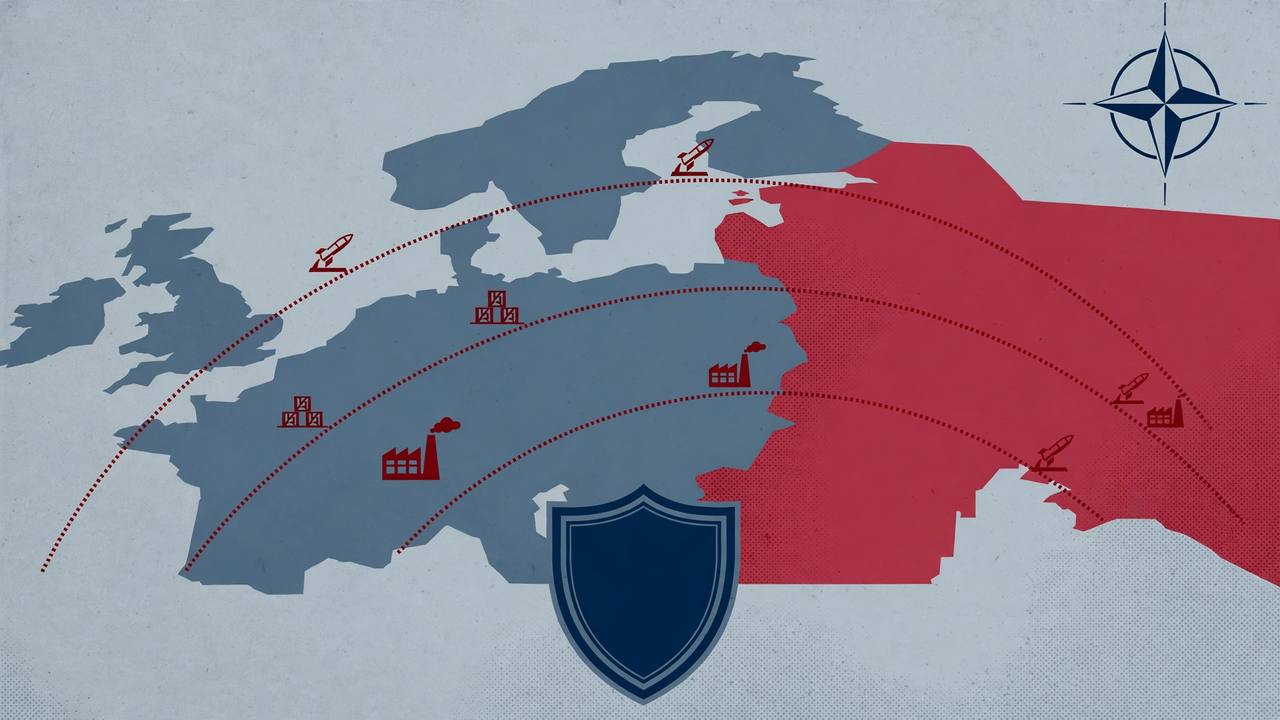
NATO is developing defence plans that would strike targets deep inside Russia if Moscow attacks alliance territory, The Wall Street Journal reported on Wednesday, November 4 — a major shift away from decades of planning that focused only on stopping Russian forces at NATO's borders. The plans, developed under the alliance's Supreme Allied Commander Europe, US General Alexus Grynkewich, would target the military bases, supply networks and industrial facilities that sustain a Russian invasion, not just the troops crossing the border.
Source: The Wall Street Journal via Bytes Europe / Kyiv Post
Grynkewich outlined the approach at a security conference in Warsaw on October 12 as his “theory of victory.” NATO forces would first stop the opening wave of an attack, then undermine the enemy's ability to sustain further operations; if the offensive continued, the alliance would strike both the attacking forces and everything that supports, supplies or controls them. “We will dismantle the warfighting system being used against us by striking both the forces advancing and everything that supports, supplies, or controls those forces,” Grynkewich said, as reported by the Journal and Ukraine's UNN news agency.
Source: UNN via EuropeSays
What would be hit — and with what
The planned strikes would reach roughly 150 kilometres (93 miles) to thousands of kilometres behind the front line, using precision missiles alongside cheaper weapons such as drones, the Journal reported. Potential targets extend beyond airfields and military bases to supply depots, command and communications nodes, industrial facilities, critical infrastructure and raw-material resources supporting Russia's war effort. The aim is to make such strikes an automatic component of NATO's response to a Russian attack. The strategy does not envision escalation to nuclear weapons.
Long-range precision weapons are central to the approach: established US systems such as Tomahawk cruise missiles and ATACMS ballistic missiles, alongside weapons still under development. European countries are seeking to expand stocks of Storm Shadow, SCALP and Taurus cruise missiles while developing additional systems. Fabian Hoffmann, a senior research fellow at the Norwegian Institute for Defence Studies, told the Journal that 20 European manufacturers are pursuing at least 48 projects to develop inexpensive cruise missiles, though not all of them will succeed.
Polish Major General Ireneusz Nowak told the Journal that defence also requires the ability to strike back. “In the event of an armed confrontation with Russia, we would definitely want to strike its defence-industrial complex. We must treat precision strikes deep in the rear as a deterrence tool,” he said. Nowak argued that if Ukraine had possessed that capability at the outset of Russia's invasion, the war would not have settled into positional fighting resembling the First World War. Military planners describe the shift as deterrence by “denial” — actively preventing an attack rather than only defending against its arrows, or, in the phrase used in the reporting, striking the archer rather than defending against the arrows.
Lessons from Ukraine — and the Middle East
The approach reflects lessons from nearly five years of Russia's war against Ukraine, as well as conflicts in the Middle East. Ukraine has increasingly pursued the same logic, striking military and economic targets deep inside Russia with longer-range weapons — oil refineries, drone and battery factories, data centres and fuel depots — including domestically developed Flamingo cruise missiles, according to the report. Ukraine's ambassador to NATO, Alyona Hetmanchuk, has also stressed at alliance conferences that defensive measures alone cannot eliminate the underlying threat. The United States, for its part, is modernising and replenishing its stocks of long-range Tomahawk and ATACMS missiles.
The unresolved question: political approval
Analysts cautioned that military planning alone does not guarantee political authorisation. Nico Lange, a former senior German defence ministry official, told the Journal that a gap remains between military plans that incorporate offensive action to defend against Russia and political views that equate defence primarily with barriers or a “drone wall.” The open question, the report said, is whether European leaders would actually authorise the operations their military planners consider necessary to stop and defeat an attack. The alliance held its first symposium devoted to deep strikes in June, organised by Grynkewich.
Background: why NATO is rewriting the playbook
For decades, European defence planning focused on preventing Soviet or Russian forces from advancing after crossing NATO borders. Alliance strategists now consider that approach insufficient: an invasion force that keeps its bases, factories and logistics intact behind the front can sustain wave after wave of attack. Russia's war on Ukraine — now in its fifth year — has also been marked in recent days by some of its deadliest strikes, including the bombing of an aid centre in Komyshuvakha in Zaporizhzhia region, where the death toll reached 40 as the search entered a third day. NATO has 32 member countries, and its eastern flank states have separately stepped up border security, including Poland's special operation on the border with Russia's Kaliningrad exclave.
On NATO's eastern flank, Poland has deployed counterterrorism police in a special operation on the Kaliningrad border. Read: Poland launches special operation on Russian border
What happens next
The plans remain military planning, not an adopted political decision: watch for whether NATO governments publicly endorse the deep-strike concept, how quickly European cruise-missile production expands, and how Moscow responds. Russia has repeatedly warned that strikes on its territory by NATO-supplied weapons would mark an escalation. Any Kremlin reaction — and any debate in European parliaments about authorising strikes in advance — will show whether the “theory of victory” stays on paper or becomes the alliance's settled doctrine.
What is solid
- NATO is developing plans envisioning conventional precision strikes deep inside Russia if Moscow attacks alliance territory (Wall Street Journal, Nov 4, via Kyiv Post, UNN, Dagens).
- SACEUR Gen. Alexus Grynkewich presented his 'theory of victory' in Warsaw on Oct 12; NATO held its first deep-strike symposium in June.
- Planned strike depth runs from about 150 km to thousands of km; the plan does not envision nuclear escalation.
- Polish Maj. Gen. Ireneusz Nowak publicly backed striking Russia's defence-industrial complex as deterrence.
What is only claimed
- Whether European governments would politically authorise such strikes — analysts told the Journal a gap remains between military plans and political views; no government decision has been announced.
- Exact target lists and timelines have not been published; the reporting describes the concept, not an operational order.