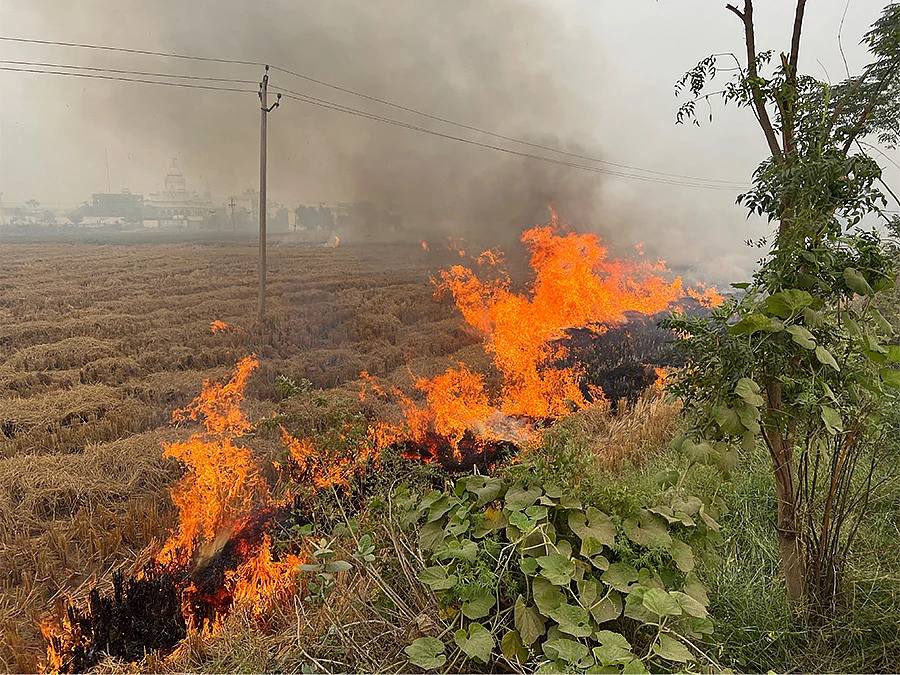
Bathinda/Chandigarh: Punjab recorded a nearly six-fold jump in farm fires on Tuesday, November 3, with incidents surging from 98 a day earlier to 584 — the highest single-day count of the ongoing paddy-harvesting season — the Times of India reported from Bathinda. Punjab Khabarnama reported the same figures: 584 farm fires detected in 24 hours on November 3, the season's biggest single-day spike.
Source: The Times of India
The jump took the state's cumulative tally for the season to 2,196 farm fires between September 15 and November 3, both reports said. The new total follows the earlier counts reported on this site — 1,514 incidents at the Commission for Air Quality Management's November 1 review and 1,612 counted up to November 2 — and 1,612 plus Tuesday's 584 gives exactly 2,196. Punjab Khabarnama noted the season total is still below the 2,518 incidents recorded in the corresponding period last year.
Source: Punjab Khabarnama
Ferozepur, Bathinda and Sangrur among the hotspots
Punjab Khabarnama reported the district-wise break-up for November 3: Ferozepur recorded 112 farm fires, followed by Bathinda with 80 and Sangrur with 78, while Tarn Taran reported 56. The daily sequence shows how sharply the count rose in the final days: 292 fires on October 31, 175 on November 1 and 98 on November 2, before the jump to 584 on November 3.
Source: Punjab Khabarnama
Delhi AQI reaches 350, worst in 287 days
Delhi's air quality slipped further into the 'very poor' category on Tuesday, with the 24-hour average Air Quality Index reaching 350 — its worst reading in 287 days, and the highest since 378 on January 20 — according to the Central Pollution Control Board data reported by Mirror Now. Of the capital's monitoring stations, 10 recorded 'severe' pollution, 35 were 'very poor' and 12 'poor'; Jahangirpuri was the worst at 462, followed by Punjabi Bagh at 445 and Rohini at 442.
Source: Mirror Now
The Commission for Air Quality Management (CAQM) had already invoked Stage II of the Graded Response Action Plan (GRAP) across Delhi-NCR after the capital's air entered the 'very poor' category on November 2. Under GRAP Stage II, authorities intensify measures such as mechanical road sweeping, water sprinkling, construction-site inspections and steps to cut traffic emissions. The Air Quality Early Warning System has forecast that Delhi's air is likely to remain in the 'very poor' category from November 4 to November 6.
Source: Punjab Khabarnama
According to the Decision Support System (DSS) for Delhi, crop-residue burning contributed around 8.6 per cent to the capital's PM2.5 pollution on November 2, Punjab Khabarnama reported, while Mirror Now reported the DSS put stubble burning's share at 15.3 per cent in its latest assessment, behind transport at 15.8 per cent. Vehicular emissions, road dust, construction, industry and weather conditions that trap pollutants near the surface also add to Delhi's pollution load.
Source: Mirror Now
CAQM notices to Gurdaspur and Kapurthala officials
Punjab Khabarnama reported that the CAQM has issued show-cause notices to the Deputy Commissioners and Senior Superintendents of Police of Gurdaspur and Kapurthala, seeking explanations over the increase in stubble-burning incidents and the enforcement measures taken, with responses due by November 6. The commission also raised concerns over Tarn Taran, which it said recorded 797 farm-fire incidents between September 11 and October 29, compared with 296 in the corresponding period last year, and sought details of preventive measures and field-level monitoring.
Source: Punjab Khabarnama
Political exchange continues — allegations labelled
The worsening air has continued the political exchange between the BJP and the AAP. Delhi Environment Minister Manjinder Singh Sirsa has alleged that the Punjab government failed to control stubble burning and that Punjab Police personnel helped farmers set residue on fire — allegations that have not been independently established and that the AAP has rejected, accusing the BJP of shifting responsibility for Delhi's pollution onto Punjab's farmers. Awaaz Punjab reported that exchange in full earlier on Tuesday.
Source: Punjab Khabarnama
Read the earlier exchange between Delhi minister Manjinder Singh Sirsa and the AAP over farm fires: Sirsa's farm-fire allegation and the AAP's rebuttal
The previous farm-fire count and the CAQM's seven-district directive: Punjab farm fires at 1,514 as CAQM directs seven districts to step up
What happens next
Attention now stays on the daily satellite counts as the paddy harvest moves through its final weeks, on the replies Gurdaspur and Kapurthala officials must file with the CAQM by November 6, and on whether Delhi's air remains 'very poor' through November 6 as forecast. Farmers' organisations have repeatedly sought greater financial support and incentives for managing crop residue, while authorities have promoted residue-management machinery and other methods to reduce burning.