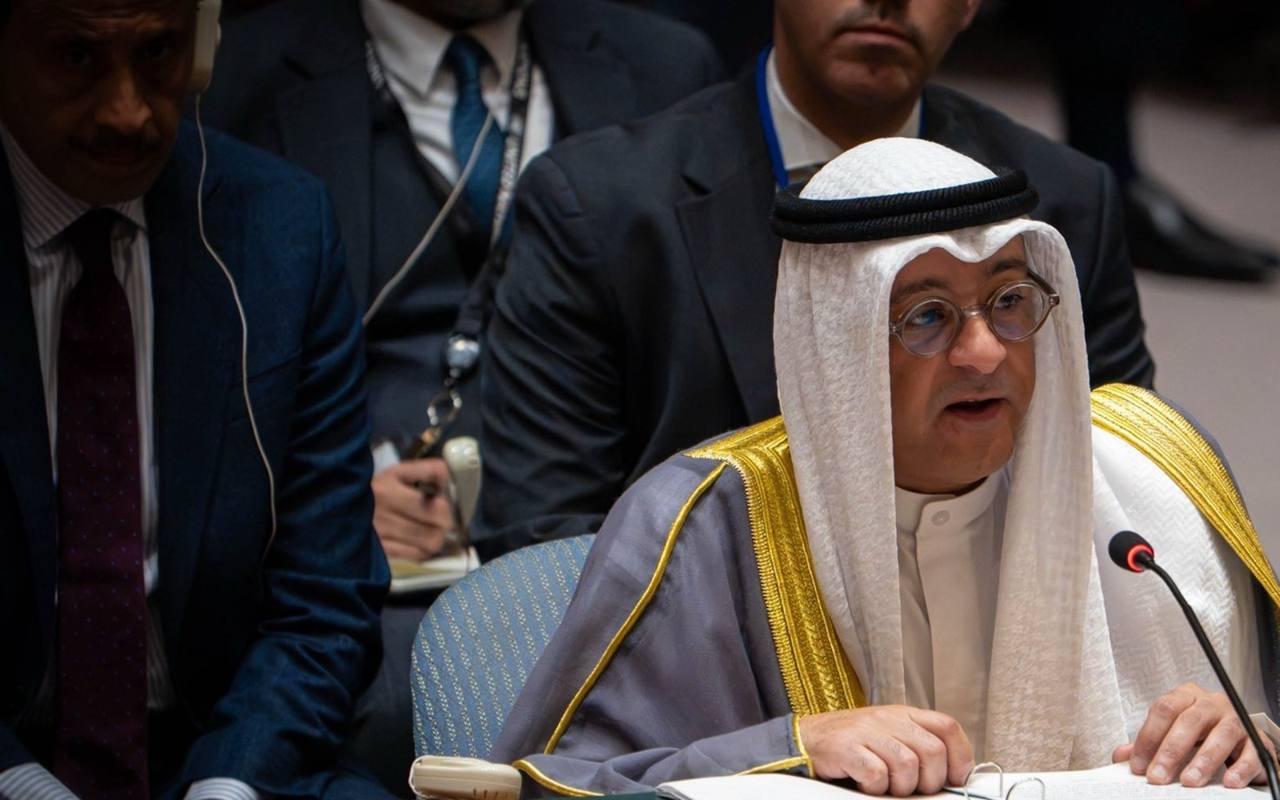
Gulf Arab states demanded at the UN Security Council in New York on Friday, November 13, that Iran pay full compensation for the damage caused by its missile and drone attacks on them since the war began in February, and asked the Council to hold Tehran to account.
Source: Reuters reporting via The Insight International, Nov 13, 2026
The session was the meeting Bahrain had sought on behalf of the six Gulf Cooperation Council (GCC) states, with GCC Secretary-General Jasem Mohamed Albudaiwi expected to brief the Council — the request Awaaz Punjab reported on November 12. On Friday, Albudaiwi delivered that briefing in person. Read: Bahrain seeks urgent UN Security Council meeting on the Middle East
What the Gulf states told the Council
Albudaiwi told the Council that Iran had launched thousands of missiles and drones at Gulf states since February 28 — the GCC tally presented at the meeting put the figure at more than 7,000 projectiles — hitting airports, ports, oil and gas facilities, power stations, desalination plants and homes, according to the report of his briefing. 'The GCC holds Iran fully responsible for these attacks and their consequences,' he said, rejecting Iran's arguments for striking states that, he said, were not party to the war and had worked to keep the region out of it.
Source: Reuters reporting via The Insight International, Nov 13, 2026
The GCC called for an immediate and unconditional end to Iranian attacks on its members and on Jordan, whether carried out directly or through allied groups, and for guarantees they would not be repeated. Albudaiwi urged full implementation of Security Council Resolution 2817, adopted in March, which condemned Iran's attacks and its threats to shipping; China and Russia abstained on that vote. He said shipping in the Strait of Hormuz must return to the conditions that existed before February 28, rejected any attempt to block passage or impose transit fees, and said any future agreement with Iran must deal with Gulf concerns over its nuclear programme, ballistic missiles, drones and support for armed groups. He also called for an end to Houthi attacks on Saudi Arabia and on merchant ships, and for strict enforcement of the UN arms embargo on the Yemeni group.
Source: Reuters reporting via The Insight International, Nov 13, 2026
UN: Gulf exports recovering, but shipping is far from normal
Khaled Khiari, a UN assistant secretary-general, told the meeting that energy exports from the Gulf had largely recovered, partly through alternative routes, but that this 'should not be mistaken for a return to normality.' Shipping volumes remain below pre-war levels, he said, and October had the highest monthly number of incidents against commercial vessels since February. As of November 11, the International Maritime Organization had recorded 134 confirmed incidents in the Strait of Hormuz and the wider region, and 25 seafarers had been killed, Khiari said. He noted there had been no major military exchanges since early September, but said the UN was deeply concerned by talk of renewed confrontation, and welcomed the resumption of diplomatic contacts in Doha and elsewhere.
Source: Reuters reporting via The Insight International, Nov 13, 2026
UN News, in its live coverage of the session, added that transits through the Strait of Hormuz remain around 65 per cent below pre-conflict levels, according to UK Maritime Trade Operations, and that transits through the Bab al-Mandab Strait are down by roughly a quarter since the Houthis declared a blockade on Saudi-linked shipping in July. A 60-day US-Iran ceasefire mediated by Pakistan in June lapsed in August without a peace deal, UN News noted.
Source: UN News, Nov 13, 2026
Iran answers back at the same table
Iran's deputy ambassador, Gholamhossein Darzi, clashed with Bahrain and the United States at the session and warned that Iran's response to any renewed fighting would be 'directed against the source of aggression, wherever it may be,' according to the briefing report. Middle East Eye reported that Darzi warned any renewed US and Israeli attacks would prompt an immediate response, accused some Gulf states of allowing their territory, airspace and military facilities to be used against Tehran, and argued they should be held accountable and compensate Iran for damage. Bahrain rejected the accusation, saying Iran could not use self-defence to justify attacks on neighbouring countries.
Source: Middle East Eye via TalkFuse, Nov 13, 2026
The United States backed the Gulf states at the session. US envoy Jennifer Locetta told the Council that Iran ignores the Council and the overwhelming opinion of the international community, accused Tehran of attacking neighbouring countries, firing on commercial vessels and supporting armed groups, and accused Yemen's Houthis of escalating attacks against Saudi Arabia, including on commercial vessels, airports and energy infrastructure, according to the UNifeed record of the meeting.
Source: UNifeed / UN Web TV, Nov 13, 2026
The Council met hours after a fresh exchange of claims over Bahrain: the US military said it had shot down two Iranian drones launched toward Bahrain and denied a Revolutionary Guards claim to have destroyed a US early-warning radar there. Read: CENTCOM says two Iranian drones headed for Bahrain were shot down
Why this matters for Gulf workers and for India
The targets the GCC listed — airports, ports, oil and gas plants, power stations and desalination plants — are the workplaces and the basic lifelines of the Gulf's large migrant workforce, including lakhs of Indian and Punjabi workers who staff the region's energy, construction, transport and services sectors. Seafarers, many of them Indian, crew the ships still moving through Hormuz, where 25 have been killed since February according to the IMO figures given to the Council. As long as Hormuz traffic stays far below pre-war levels, freight costs and oil prices carry a war premium that feeds directly into fuel and goods prices in India and Punjab, and into the safety of the workers whose remittances support families at home.
What happens next
No new resolution from Friday's meeting was reported. The GCC's ask is that the Council oblige Iran to pay full compensation and enforce Resolution 2817; Iran's counter-position, stated at the same table, is that Gulf states which hosted operations against it should themselves be held accountable. With the June ceasefire long lapsed, no peace deal in place, and both sides restating their claims in the Council chamber, the next test is whether the diplomatic contacts the UN welcomed — including in Doha — produce anything both sides will accept, or whether the shipping incidents that peaked in October resume their climb.
What is solid
- The Security Council met on November 13 at Bahrain's request on behalf of the six GCC states, and GCC Secretary-General Jasem Albudaiwi briefed it
- UN official Khaled Khiari gave the Council the IMO figures: 134 confirmed Hormuz-area incidents as of November 11 and 25 seafarers killed, with October the worst month for shipping incidents since February
- Resolution 2817, adopted in March with China and Russia abstaining, condemned Iran's attacks and threats to navigation
What is only claimed
- The figure of more than 7,000 Iranian missiles and drones is the GCC's tally; Iran disputes responsibility and says Gulf states enabled attacks on it, and each side demands compensation from the other
- Iran's claim to have destroyed a US early-warning radar in Bahrain was denied by the US military hours before the meeting