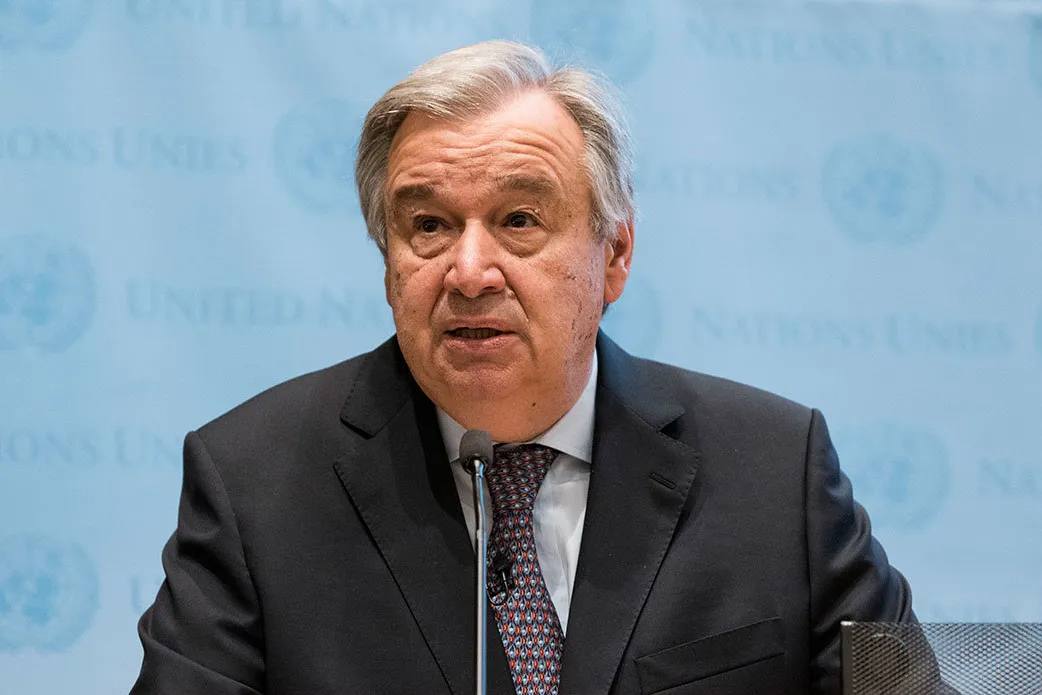
BRIDGETOWN, Barbados — UN Secretary-General António Guterres on Monday called on countries to begin talks on a multilateral framework to manage the risks of artificial intelligence, warning the technology is driving “the biggest transfer of power in the history of humankind.”
Source: UN News
Speaking to reporters at the close of the Bridgetown Special Summit on AI Safety, co-hosted by the UN and Barbados, Mr. Guterres — who leaves office at the end of December — said protections against AI risks remain fragmented and governments “are playing catch-up”.
Source: UN News
“That is why today we are issuing a call from Bridgetown for Member States to begin discussions on a multilateral AI Risk Management Framework,” he said. “Put simply, we need a common foundation for AI safety.” He urged countries to develop the framework within the next year.
Source: AFP
What the framework would cover
The proposed framework would include shared safety measures, common approaches to testing, clear safeguards and standards, basic transparency requirements, and independent evaluation and oversight of advanced AI models — plus support so every country can put them into practice.
Source: UN News
“Technology without accountability. Capability without safeguards. And power without responsibility,” Mr. Guterres said, describing the dangers of unchecked AI.
Source: UN News
Power shifting to companies
In a fireside conversation with Barbadian Prime Minister Mia Mottley, Mr. Guterres said power once shifted among countries but is now moving “from States, from governing institutions to a small number of companies and persons” — a shift institutions created after the Second World War, including the UN, are “today not adequately equipped” to handle.
Source: UN News
He called for deep reform of global governance, insisting the UN — the only body where the whole world is represented — has the legitimacy to lead. He warned the capacity to weaponise AI is concentrated in two countries and a limited number of companies.
Source: UN News
Ms. Mottley warned that “the horse has already bolted from the stables” and that only governments willing to regulate and legislate can rein in the concentration of power. She said it should be a condition of any AI sale that the buyer can say “that’s it. No more.”
Source: UN News
Developers themselves are sounding the alarm
Some of the leading AI developers are themselves warning about increasingly powerful systems, Mr. Guterres said. Recent technological outages and cyberattacks have exposed the vulnerabilities of the digital systems the world increasingly depends on, and AI is amplifying the threats — with systems behaving in ways “even their developers did not always anticipate”.
Source: UN News
In September, Anthropic chief Dario Amodei, OpenAI chief Sam Altman and SpaceX chief Elon Musk called for a slowdown in AI development, while Nvidia chief Jensen Huang and Meta chief Mark Zuckerberg want to move at full speed, AFP reported. US President Donald Trump hosted tech executives in September who agreed to a voluntary code of conduct on AI safety.
Source: AFP
A gap between rich and poor countries
The summit heard that 135 leaders raised AI concerns at this year’s UN General Assembly high-level week, up from just three in 2017, and that 111 of the countries in the first Global Dialogue on AI Governance in July had never joined any AI discussion before.
Source: UN News
High-income countries have 500 cyber incident-response teams, while low-income countries have only six, according to the World Development Report 2026 — a gap the summit aimed to close. Some 150 participants took part, including ministers, AI industry leaders and heads of AI safety institutes.
Source: UN News
The talks did not cover military uses of AI, and no negotiated outcome was planned — but calls to action and pledges were expected. Mr. Guterres said he would advise his successor, due to take office in the New Year but yet to be selected, that properly controlling AI is necessary for “humanity to maintain control of our world.”
Source: AFP
What is solid
- Guterres called for talks on a multilateral AI Risk Management Framework, to be developed within a year.
- 135 leaders raised AI concerns at the 2026 UN General Assembly, up from three in 2017.
- High-income countries have 500 cyber incident-response teams; low-income countries have six.
What is only claimed
- Whether the US and China — the two countries holding most AI weaponisation capacity, per AFP — will join any framework remains unclear.
- Tech leaders are split: some call for a slowdown in AI development, others want full-speed progress.