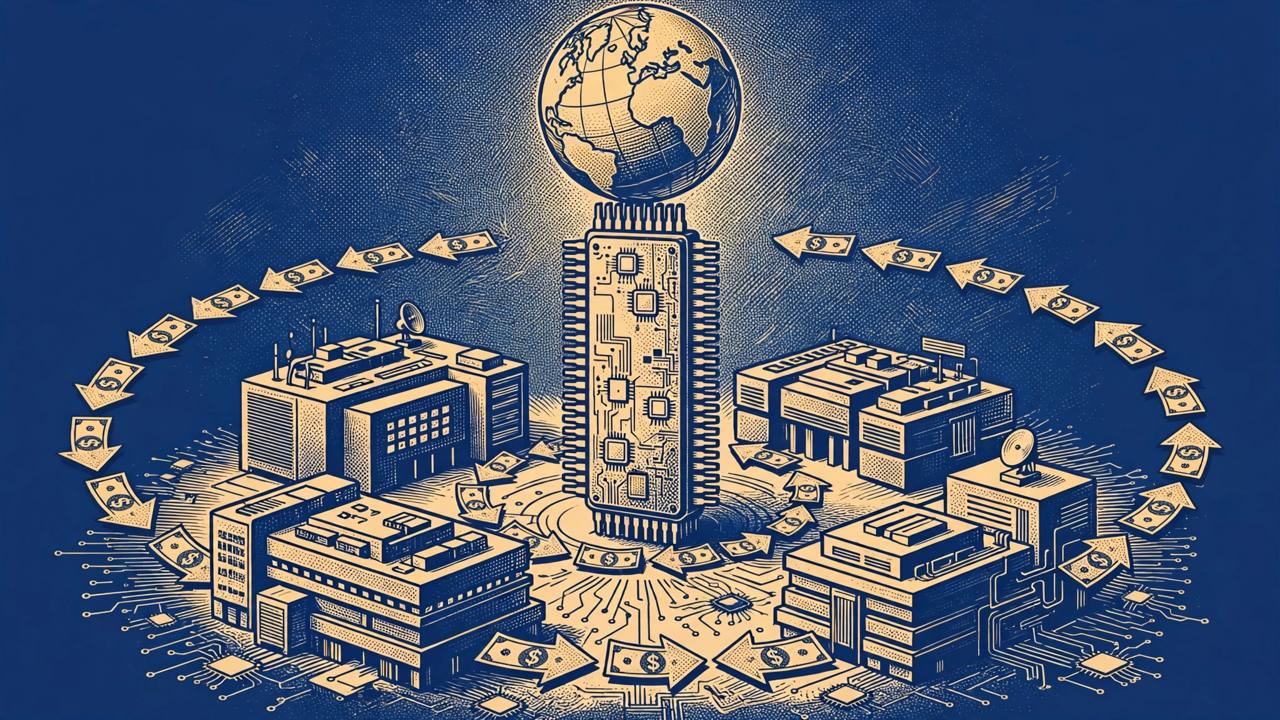
The head of the International Monetary Fund has warned that the world economy has come to depend so heavily on artificial intelligence investment that it is effectively standing on a single leg — and that a loss of confidence in the sector could turn into a financial stability problem. IMF Managing Director Kristalina Georgieva made the remarks on Monday, November 16, in an interview with CNBC on the sidelines of the ASEAN summit in the Philippines, the Philippine News Agency reported.
Source: Philippine News Agency (Anadolu)
"We have a world economy that is standing on one leg on the AI leg. If this leg wobbles, that can lead to financial stability troubles," Georgieva said. She warned that a sudden retreat from AI investment could undermine economic growth well beyond the technology sector itself.
What is 'circular financing' — and how big has it become?
Georgieva's central concern is the rapid growth of so-called circular financing among AI companies: arrangements in which money invested in an AI business flows back to the investor through purchase orders for chips, computing capacity or other services, creating a web of interconnected financial obligations. According to figures cited by the IMF chief, such arrangements have grown to slightly more than $1 trillion — yaani 1 lakh crore dollars — with around two-thirds of the total funded through debt rather than equity.
"It's not a huge size, but it is a rapid increase," Georgieva said of the $1 trillion figure. The IMF examined this web of deals in its October Global Financial Stability Report; reporting on that analysis put 14 large transactions since 2023 at roughly $300 billion in equity and $650 billion in debt, linking the balance sheets of chipmakers, cloud companies and AI developers in ways that can amplify stress if one part of the chain weakens.
A warning she has been building since October
Monday's warning follows concerns Georgieva raised in October, when an IMF blog post titled "The World Can't Afford to Get AI Wrong" described the AI industry as highly concentrated and highly leveraged, and warned that disappointing revenues or earnings could undermine investor expectations and push down share prices. At the close of the IMF and World Bank annual meetings in Bangkok on October 17, she had already used the same image, saying that depending on a single driver of growth "is like we stand on one leg." CNBC reported that Nvidia, whose chips power most advanced AI systems, has lost more than $1 trillion in market value over the past month as AI valuations have slid.
Georgieva also described global growth as caught between two opposing forces, a theme she set out in her address to the 49th ASEAN Summit in Manila on November 15: a negative energy shock linked to the Middle East war is weighing growth down, while the AI investment boom is pushing it up — and both forces are inflationary, prompting central banks to raise interest rates. She called ASEAN a "bright spot" in the global economy, growing at 4.9 percent against a global average of 3.1 percent despite the energy shock and the threat of a super El Niño, BusinessMirror reported from the summit.
Source: BusinessMirror
In the same Manila remarks, Georgieva said cutting non-tariff barriers inside ASEAN could lift the bloc's combined GDP by 4.3 percent over the long term — up to 2.5 percent from services trade reforms alone — and create around 4 million jobs with the right labour policies. She praised the new ASEAN Digital Economy Framework Agreement and noted that ASEAN's tax-to-GDP ratio of 12 percent still lags the 15 percent Asian average, BusinessWorld reported.
Source: BusinessWorld
What happens next
For now, Georgieva characterised recent market fluctuations as "orderly" and unlikely to develop into a broader disruption. "We have to be watchful," she added. Investors will test that calm in the weeks ahead: any sharp earnings disappointment from a major AI company, or a sudden tightening in the debt markets that fund the build-out, is exactly the kind of wobble the IMF chief says the one-legged world economy can least afford. The IMF has committed to help ASEAN build deeper capital markets and to assess AI's impact on financial stability, growth and jobs.