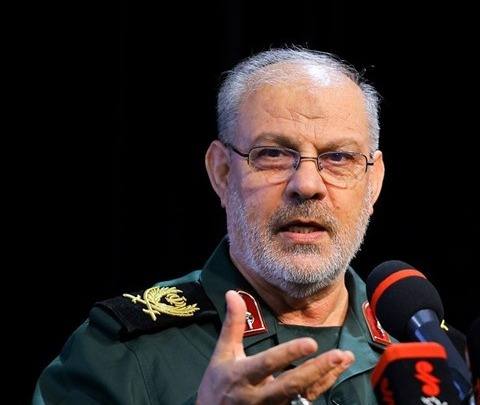
TEHRAN — Iran's Revolutionary Guard has formally dropped the range ceiling it observed for years on its ballistic missiles. IRGC spokesman Brigadier General Hossein Mohebbi told a news conference in Tehran on Saturday, November 7, marking Aerospace Week, that the self-imposed limit of about 2,000 kilometres (1,240 miles) on missile ranges 'has been lifted for us', the Associated Press reported, citing state-linked outlets including Tasnim and Mehr.
Source: Associated Press via The Insight International
Tasnim, the agency closest to the IRGC, reported the same announcement in its own words: the spokesperson 'announced that restrictions on the range of Iran's missiles have been lifted, saying the country must demonstrate its expanded capabilities in practice rather than merely make statements'. Mohebbi put it as a duty to show capability in the field: 'Our duty is to show our capabilities on the battlefield', he said, according to the AP report. No new missile, test or range figure beyond the lifted cap was announced on Saturday — what changed is the declared policy, not a demonstrated weapon.
Source: Tasnim News Agency
Why the 2,000 km line mattered
For years the IRGC maintained that it was limiting its ballistic missiles to about 2,000 kilometres, a figure long understood as a signal to European countries that they would not be targeted, AP reported in its wider Saturday coverage of the Qeshm and Hormuz escalation. A missile flown 2,000 kilometres from Iran already reaches across the Gulf and much of the Middle East; removing the cap signals an intention to develop weapons able to reach more distant targets, which is why the announcement — a single sentence at a press conference — carries weight well beyond Tehran.
The range announcement formalises warnings Awaaz Punjab readers have already seen this week, starting with the Iranian army's spokesman promising retaliation with no geographical limit. Read: Iran warns US of retaliation 'without geographical limits'
The remarks followed an order by Supreme Leader Mojtaba Khamenei for an immediate and effective response to any threat without geographical limits, and a broader update of Iranian military target lists covering US and Israeli assets, AP reported. Earlier this week Iran's army spokesperson Mohammad Akraminia, citing the same Khamenei directives, warned that any fresh US attack would be answered immediately and without any geographical limit, with American bases and interests far beyond the Middle East said to be within range of Iranian missiles and drones. Iranian lawmakers went further on the record, naming Italy and Germany and warning that missiles would reach Europe if the United States struck from European bases — a claim Britain pushed back on, saying there is no assessment that Iran is currently targeting Europe.
The lawmakers' Europe warning, and Britain's pushback, were reported earlier this week. Read: Iranian lawmakers name Italy and Germany in missile warning
Claims that could not be verified
Mohebbi also claimed advances in Iranian air defences and underground missile production after the recent fighting, including the downing of enemy aircraft and drones, AP reported. Those claims could not be independently verified, and AP presented them as claims. The same caution applies to the practical meaning of Saturday's announcement: lifting a self-imposed cap is a statement of intent and doctrine. No evidence was published on Saturday of a longer-range missile having been built or tested.
What is solid
- IRGC spokesman Brig Gen Hossein Mohebbi announced in Tehran on Saturday, Nov 7, that the ~2,000 km self-imposed limit on ballistic missile ranges 'has been lifted for us' (AP, citing Tasnim and Mehr; Tasnim's own report carries the same announcement).
- The announcement followed Supreme Leader Mojtaba Khamenei's order for a response to any threat without geographical limits and an update of target lists covering US and Israeli assets (AP).
- The statement is a policy/doctrine change: no new missile, test or longer range figure was demonstrated or announced on Saturday (AP / Tasnim reporting).
What is only claimed
- Mohebbi's claims of advances in air defences and underground missile production, including downing enemy aircraft and drones, could not be independently verified (AP).
- Whether Iran can or will actually field missiles beyond 2,000 km — and how quickly — is unproven; the earlier lawmakers' claim that missiles 'will reach Europe' was disputed by Britain, which said there is no assessment Iran is currently targeting Europe.
- Iranian claims about Hormuz shipping and US claims about Iranian capabilities in this crisis have repeatedly diverged; casualty and damage claims from either side remain attributed claims, not settled fact.
The moment it lands in
The announcement comes amid stalled US-Iran talks and rising fears of renewed strikes: the United States struck an Iranian air-defence site on Qeshm Island on November 6, which President Trump described as minor, mediators including Qatar are trying to prevent a wider escalation, and at least 11 ships were attacked in and around the Strait of Hormuz over the week ending November 6, according to UKMTO figures reported by AP. For the Gulf states — and for the lakhs of Punjabi and Indian workers who live there — a declared Iranian move toward longer-range missiles raises the stakes of any renewed round, even though no report on Saturday linked the announcement to any change for civilian workers, flights or shipping schedules.
What happens next
Watch for three things: any Iranian test or unveiling that would turn Saturday's words into a demonstrated capability; a response from Washington and European capitals, whose territory the lifted cap is understood to put notionally in reach; and whether Trump's pending decision on resuming strikes makes the new doctrine an active one. Until a longer-range weapon is shown, Saturday's news is a signal — but in a war that has run since February 28, signals from the IRGC's own spokesman are how the next phase has repeatedly been announced first.