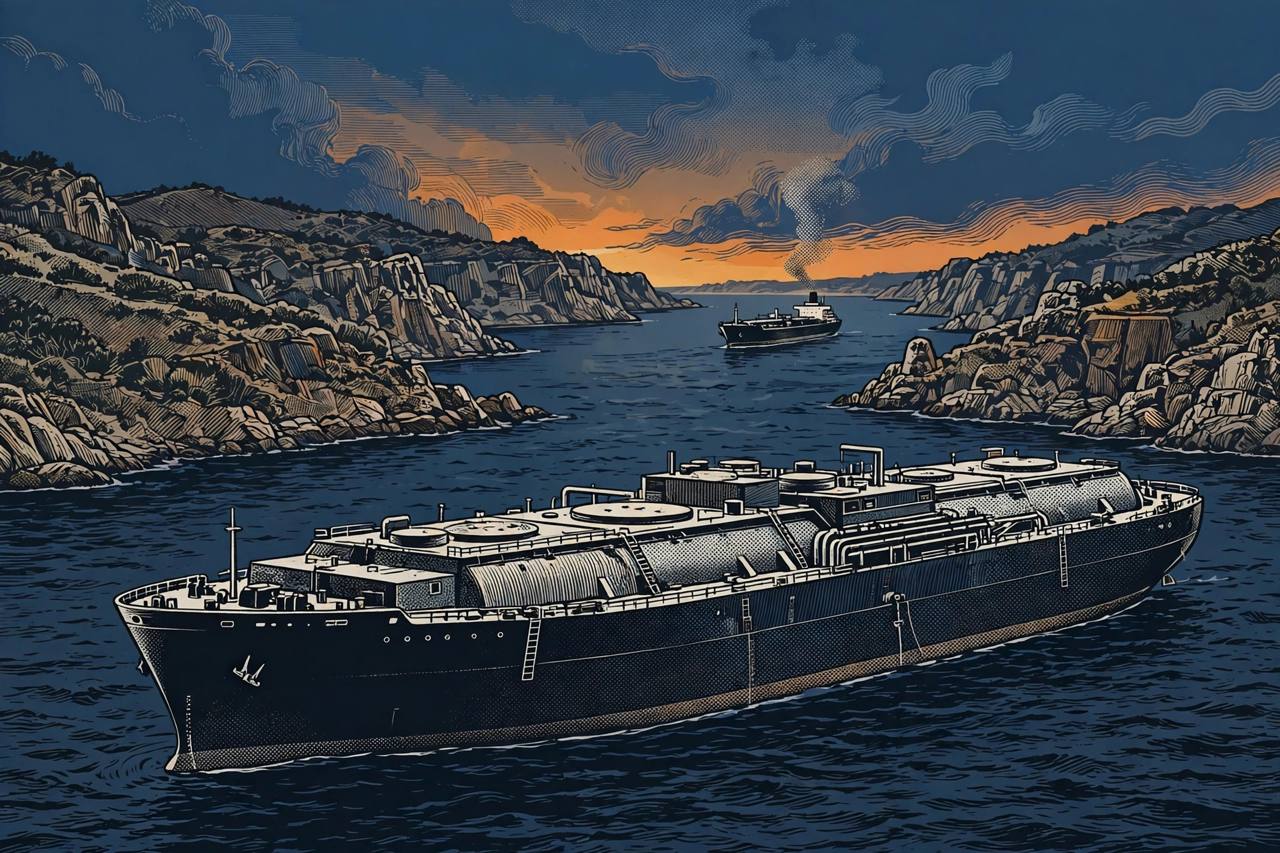
Iran's Islamic Revolutionary Guard Corps (IRGC) said on Sunday that a supertanker carrying more than two million barrels of crude oil sank in the southern waters of the Gulf after striking a naval mine in the Strait of Hormuz — a claim no shipowner, flag state or naval force had confirmed by Sunday evening.
Source: AFP via Islamabad Post
In a statement carried by Iranian state television, the Guards said two oil tankers travelling on what they called an unauthorised route in the southern part of the strait had struck naval mines in the previous few hours, causing massive explosions and fires. One vessel, a supertanker loaded with more than two million barrels of crude, sank, the statement said, while the second was left burning. The Guards named neither vessel and gave no flag, owner, position or imagery of a sinking.
Source: AFP via Islamabad Post
The claim is an escalation in wording from Tehran's near-daily tanker announcements since late October. On Saturday, Iran's regular navy said a tanker had caught fire after hitting a mine east of the strait; Sunday's statement is the first in this run to assert that a fully laden supertanker has actually sunk.
Source: Silent Dossier
Read the earlier tanker incident reported on Saturday, east of the strait: Iran navy tanker mine fire, Nov 14
What maritime authorities have actually confirmed
The United Kingdom Maritime Trade Operations (UKMTO) centre said on Sunday it was aware of a report, received from Indian shipping authorities, of an attack on a tanker sailing eastbound through the Gulf before it entered the strait. UKMTO said all crew were accounted for and safe, the damage and any environmental impact were unknown, and it was unclear whether that report was the same incident the Guards announced.
Source: UKMTO via Silent Dossier
The United States military, which says it has cleared the main shipping routes through the strait of mines, had not confirmed any sinking by Sunday evening. US Central Command has said it has helped Gulf countries export 1.5 billion barrels of oil via Hormuz since the summer, even as Iran insists vessels must use routes it authorises and the United States maintains a naval blockade on Iranian ports.
Source: AFP via Islamabad Post
Why the claim matters, and what is not known
The Strait of Hormuz normally carries about one-fifth of the oil consumed worldwide, and it has been effectively restricted since the US-Iran war began on February 28, 2026. A confirmed loss of a fully laden very large crude carrier — roughly two million barrels, yaani about 20 lakh barrels of crude in a single hull — would be the largest tanker loss of the war and would raise immediate questions about oil spills, insurance and whether tankers can keep moving at all. None of that is confirmed yet: no vessel name, no spill report and no independent imagery had emerged by Sunday evening in Toronto.
The tanker announcement came on the same day the Guards said they had sent six drones against a US air-defence radar at Al-Riffa in Bahrain, a claim Bahrain and the United States have disputed, and as Iran's parliament speaker Mohammad Bagher Ghalibaf repeated that Tehran will not stay in a state of 'neither war nor peace' unless Washington meets its seven conditions for reopening the strait.
The same day's Bahrain drone claim, reported earlier: IRGC six drones at Al-Riffa radar, Nov 15
What is solid
- The IRGC issued the sinking statement on state TV on Sunday, Nov 15
- UKMTO received a separate Indian-authorities report of an attack on a tanker in the Gulf, crew safe
- No owner, flag state or naval force had confirmed a sinking by Sunday evening
What is only claimed
- That a supertanker actually sank, and that mines caused the explosions
- Whether the UKMTO-reported tanker attack is the same incident the IRGC announced
What happens next
Shipping trackers, satellite imagery and any statement from a flag state or owner are the tests that will settle this claim in the coming hours. Oil markets reopen after the weekend with Brent last settled at $95.84 a barrel on Friday. For the lakhs of Punjabi and Indian workers in the Gulf — including Indian seafarers, whose authorities filed Sunday's UKMTO report — the practical question is unchanged: whether the world's most important oil route can be crossed safely, and on whose terms.