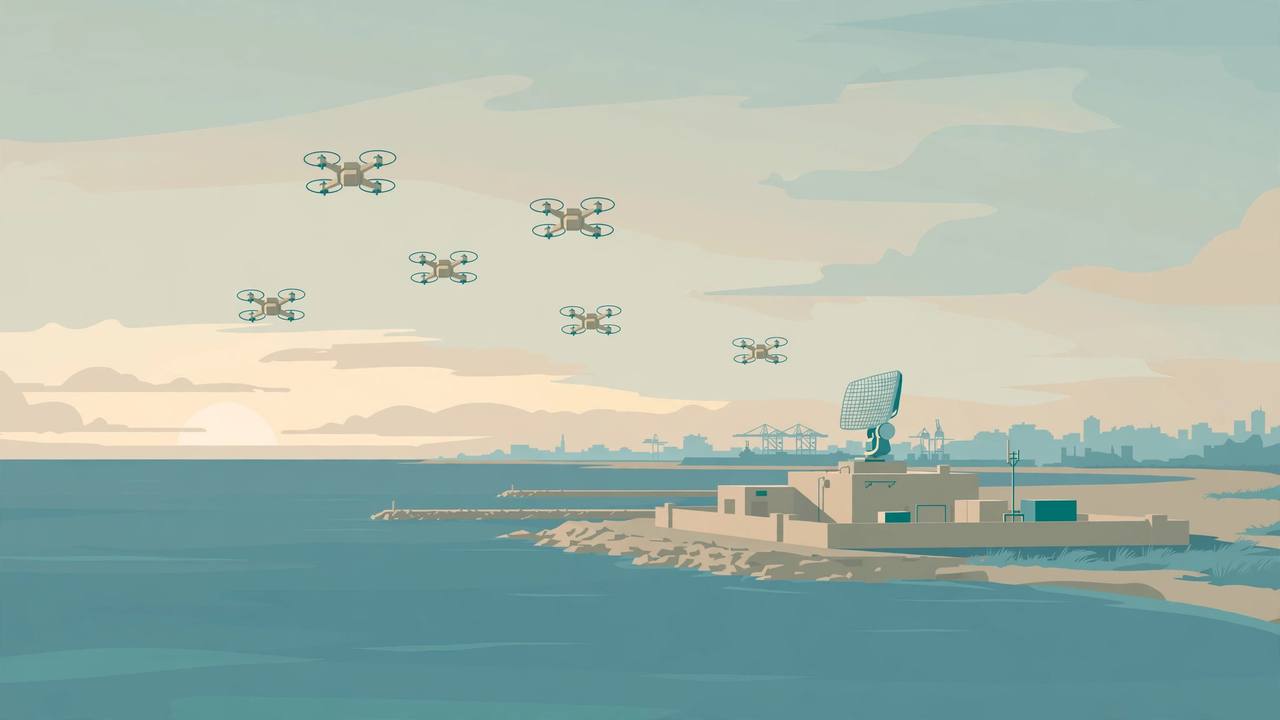
This is a new development in the Bahrain drone confrontation first reported on November 13: Iran's Revolutionary Guards then claimed to have destroyed a US early-warning radar, a claim US Central Command rejected, saying its forces shot down two Iranian drones with no injuries or damage. Tehran now says it has struck again, with six drones, and Bahrain has issued its first public threat alerts since September. Read the earlier Bahrain drone report
MANAMA — Bahrain issued two separate alerts about potential threats in posts on the social media platform X early on Sunday, November 15, the first such warnings by the Gulf kingdom since September, Reuters reported. The Interior Ministry urged citizens and residents to remain calm and proceed to the nearest safe location, and it did not provide further details on the threats.
Source: Reuters, Nov 15, 2026
Hours later on Sunday morning, Iran's Islamic Revolutionary Guard Corps (IRGC) said its Aerospace Force had targeted a US air-defence radar at Bahrain's Al-Riffa helicopter base with six drones, in what it called the “second phase of a decisive and crushing response to [US] aggression.” The claim was carried by Iran's Press TV from an IRGC statement released on Sunday morning.
Source: Press TV, Nov 15, 2026 (IRGC statement)
The IRGC claimed the “precise and successful impact of these drones was heard in various parts of Bahrain.” That claim of a successful hit has NOT been independently confirmed: Reuters reported no Bahraini confirmation of any strike or damage alongside the alerts, and US Central Command (CENTCOM) had issued no response to the new six-drone claim at the time of reporting. CENTCOM's earlier denial concerned Friday's separate attack, not this new claim.
Source: Reuters, Nov 15, 2026
What happened on Friday
On Friday, November 13, the IRGC announced it had destroyed a US military early-warning radar in Bahrain in a precision strike, saying it was retaliation for an overnight air attack on a telecommunications tower in the southern Iranian town of Sirik, on the Strait of Hormuz coast. CENTCOM rejected that account the same day: “The IRGC launched two one-way attack drones toward Bahrain and both were shot down by US forces. There were no injuries or damage.” Reuters reported it could not independently verify the Iranian account of a destroyed radar.
Bahrain matters far beyond its size: the island kingdom hosts the headquarters of the US Navy's Fifth Fleet at Naval Support Activity Bahrain, which directs American naval operations across the Middle East. Friday's drone launch was reported as the first Iranian targeting of Bahrain since September, and Sunday's alerts were the first public threat warnings Bahrain has issued since September — a sign Manama is treating the renewed fire seriously even while it has not confirmed any hit.
The Hormuz warning in the same statement
In the same Sunday statement, the IRGC repeated its warning over the Strait of Hormuz, declaring: “The Strait of Hormuz is closed, and any aggression by the American enemy will be met with a harsher and more crushing response.” It said more drones were dispatched in this phase than in the previous one and warned that every act of aggression would prompt a “tough” and “ calculated” response. The statement presented the Bahrain strike as “a serious warning to the aggressor enemy to cease its aerial provocations and oil smuggling in the Strait of Hormuz.” These are the IRGC's own claims and warnings, reported here as such; no independent confirmation of a radar hit accompanied them.
The confrontation sits inside the wider US–Israeli war on Iran that began on February 28, in which Iranian forces have repeatedly targeted US bases and assets across the Gulf, including facilities in Bahrain, and US forces have continued strikes on Iranian territory. Only on Saturday, Reuters reported that President Donald Trump has told senior advisers he may hold off on attacking Iran if the US faces no new provocations from Tehran or the Iran-backed Houthis in Yemen — a reported leaning, based on anonymous sources, that Sunday's claimed drone wave will now test.
For the lakhs of Indian and Punjabi workers who live and work across the Gulf, including in Bahrain, the practical news on Sunday morning was the official safety guidance itself: Bahrain's Interior Ministry told people to stay calm, go to the nearest safe place and follow official channels. No side reported any casualties from the Sunday-morning events at the time of reporting, and no harm to foreign workers was reported.
What is solid
- Bahrain's Interior Ministry issued two potential-threat alerts early on Sunday, November 15 — its first such warnings since September — and urged people to stay calm and go to the nearest safe location (Reuters, reporting the ministry's own X posts).
- On Friday, November 13, US Central Command said US forces shot down two Iranian one-way attack drones launched toward Bahrain, with no injuries or damage.
What is only claimed
- The IRGC's claim that six drones successfully hit a US air-defence radar at Al-Riffa helicopter base on Sunday — no independent confirmation and no CENTCOM response yet.
- The IRGC's earlier claim to have destroyed a US early-warning radar in Bahrain on Friday, which CENTCOM called false.
What happens next
The next facts to watch are an official US or Bahraini account of Sunday morning — whether CENTCOM confirms an interception, damage, or nothing at all — and whether Washington treats the claimed second wave as the kind of new provocation that ends the reported pause in US strikes on Iran. Until an official account appears, the verified core of this story is narrow: Bahrain alerted its public for the first time in two months, and Iran's Guards publicly claimed a bigger second drone attack on a US radar in the kingdom.