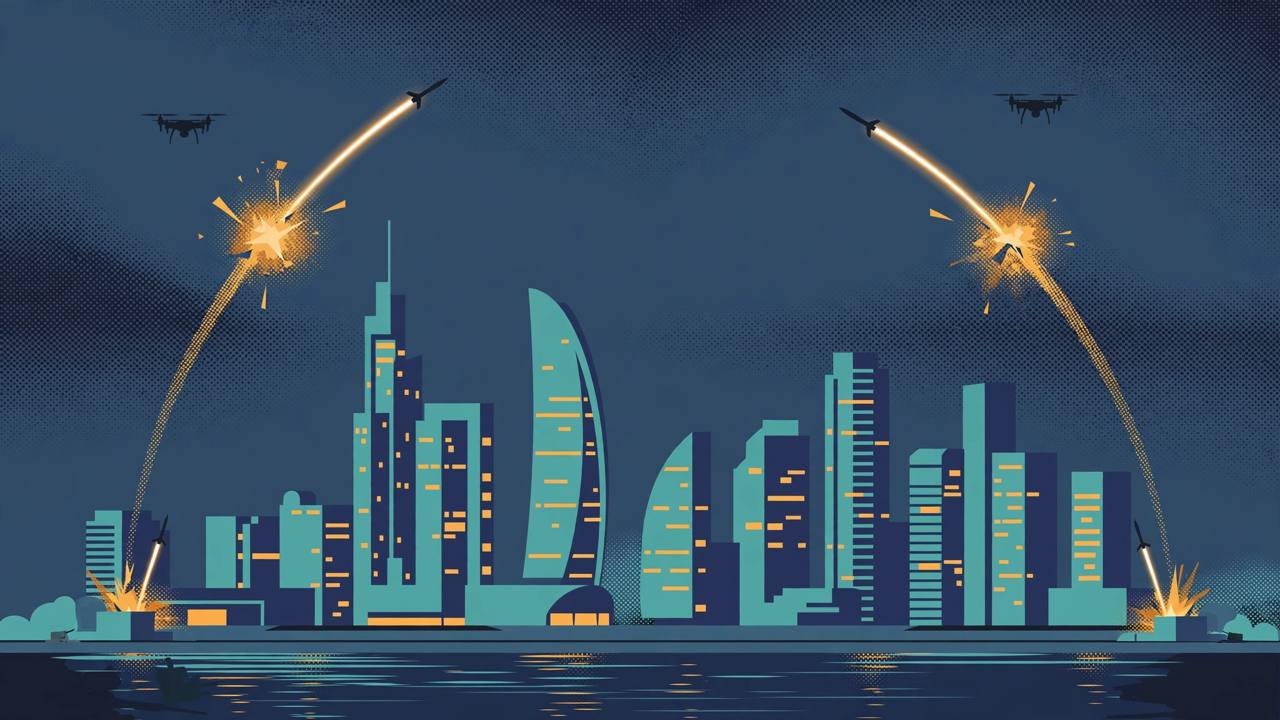
The Saudi-led coalition fighting Yemen's Houthis said on Saturday, November 14, that it intercepted and destroyed two drones launched by the Iran-aligned group towards the Saudi capital Riyadh and the kingdom's southern region, Reuters reported. The coalition backs Yemen's internationally recognised government against the Houthis, who control the capital Sanaa.
Source: Reuters, via Devdiscourse, Nov 14, 2026
Coalition spokesperson Major General Turki al-Malki announced the interceptions in a post on X, saying that "two drones launched by the Houthi terrorist militia were intercepted and destroyed in the Riyadh and southern regions". The coalition gave no further details about the intended targets.
Source: IPP News, Nov 14, 2026
No casualties, damage, or effect on flights, airports or oil infrastructure was established in the reports of Saturday's interceptions, and the coalition did not give an exact time for the incident. Saturday's statement concerns drones only: it should not be read as confirmation of the Houthis' separate claims on Friday that they had fired ballistic missiles at Saudi forces in Jazan.
Source: JBiz News, Nov 14, 2026
Another front in the war around Iran
Cross-border fighting between the coalition and the Houthis has intensified amid the US-Israeli war with Iran, opening another front in the conflict, Reuters reported. The coalition has battled a surge in attacks since hostilities reignited in July, and in recent weeks the Houthis have launched strikes on a range of Saudi targets including airports, energy infrastructure, military sites and Riyadh's financial district, frequently aiming at the capital and particularly its international airport.
Only a day earlier, on Friday, the Houthis claimed drone strikes on King Khalid International Airport in Riyadh and a pumping station on the East-West oil pipeline — claims Riyadh did not comment on and which could not be independently verified. Read: Houthis claim Riyadh airport and pipeline strikes; Riyadh silent
Last Sunday, November 8, a Houthi strike damaged a skyscraper owned by Saudi state oil giant Aramco in Riyadh's financial district. Twenty-six people have been killed in attacks on the kingdom since September, 23 of them in strikes on airports, according to the authorities. On Wednesday, November 11, the coalition said its air defences had destroyed three Houthi cruise missiles aimed at the Riyadh region and two drones launched toward Makkah and the south — the second consecutive day of fire toward the capital that week.
Wednesday's salvo — three cruise missiles toward Riyadh and drones toward Makkah — was the second straight day of Houthi fire at the Saudi capital. Read: Saudi air defences destroy three cruise missiles aimed at Riyadh
The Yemen conflict first erupted in 2014, when the Houthis seized Sanaa and forced the government to relocate to Aden; the Saudi-led coalition has fought in support of that government for more than a decade. Since the four-year truce collapsed this summer, more than 1,600 people have been killed in Yemen and over 300,000 forced to flee their homes, according to the United Nations. In Yemen, the Houthis frequently report Saudi airstrikes in areas under their control.
Saturday's interceptions land in a sensitive week for the wider war: President Donald Trump has told advisers he may hold off further US attacks on Iran unless Tehran or the Iran-backed Houthis provoke the United States — a threshold that continued Houthi fire toward Saudi Arabia directly tests. Riyadh and the kingdom's south are also home to lakhs of Indian and Punjabi workers, for whom every alert over the capital is a safety question, not just a headline. What happens next depends on whether the Houthis answer Saturday's statement with fresh launches, and whether the coalition responds with strikes in Yemen, as it has after earlier salvos.