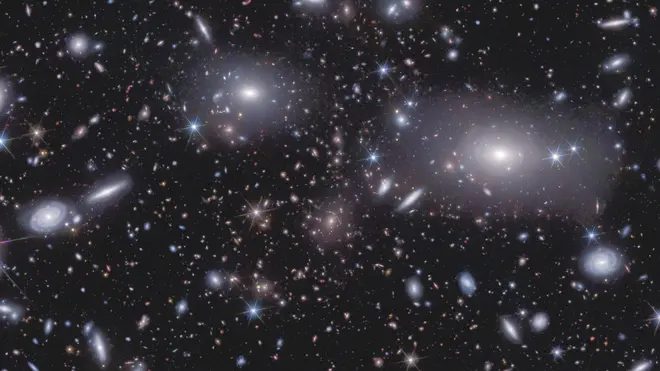
The European Space Agency's Euclid space telescope has released its first major batch of data, capturing the light of more than a billion objects over an area of sky as big as 9,500 full Moons, ESA announced on Thursday, November 12 — the foundation for the largest-ever 3D map of the cosmos.
Source: European Space Agency (ESA), Nov 12, 2026
The release, named DR1-Foundation, comprises around 13 months of observations gathered from spring 2024 to spring 2025, and is the first major release of mission data since the telescope's launch in July 2023, ESA said. Euclid began routine science observations on February 14, 2024, from the L2 Lagrange point, 1.5 million kilometres from Earth.
Source: Scientific American, Nov 13, 2026
"These are far more than beautiful pictures; today marks a scientific milestone in our study of the cosmos," said ESA's Director of Science, Professor Carole Mundell. "This major Euclid data release represents the largest space-based survey of its kind, laying the foundation of future discovery in a new regime for astronomy."
Source: European Space Agency (ESA), Nov 12, 2026
A billion objects, 900 million galaxies
The release includes more than 900 million galaxies, around 15,000 strong gravitational lensing candidates, over 60 million quasar candidates and the spectra of more than 160 million sources, ESA said. The Euclid Wide Survey results cover 1,900 square degrees of sky and total 1.7 million gigabytes of data — yaani 1.7 petabytes, or about 17 lakh gigabytes.
Source: European Space Agency (ESA), Nov 12, 2026
The strong-lens catalogue in the release is the largest ever — bigger than all previous catalogues combined, according to the Euclid Consortium — because strong lenses, which form when a foreground galaxy distorts the light of a distant galaxy behind it, let scientists "weigh" galaxies including their invisible dark matter.
Source: European Space Agency (ESA), Nov 12, 2026
"This is a change in scale from Euclid's previous releases, which included a few days of observations over around 60 square degrees of sky," said Valeria Pettorino, ESA's Euclid project scientist. "We're now releasing more than a year of data covering a significantly larger area. This unlocks ground-breaking science."
Source: European Space Agency (ESA), Nov 12, 2026
Only 14 percent of the sky — so far
Even at this scale, the dataset covers only about 14 percent of the total sky area Euclid will survey over its six-year mission, ESA said. The full Data Release 1 is due in mid-2027 and will add weak-lensing observations and calculations of how galaxies and galaxy clusters fit into the cosmic web.
Source: European Space Agency (ESA), Nov 12, 2026
What happens next: the data is public through the Euclid Data Space platform, and scientists will now mine it to measure galaxy distances and place them into the 3D structure of the Universe — the detective work aimed at the mysteries of dark energy, dark matter and the cosmic web.