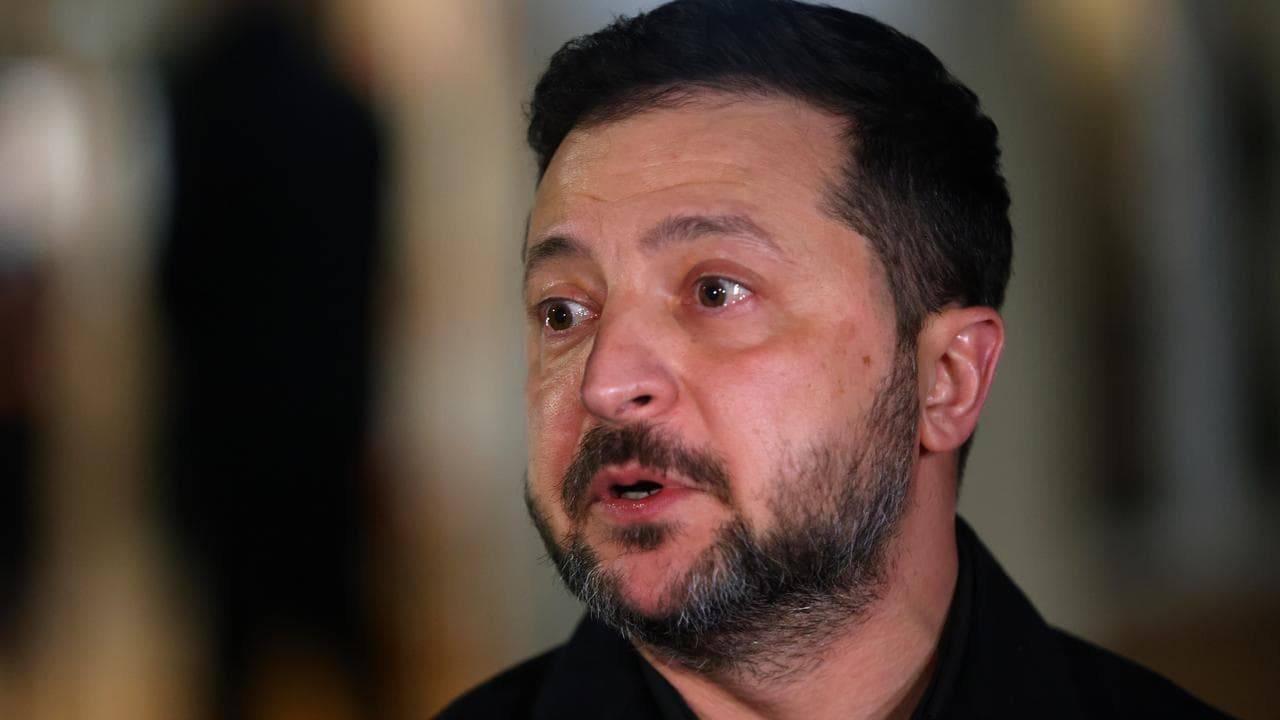
United States negotiators have raised, for the first time, the question of whether Ukraine would withdraw from its eastern Donbas region in exchange for joining NATO, President Volodymyr Zelenskiy says.
Source: AAP / AP, Nov 14, 2026
"The Americans raised a question: 'What if Ukraine joins NATO? Would Ukraine withdraw from Donbas?' This was the first time this had been raised," Zelenskiy told reporters in remarks released by his office on Saturday. "That is why I believe NATO is back on the agenda. But you have also heard (Russian President Vladimir) Putin's signals, and this is an extremely difficult conversation."
Zelenskiy reiterated his position that Kyiv was not willing to retreat from its territory. But he said that if Ukraine received a comprehensive security package — one that includes security guarantees, a strong and well-funded Ukrainian army and funds to rebuild — he would put the question to a referendum.
A question floated after the Abu Dhabi talks
The proposal came following the latest round of peace talks with Russia in Abu Dhabi. After two days of talks with Russian and Ukrainian delegations there this week, US envoys Steve Witkoff and Jared Kushner went in person to brief Russian President Vladimir Putin in the Kremlin and Zelenskiy, who was meeting European leaders in Dublin, Ireland.
More talks are planned as negotiators seek a breakthrough in the peace efforts, according to Witkoff and Kushner. Kushner said Russia has agreed to include European countries in upcoming talks, and that Europe's presence at the table will allow negotiators "to address the broader postwar European security arrangements alongside the territorial issues between Ukraine and Russia," in his words on X.
European leaders are scrambling to find an envoy to the talks while remaining wary of Russian manoeuvring. The European Union's top diplomat, Kaja Kallas, said in Dublin that the bloc must insist on a ceasefire before taking the negotiations further: "If we start to talk about what Russia is asking regarding the security architecture, we actually walk into the traps that Russia is setting us." German Chancellor Friedrich Merz made the same point about Moscow's wish to reopen Europe's security order: "Russia wants to talk about questions of European security architecture. We don't need to talk about that. There is one," he said, referring to the NATO alliance.
Five countries — Germany, France, the United Kingdom, Italy and Poland — together with the EU institutions will represent Europe in possible peace talks between Russia and Ukraine, European Council president Antonio Costa said on Friday evening in Dublin. "Europe must speak with one clear voice and united voice in all discussion that shape the future of Ukraine and the security of our continent. And this is ultimately a team effort," Costa said.
The war raging behind the talks
The diplomacy is unfolding against one of the heaviest weeks of aerial warfare in the conflict. Ukraine fired almost 1,200 drones at Russia in one of its biggest aerial attacks since the Russian full-scale invasion nearly five years ago. Russia's defence ministry said its forces downed 1,198 Ukrainian long-range drones between late Thursday and early Friday — a claim made by Moscow that Kyiv has not confirmed in those terms.
Strikes on three Russian regions killed seven people and wounded 17, local officials said. Ukraine's General Staff said it hit an oil refinery in the Russian city of Volgograd, starting a fire. Russia, for its part, launched 117 drones against Ukraine, killing at least two people, authorities said, and a single Russian attack on Friday on southern Zaporizhzhia hit two five-storey apartment blocks and wounded 30 people, officials said.
Russian attacks on Ukraine's energy infrastructure caused widespread power outages across about half of the country's regions on Friday, First Deputy Minister of Energy Artem Nekrasov said. The war has killed hundreds of thousands of soldiers and thousands of civilians, analysts and humanitarian organisations say — the human cost behind every line of the territorial argument now being put, for the first time, in NATO terms.
More talks are planned, and Europe is choosing who speaks for it at the table. The central question Zelenskiy has now put on the record — Donbas against NATO membership and a full security package, decided by referendum — has been raised by Washington, not settled by anyone. Moscow's own demands, and Putin's signals, remain the other side of what Zelenskiy called an extremely difficult conversation.