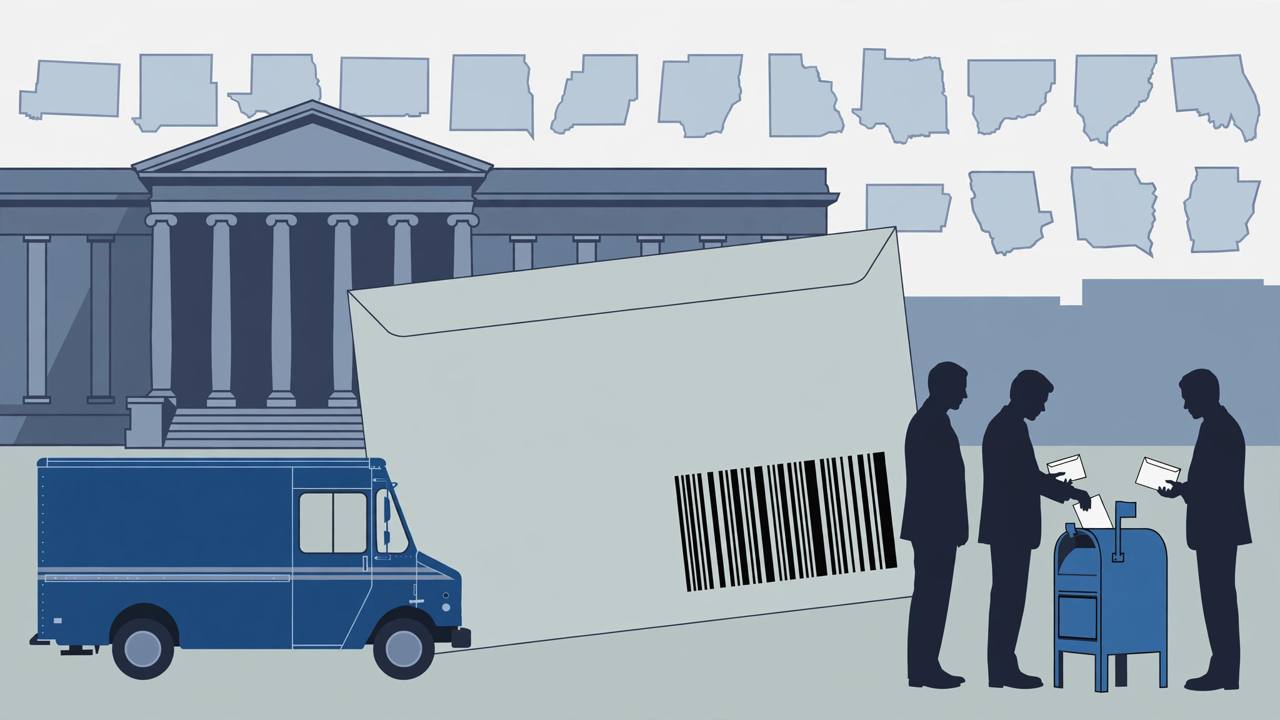
Twelve Republican state attorneys general have started an appeal to revive President Donald Trump's mail-voting restrictions in time for the 2028 presidential election, NPR reported on Friday, November 13, 2026. On Thursday, the states began the process of appealing a September court order that blocked the U.S. Postal Service (USPS) from carrying out a new ballot-mail plan issued in response to a Trump executive order.
Source: NPR
The twelve states are Alabama, Florida, Indiana, Kansas, Louisiana, Missouri, Montana, Nebraska, Oklahoma, South Carolina, South Dakota and Texas. Their appeal, filed in Washington, D.C., is the first major movement in the case since this year's midterm elections, according to Democracy Docket, which tracks voting litigation.
What the blocked Postal Service plan would do
The rule USPS released in late August would require states to turn over lists of voters' names and addresses in order to have their mail ballots delivered, NPR reported. Democracy Docket's account adds detail: states would have to upload a list of approved mail voters to a new government portal and redesign ballot envelopes with trackable barcodes, and Judge Nichols' order also barred states from voluntarily working to implement the rule.
U.S. District Judge Carl Nichols, a Washington, D.C.-based judge nominated by Trump, issued a preliminary injunction in September blocking USPS from implementing the plan for all federal elections, including the 2028 race. Nichols found the mailing agency likely has no power to impose that requirement on states — in Democracy Docket's summary, that USPS likely overstepped its authority. The challenge was brought by Democrats and civil rights groups, who allege the restrictions are an unconstitutional power grab; the Elias Law Group represents the plaintiffs in the case.
Nichols is one of two judges who blocked the plan. In a separate case out of Massachusetts, U.S. District Judge Indira Talwani also issued a preliminary injunction in September, in a challenge brought by voting-rights groups and 24 Democratic-state attorneys general. In September, the U.S. Supreme Court refused to pause Talwani's ruling, which kept Trump's mail-ballot order from taking effect for this year's midterms.
Where the Trump administration stands — for now, unclear
It is not yet clear whether the Trump administration itself will appeal Nichols' ruling: the federal government's deadline for filing its own notice of appeal expired Friday, NPR reported, and the Justice Department declined to say what it intended to do. That leaves the twelve Republican-led states carrying the appeal on their own, at least for now.
The states' move comes just days after the midterm elections concluded. Democracy Docket notes the appeal marks the first major step in the case since those elections, in which, it reports, Democrats flipped control of Congress. With the injunctions in place, the USPS plan could not be used in the midterms; the appeal decides whether it can return for 2028.
Why mail voting rules matter to diaspora voters
Tens of millions of Americans vote by mail in federal elections, including large numbers of Punjabi and other immigrant voters in states such as California, New York, Washington and Texas, where mail ballots are a routine way to vote while working long shifts, driving trucking routes or caring for family. A rule that conditions ballot delivery on states handing voter lists to a federal portal would change how every one of those ballots moves — which is why both sides treat the case as a fight over who controls federal elections: Congress and the states, or federal agencies acting on a presidential order.
What is solid
- Twelve Republican attorneys general began an appeal on Thursday, November 12, 2026, reported by NPR on November 13.
- Judge Carl Nichols' September preliminary injunction blocks the USPS plan for all federal elections, including 2028.
- Judge Indira Talwani issued a parallel September injunction in Massachusetts, and the Supreme Court refused to pause it for the midterms.
What is only claimed
- Supporters of the restrictions present them as election-security measures; the Democratic and civil-rights plaintiffs allege they are an unconstitutional power grab. The courts have so far ruled only on preliminary injunctions — likelihood and authority — not a final judgment on the whole dispute.
What happens next
The appeal now goes forward in the federal appeals process in Washington, where judges will decide whether Nichols' injunction stands. If it is overturned, USPS could move to put the voter-list and envelope requirements into effect ahead of 2028; if it stands, the plan stays blocked unless the Supreme Court takes the case. The administration's own position — whether it joins the states' appeal — is the first thing to watch, after Friday's deadline passed without a public answer.
Source: Democracy Docket