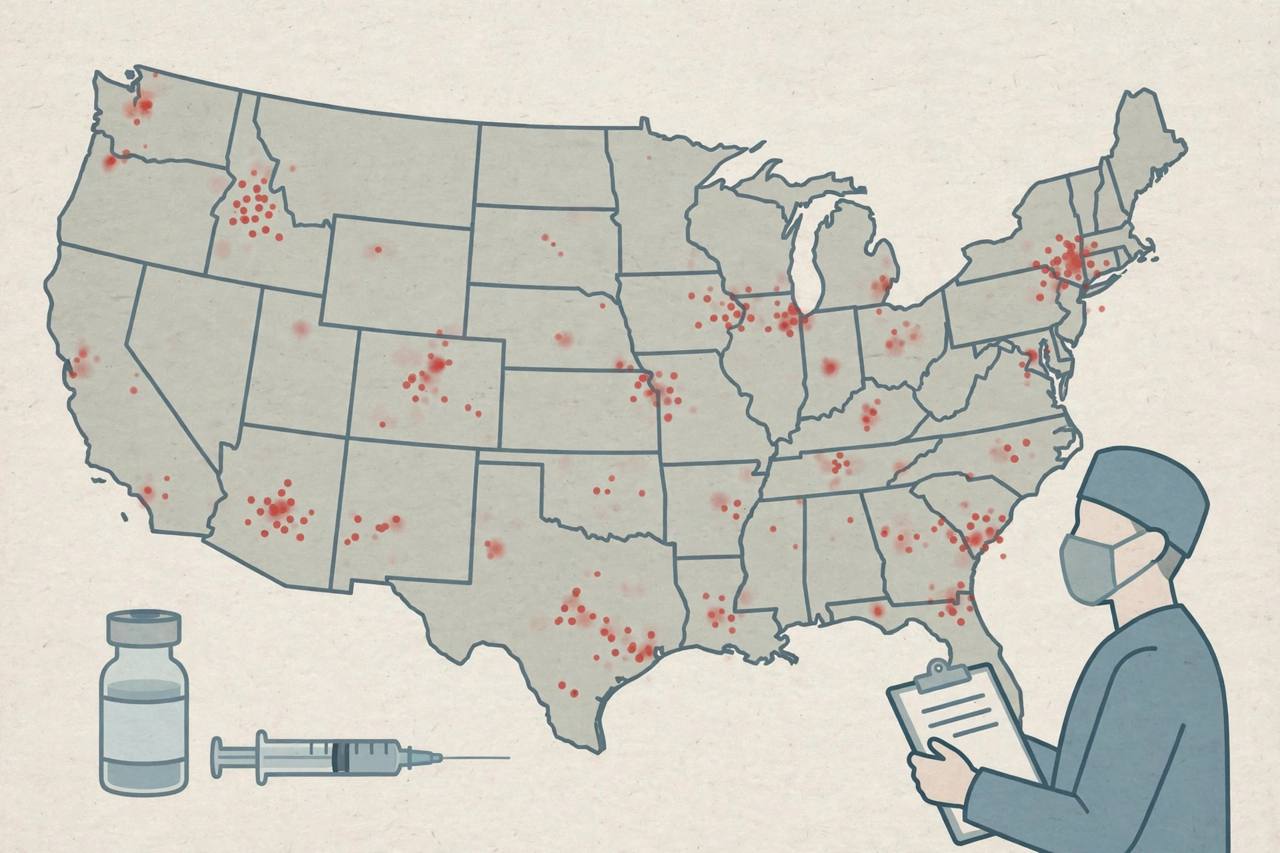
The United States measles outbreak — already the country's worst in decades — passed another grim milestone on Friday, November 13, as the Centers for Disease Control and Prevention (CDC) reported 5,412 confirmed measles cases for 2026 as of November 12, and health officials in Pennsylvania and Wisconsin each reported a new measles-associated death. The new national total is up 230 cases from the 5,182 cases the CDC reported a week earlier, the 14th straight week of a triple-digit increase, according to CIDRAP at the University of Minnesota.
Source: CDC
Pennsylvania's seventh measles-associated death this year involved an unvaccinated resident of Montour County, in east-central Pennsylvania, who had tested positive for measles, the Pennsylvania Department of Health said in a press release on Friday, Reuters reported. The department gave no further information, citing privacy for the deceased. Separately, Wisconsin health officials confirmed a second child has died from measles in the state this year: the pediatric death occurred in Grant County, in the state's southwestern corner, and the Wisconsin Department of Health Services said it would release no additional information to protect the privacy of the child and the family, according to WTAQ-WLUK reporting carried by WIXX. The first Wisconsin pediatric measles death, confirmed just last week, was the state's first measles death since 1990.
Source: Reuters
Two death tolls — and why they differ
The CDC's update added two measles-related deaths, taking its national total to six for 2026 — twice the three deaths recorded in all of 2025 — and the agency says that number is subject to change as reviews are completed. State health departments, however, report 10 measles-associated deaths in 2026: seven in Pennsylvania, two in Wisconsin and one in New York, where a child died earlier this month in the state's first measles-associated death in more than 30 years, Reuters and NBC News reported. Reuters reported that the discrepancy arose after the CDC, under US Health Secretary Robert F. Kennedy Jr., began using National Center for Health Statistics mortality data instead of state figures. Epidemiologists cited by CIDRAP also speculate that the true number of infections is far greater than the confirmed count, because many people with mild or moderate illness never seek medical care — and may not isolate, which risks further spread.
What is solid
- CDC confirmed total: 5,412 cases as of Nov 12, 2026, up 230 in a week
- Pennsylvania: 1,542 cases in 46 counties, 305 hospitalizations, 7 deaths (state DOH via Reuters)
- Wisconsin: 649 cases in 20 counties since August; a second child, in Grant County, has died (state DHS via WTAQ-WLUK)
What is only claimed
- National death toll: CDC confirms 6 deaths; state departments together report 10 — the two counts use different data sources
Where the outbreak is growing fastest
Pennsylvania remains the country's largest hot spot, with 1,542 cases in 46 counties as of Friday, including 305 hospitalizations, after 61 new infections in the past week; Bucks County was newly added to the list of counties with confirmed cases, Reuters reported. Its previous six deaths involved three Lancaster County residents, two from Jefferson County and one from Mifflin County. Wisconsin reported the most new infections of any state this past week — 174 — and its Department of Health Services has counted 649 cases in 20 counties since the outbreak began in August, concentrated in the southwest, where Grant County alone accounts for more than a third of the state's cases, according to CIDRAP. Ohio added 61 infections this week, taking its 2026 total to 372; Minnesota confirmed 21 new infections for a total of 160; and Indiana reported 37 new cases, bringing its total to 171.
Source: CIDRAP
Of the 5,412 national cases, 96% — 5,216 cases — are outbreak-associated: 3,831 from outbreaks that started in 2026 and 1,385 from outbreaks that started in 2025, the CDC said. People who had not been vaccinated, or whose vaccination status is unknown, make up 96% of reported cases, according to CDC data cited by CIDRAP, and the hospitalization rate remains 11%, the same as last week and in 2025. For the full year of 2025, the CDC recorded 2,289 confirmed cases — so the 2026 total is now about 2.4 times the whole of last year, with roughly seven weeks still to go, and US cases have climbed above 5,000 for the first time since 1991.
Falling vaccination coverage is the backdrop
Measles was declared eliminated in the United States in 2000, after decades of high uptake of the measles, mumps and rubella (MMR) vaccine. That protection is thinning: CDC data show MMR coverage among US kindergartners fell from 95.2% in the 2019–2020 school year to 92.4% in 2025–2026 — below the level of more than 95% the CDC says protects a community — leaving approximately 280,000 kindergartners at risk. The state-level picture explains the map of the outbreak: kindergarten MMR coverage for 2025–26 was an estimated 85.1% in Wisconsin, 85.7% in Minnesota, 88.1% in Ohio and 92.7% in Pennsylvania, all of which allow religious, personal or philosophical exemptions, while West Virginia — which does not allow such exemptions and has reported just two cases all year — stood at 98.9%, CIDRAP reported. The CDC notes that two doses of MMR vaccine are 97% effective at preventing measles, and one dose is 93% effective.
Pennsylvania officials say an intensified vaccination push may be slowing their outbreak. State Epidemiologist Lisa McHugh, PhD, MPH, said during a webinar hosted by the Association of Health Care Journalists that the state's outbreak seems to be slowing and that officials hope the trend continues, CIDRAP reported. Pennsylvania administered about 56,000 MMR doses in September and 61,000 in October — against a normal monthly average of about 25,000 — including campaigns and home visits aimed at under-immunized communities. McHugh cautioned that the state may still see an increase in late winter and early spring, when measles infections tend to spike.
Measles spreads through the air when an infected person coughs or sneezes, and a person can catch it simply by being in a room where someone with measles has been, the CDC says. The agency's advice is unchanged: the best protection is the MMR vaccine, and parents should talk to their healthcare provider about vaccination — especially before travel. School MMR requirements and records matter in every state, including for Punjabi diaspora families whose children attend schools in the hot-spot states named in this report.
What happens next
A commission of the Pan American Health Organization (PAHO), the World Health Organization's regional body, is meeting this week to decide whether the United States — and Mexico — will lose the measles elimination status the US has held since 2000, following Canada, which has already lost it. A decision is expected on November 17. Noel T. Brewer, PhD, of the Gillings School of Public Health at the University of North Carolina, who chairs the committee reporting to PAHO on US measles activity, told CIDRAP News that genomic sequencing data from Utah's large outbreak earlier this year suggest public health records are missing many infections. Speaking at the AHCJ webinar, Brewer said: 'The United States is no longer a safe place for children in regards to measles.' The CDC publishes its national update weekly, based on confirmed cases jurisdictions notify to it as of noon on Thursdays; states hold the most up-to-date figures for their own jurisdictions.