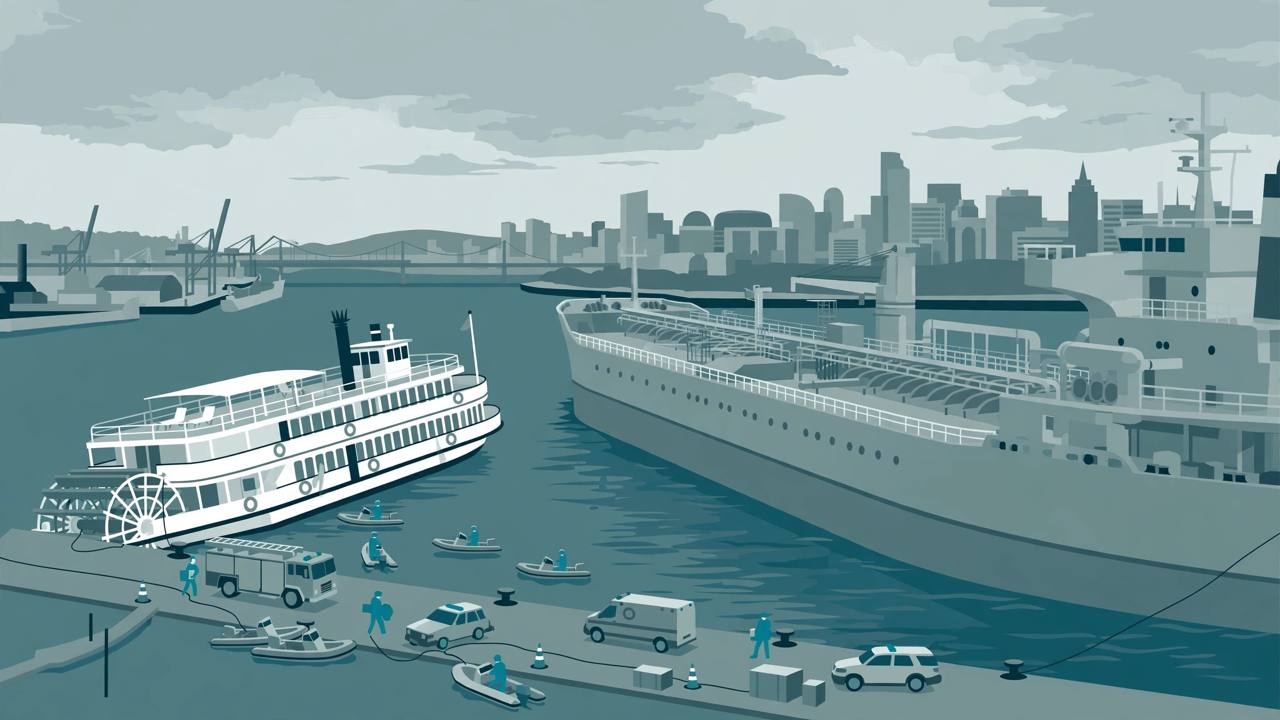
A bitumen tanker slammed into a docked river cruise ship on the Mississippi River in New Orleans at about 12:30 p.m. Central Time on Friday, November 13, rolling the paddlewheel vessel onto its side, throwing passengers into the water and triggering one of the largest river rescues in the city's recent history. By Friday evening, officials delivered the news everyone had feared would be worse: all roughly 180 passengers and crew aboard the American Heritage had been accounted for, 32 people had been taken to hospitals, none with critical injuries, and there were no deaths.
Source: Associated Press via Europesays
The American Heritage, operated by American Cruise Lines, had docked about two hours earlier outside the Port of New Orleans Administration Building at the end of an eight-day Mississippi River cruise and was disembarking guests when the tanker Atlantic Asphalt struck it, the Port of New Orleans said. Port officials put 129 passengers aboard, in addition to crew. Video from the riverfront showed the five-deck riverboat listing heavily, taking on water and partially sinking at its berth.
The rescue pulled in the US Coast Guard, Port NOLA Harbor Police, the New Orleans Fire Department, New Orleans Police and local emergency medical services. CBS News reported at least 14 people were rescued from the water itself. Louisiana Lieutenant Governor Billy Nungesser told WWL Louisiana that about 85 people had been rescued and assisted inside the Port of New Orleans building by mid-afternoon, and added: 'It doesn't appear there's been any loss of life.' Homeland Security Secretary Markwayne Mullin said on social media that the federal government was 'throwing every asset we have' into helping rescue passengers.
Mayor: the tanker 'lost control' — but the cause is not established
At a late-afternoon briefing, New Orleans Mayor Helena Moreno said the tanker had 'lost control,' but she and investigators were careful to say the cause has not been established. US Coast Guard Captain Melanie Burnham said Coast Guard investigators were on scene working to determine what caused the tanker to lose control, and Harbor Police Chief Melanie Montroll joined the briefing. Moreno confirmed no one aboard the tanker was hurt. Early reports that the tanker may have lost power before veering into the docked ship have not been officially confirmed, and Awaaz Punjab is treating them as unconfirmed.
Source: Reuters via The Hindu BusinessLine
The Coast Guard closed the Mississippi River to vessel traffic in the vicinity of the collision — reported as the stretch between mile markers 93 and 96 — while responders secured the area. The river at New Orleans is one of the busiest commercial waterways in the United States, and a closure there is felt well beyond the city: Gulf port traffic, grain and energy shipments and the truck corridors that feed the port all depend on the same riverfront.
The two ships
The Atlantic Asphalt is a 17,764-deadweight-ton bitumen tanker built in 2017 and flagged in the Marshall Islands (IMO 9798428); shipping data cited by Splash 247 lists its owner as the single-ship company Nave Shipping and its operator as Swiss firm Asphaltos Trade, while the Associated Press, citing the tracker MarineTraffic, reported the tanker is owned by a subsidiary of the China State Shipbuilding Corporation — the ownership accounts differ and the investigation has not addressed them. The American Heritage is a paddlewheel-style overnight riverboat built in 2015 with a capacity of about 150 passengers, one of the modern river cruise vessels American Cruise Lines runs on the Mississippi.
American Cruise Lines confirmed its guests and crew were evacuated and said it was 'deeply concerned for everyone involved.' The company had not, by Friday evening, published a schedule for recovering the vessel or resuming sailings from New Orleans.
Investigators have not established why the tanker struck a stationary ship at a dock in daylight, whether there has been any fuel or cargo pollution in the river, how badly the American Heritage is damaged below the waterline, or when river traffic and cruise operations at the berth will return to normal. Those answers now belong to the Coast Guard and NTSB investigations.
For Punjabi truckers and port workers along the Gulf corridor, the collision is a reminder of how quickly the region's freight chain can seize up: the Port of New Orleans connects ocean shipping to the I-10 corridor and the river system in a single waterfront, and incidents that close the river tend to push cargo — and delays — onto the highways within days. No road closures in New Orleans had been announced in connection with the collision by Friday evening.
What happens next
The National Transportation Safety Board said it is sending a 'Go Team' to New Orleans on Saturday to open its own investigation alongside the Coast Guard's. Salvage of the listing riverboat, a pollution assessment and the reopening of the closed river stretch are the immediate operational questions. For the 32 people taken to hospital, officials said the injuries were not critical — an outcome that, given a 520-foot tanker striking a docked passenger vessel in the middle of the day, officials at the briefing openly described as fortunate.
Reporting in this story is based on the Associated Press, Reuters, the Port of New Orleans, New Orleans Mayor Helena Moreno's briefing, the US Coast Guard and WDSU/WWL local reporting. This is a developing story; casualty and vessel details are as officials reported them on Friday evening and may be updated.