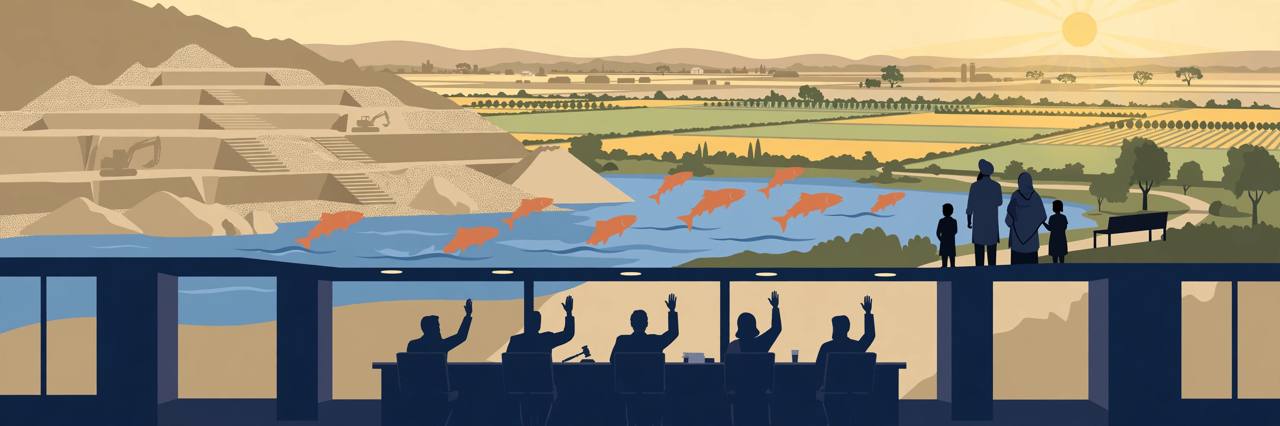
FRESNO, California — Fresno County's Board of Supervisors voted 3-2 on Thursday afternoon, November 12, to approve CEMEX's Rockfield quarry expansion on the banks of the San Joaquin River, granting the Mexico-based building-materials company permission to blast a pit 300 feet deep into hard rock beside the river. The vote is the outcome of the hearing Awaaz Punjab previewed on November 11, and it overturns the result below it: in October, the county Planning Commission split 3-3 on the same reduced plan, a tie that counted as a technical denial, and CEMEX appealed to the five elected supervisors.
Source: Fresnoland
What the board approved is the smaller version of the project, not the company's original ask. The pit is capped at 300 feet deep and mining at 63 years; the site must stay at least 300 feet from the river and 150 feet from Friant Road. CEMEX originally sought to excavate up to 600 feet over as long as 100 years. Blasting may take place once or twice a week on weekdays between 10 a.m. and 2 p.m., and the company has said work could begin within the next few years. CEMEX's existing permits for the site expire in July 2027.
Source: Ad Hoc News, reporting ABC30
The warning the board heard — and set aside
Before the vote, Julie Vance, the regional manager of the California Department of Fish and Wildlife (CDFW), walked the supervisors through the state's objections in person: the multinational company's encroachment onto publicly owned land, questionable water rights, endangered species, and the threat to the salmon run. 'There's potential for catastrophic and irreparable impacts to the San Joaquin River,' Vance told the board. 'Once there is a pit of this size immediately adjacent to an active river channel, it will open up a liability for hundreds of years with no feasible means to undo the damage,' she said. 'Given the resources at stake, I am asking you to deny the appeal and protect the substantial investment made in the San Joaquin River by the taxpayers of this state.' Fresnoland reported that no supervisor asked her any further questions about the 'catastrophic' risks, and that three supervisors ultimately set the recommendation aside — a step an experienced state official said she could not recall happening at any other time in her career.
The physical fear behind the warning is a flood breach. Fresnoland reported on Thursday that on the company's own figures CEMEX has left itself only about 7 inches of headroom before the mine is breached by high water, and UC Berkeley fluvial geomorphologist Mathias Kondolf has warned that if the pit floods, chemicals will likely get into the river and the salmon run the state is spending about a billion dollars to restore could be ruined for good. County planners, in the project's environmental documents, have called that scenario unlikely. Fresnoland also reported that the county has no accountability measures in place to pay to undo 'catastrophic impacts' to taxpayer investments if the pit is breached and widespread damage occurs.
The swing vote and the $150,000 bargain
The deciding figure was Supervisor Garry Bredefeld, who sits on the San Joaquin River Conservancy board and whose stated concern was roads. CEMEX's lawyer, Pat Mitchell, had told the board the company would pay the county 5 cents a ton, about $150,000 a year. Late in the meeting, Bredefeld bargained with the company for another $150,000 a year, to start in about a decade, for the City of Fresno's roads, and for tarps on its trucks — and then voted yes. Sharon Weaver, executive director of the San Joaquin River Conservation Trust, was blunt: 'It's really disappointing to me that Supervisor Bredefeld, who expressed concerns about roads, then accepted this pittance CEMEX threw out as a negotiating tactic. You can barely pave a driveway for $150,000. What good is that going to do for roads?' 'A mine like this doesn't go away. We're left with the problems forever,' Weaver said.
Jobs versus the river: 120 voices in two hours
Public comment was capped at two hours — one hour for each side, one minute per speaker — and about 120 people spoke. On one side stood the mine's own workers. Ricky Phillips, a third-generation miner, described with shaking hands how his father and grandfather had mined the same riverbank pit he works today, and said he wanted to hang up his boots there just as they had. 'If they're still concerned about their fish, why would they build a hatchery there?' asked CEMEX worker Jesse Gonzalez. Another worker, with the company for 23 years, said: 'CEMEX has provided my family stability. It has also given my wife and I opportunity.' On the other side, a doctor spoke in his scrubs, a group of singing grannies took their turn, and residents who built homes near the site warned of blasting and falling values. 'Our home values will drop 30%. How many of you are going to compensate for our loss?' said one resident who lives within 200 feet of the project. 'When we built our homes there, nobody said there would be deep blast mining.'
Supervisor Nathan Magsig, who represents the area, said many residents' concerns had been addressed. 'There were a lot of concerns that this was going to be like a war zone, having to listen to that constantly,' he said of the blasting. He said he supported industry in the area and that 'we need to make sure we mitigate our impacts to the furthest extent possible.' — via Fresnoland
Background: a seven-year road to this vote
CEMEX has been looking for a new mine to carry it through the next century since the early 2000s. It originally wanted to mine Jesse Morrow Mountain, but supervisors rejected that plan in the 2010s after it emerged the mountain was a Native American burial site. The company submitted the Rockfield application in December 2019 and spent seven years on it; by Thursday, Mitchell told the board, the reports ran to nearly 11,000 pages with appendices. ABC30 reported that CEMEX and earlier operators have mined rock, sand and gravel at the riverbank site since at least 1913. The state agency also said CEMEX received an August notice of violation concerning about 14 acres of state land, and the company is working on a land swap, according to the ABC30 report carried by Ad Hoc News. In the county's own comment process, reporting based on the comment file put total public comments at roughly 675, about 90 per cent of them opposed.
What is solid
- The Board of Supervisors approved the reduced Rockfield expansion 3-2 on Thursday, November 12, overturning the Planning Commission's 3-3 deadlocked denial from October.
- The approved plan caps the pit at 300 feet and mining at 63 years, with setbacks of at least 300 feet from the river and 150 feet from Friant Road.
- CDFW regional manager Julie Vance appeared in person and asked the board to deny the appeal, citing 'catastrophic and irreparable' risk to the river.
- CEMEX's existing permits for the site expire in July 2027.
What is only claimed
- Whether a flood will one day breach the pit: Professor Kondolf and CDFW call the risk catastrophic and long-lived; county planners call the scenario unlikely.
- Whether the vote was timed around the election: Supervisor Luis Chavez says it was deliberately postponed to minimise blowback; Supervisor Buddy Mendes says the election had nothing to do with the delay.
The lame-duck argument
Three of the five supervisors who voted Thursday will be out of their seats by January, and Supervisor Luis Chavez said the timing itself was the story: 'Let's not tiptoe around the issue. There are times to be upfront. The reason this waited to come before this board is because of the election cycle. This project was ready long before. It was deliberately postponed in order to minimise the criticism and blowback.' Supervisor Buddy Mendes agreed over text that the item 'should've come six months ago,' but denied the election had anything to do with the hold-up: 'Luis doesn't know what he's talking about and I'll leave this conversation at that.' Chavez said he would keep a closer eye on gravel mines that come to the board in the future, but that Thursday's vote 'already didn't sit right' with him: 'I think we missed an opportunity to do something for the community.'
Why it matters beyond Fresno — and what happens next
The San Joaquin is the Central Valley's working river. About $1 billion in public money has been pledged to restore it so salmon can spawn beside the mine site again, and the Bureau of Reclamation has warned in writing that a breach could affect water deliveries below the site — the same river system that downstream farmers, including the Valley's large Punjabi farming families around Fresno, Madera and the west side, depend on for their orchards and fields. That is why a county land-use vote drew a state agency chief, a Berkeley professor and 120 speakers on a Thursday afternoon. What happens next runs on two tracks: CEMEX now holds its approval for the reduced plan, with blasting limited to once or twice a week in a midday weekday window and work the company says could begin within the next few years, well before its current permits expire in July 2027; and the opponents — the Conservation Trust, environmental groups and the state wildlife agency — have not accepted the result, with environmental groups and state officials continuing to challenge the project's effects on the river and salmon habitat. The pit, if it is dug, will be there for generations: as Weaver put it, the county has approved something that does not go away.