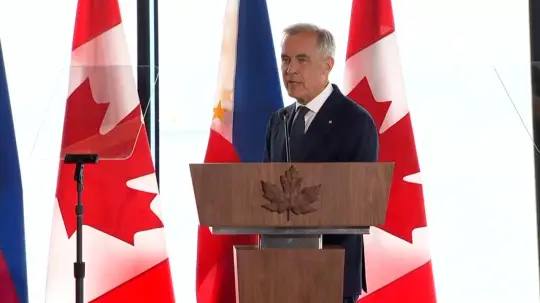
Canada will never walk away from a NATO ally, Prime Minister Mark Carney said in Manila on Saturday, November 14, rejecting any suggestion that Russia should be allowed to reorder Europe's security as part of talks to end the war in Ukraine. "There's no way that Canada as a NATO member is going to walk away from any other NATO member — ever," Carney told a news conference in the Philippine capital, The Canadian Press reported.
Source: The Canadian Press, Nov 14, 2026 (via EuropeSays)
Carney was speaking as talks brokered by the United States between Russia and Ukraine have widened well beyond borders and prisoner exchanges. American and Russian negotiators have brought the wider European security arrangements in place since the end of the Cold War — in particular how NATO itself functions — into the discussions, and European leaders have expressed concern at Russia seeking a reordering of continental security.
"The security architecture for free Europe will be determined by free Europe and NATO, not by Russia and a redux of the Minsk agreement," Carney said. He said Canada wants "more stable outcomes" than repeating historical missteps that involved trying to limit Russian expansionism without adequate deterrence, and pointed to Canada's sanctions policies and its recent ban on athletes competing under the flags of Russia or Belarus at sporting events in Canada.
Russia's demand: NATO back to its 1997 lines
The Canadian prime minister's remarks answer a Russian position that surfaced in this week's talks. The New York Times reported that an informal, unsigned Russian "non-paper" dated November 10, circulated during closed-door talks linked to Abu Dhabi, calls for NATO to withdraw its troops and bases to the alliance's 1997 borders, rule out any further expansion, and end military activity in Ukraine, Eastern Europe, the South Caucasus and Central Asia. The paper was described as Moscow's opening position, echoing demands Russia first made in December 2021, in some cases word for word.
Source: Clash Report summary of The New York Times reporting, Nov 14, 2026
The talks have also produced the week's biggest Ukraine development: President Volodymyr Zelenskiy disclosed on Friday that US negotiators had asked, for the first time, whether Ukraine would withdraw from its eastern Donbas region in exchange for joining NATO. Zelenskiy said Ukraine would not withdraw its troops, but that he could put the question to a referendum if Kyiv received a comprehensive security package — firm security guarantees, a strong and well-funded Ukrainian army, and money for reconstruction. "NATO is back on the agenda," he said.
Source: Reuters via AAP, Nov 14, 2026
Awaaz Punjab reported Zelenskiy's Donbas-for-NATO disclosure, and his referendum condition, earlier on Saturday. Read the earlier report
"We lead the brigade" in Latvia
Carney grounded Canada's pledge in the troops it already has on NATO's eastern flank. "We have 2,500 troops in Latvia. We lead the brigade there," he said, according to The Canadian Press reporting summarised by Clash Report. He also rejected any Russian buffer zone in Europe: "We're not giving Russia a cordon sanitaire. You know how well that worked. You know your history." At the same Manila news conference, Carney said he would join the APEC family photo with Russian President Vladimir Putin out of respect for the Chinese host.
Source: Clash Report, Nov 14, 2026
Canada's Latvia deployment, Operation REASSURANCE, was extended by Carney at the NATO summit in Ankara in July 2026 until 2031, with persistently deployed personnel set to rise to as many as 2,600. "Canada stands firmly with Ukraine, firmly with democracy, territorial integrity, rule of law — and all of those put us on the other side of Vladimir Putin's Russia," Carney said on Saturday.
Europe will sit at the table in the next round: EU institutions and five countries — Britain, France, Germany, Italy and Poland — will represent Europe, European Council President António Costa announced after leaders met in Dublin. No formal draft agreement has been made public, and Zelenskiy says it emerged from the Abu Dhabi talks that Putin does not want a ceasefire — so Carney's red line now faces a negotiation in which Russia's opening demand is a smaller NATO, and Ukraine's price for any Donbas move is NATO itself.