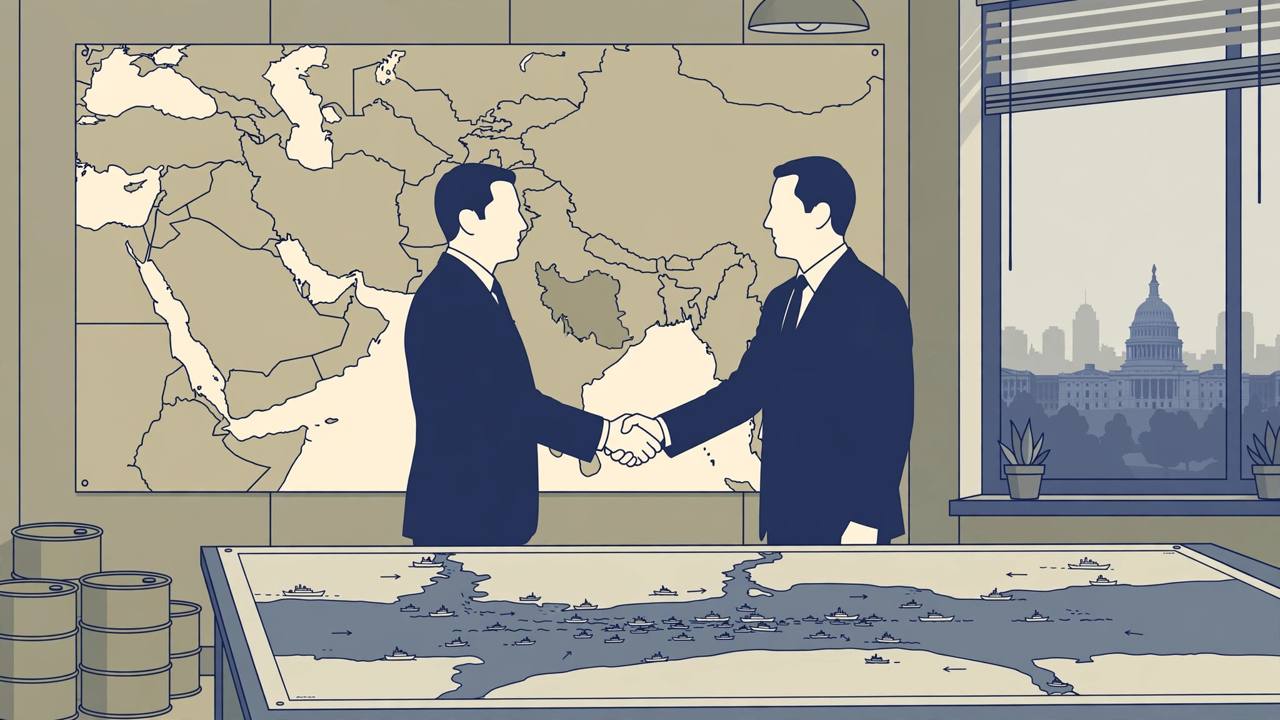
Israel's Mossad director Roman Gofman is in Washington on Friday, November 13, for talks with senior Trump administration officials about the war with Iran, Axios reported, citing three sources with knowledge of the visit.
Source: Axios via Pakistan Point, Nov 13, 2026
Gofman is meeting CIA Director John Ratcliffe in Washington and is expected to travel to Miami to meet White House special envoy Steve Witkoff, Axios said. The Jerusalem Post, citing its own separate sources, also reported that Gofman had arrived in the US capital. Mossad, the CIA and the White House all declined to comment.
Source: Jerusalem Post via Kacee Allen, Nov 13, 2026
The visit comes as Israeli Prime Minister Benjamin Netanyahu is pressing US President Donald Trump to resume military operations against Iran, Axios reported. A US official told the outlet that Trump has so far turned that request down.
Trump holds to blockade and economic pressure
Instead of renewed strikes, Trump has kept in place a naval blockade of Iranian ports and an economic pressure campaign — an approach Axios said is also favoured by Saudi Arabia, Qatar and the United Arab Emirates, the Gulf states that host large US forces and lakhs of Indian and Punjabi workers.
The two leaders discussed the Iran war in a phone call on November 5, according to a US official cited by Axios. Israeli outlet Ynet later reported that the call turned into a heated disagreement — an account Netanyahu's office rejected. Both versions are reported here as attributed claims; neither side has published a transcript.
The Financial Times has earlier reported that Netanyahu had been contacting Trump almost daily to urge renewed strikes on Tehran. Gofman, who took over Mossad in June, is one of Netanyahu's closest confidants and previously served as his military secretary, Axios noted.
The Washington meetings land a day after Trump said on social media that the United States does not need a deal with Iran and pulled Vice President JD Vance back from potential peace talks with Tehran to focus on domestic issues. The same day, the UN nuclear watchdog said in a confidential report that it is increasingly concerned about an uninspected uranium-enrichment plant at Isfahan in Iran.
Why the Gulf is watching closely
Any return to open US–Iran fighting would immediately threaten shipping through the Strait of Hormuz, the route for a large share of the world's oil and gas, and the safety of the Gulf-based Indian and Punjabi workforce. Brent crude settled about 3.3 percent higher at $95.82 a barrel on Thursday after Trump's Iran remarks, and WTI settled 2.6 percent higher at $88.74 — yaani oil's rise is already feeding inflation worries worldwide.
Background: the current war began on February 28, when the United States and Israel attacked Iran. Fighting since then has included strikes on nuclear and military sites, Iranian missile and drone attacks, a US naval blockade and repeated disruption around Hormuz, while talks on Iran's nuclear programme have repeatedly stalled.
What happens next: no decision to resume large-scale operations has been announced. Gofman's meetings with Ratcliffe and Witkoff are the immediate test of whether Israel's case gains ground in Washington, or whether the blockade-and-pressure line backed by the Gulf states continues to hold.