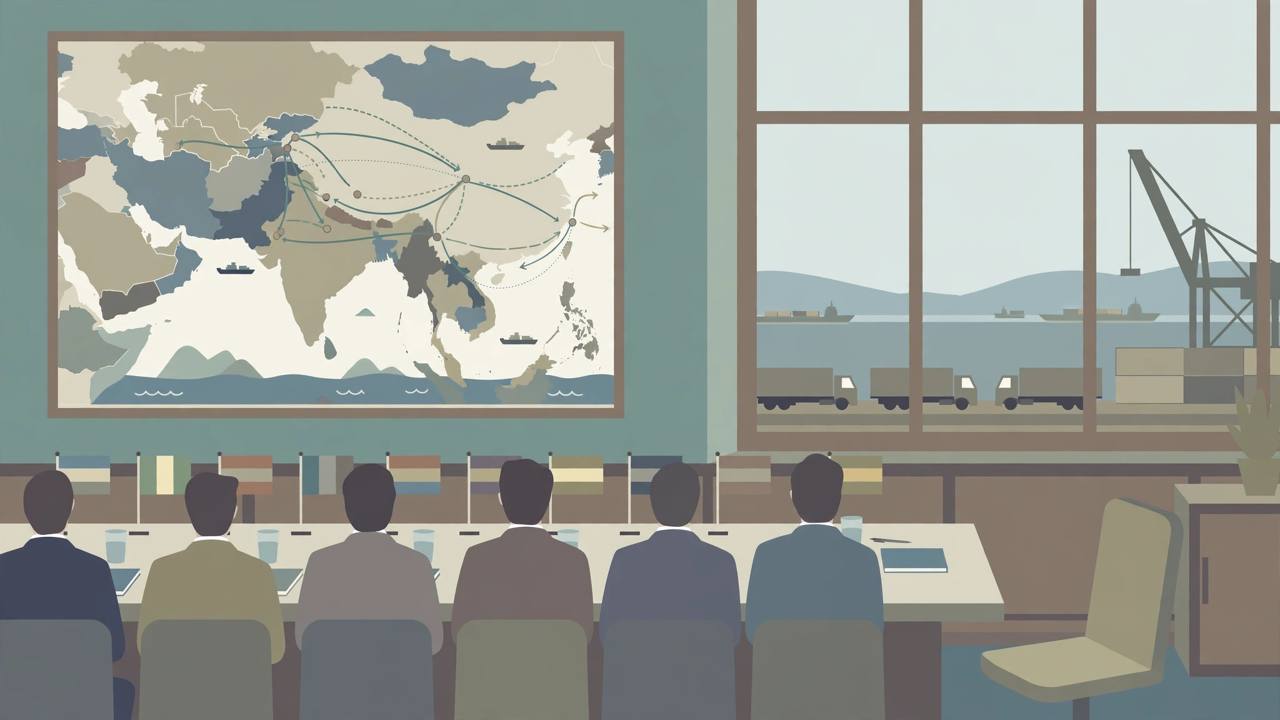
Pakistan told a regional ministerial meeting in Islamabad on Monday, November 16, that progress on trade and connectivity with Afghanistan depends on Afghan action against terrorism, as Deputy Prime Minister and Foreign Minister Ishaq Dar chaired the 30th meeting of the Economic Cooperation Organisation (ECO) Council of Ministers.
Source: Feature Pakistan
Dar said a stable Afghanistan at peace with itself and all its neighbours would benefit the Afghan people and the wider region, and that meaningful economic cooperation requires a secure and predictable environment, according to reports of his opening address carried by Feature Pakistan and The Indian Witness.
"Regional connectivity rests on more than the routes that link us. It depends upon trust between states and confidence that international commitments will be honoured. Unresolved disputes and the non-fulfillment of international obligations can erode that trust and impede economic progress," Dar said in his opening speech, as quoted by Feature Pakistan.
Source: Feature Pakistan
No one from Afghanistan is attending the meeting, according to the list of delegations shared by Pakistan's Foreign Office — an absence both reports noted gave Dar's message added weight, because the country at the centre of it had no delegation in the room to answer.
Pakistan's allegation, and Kabul's denial
Islamabad has repeatedly alleged that militant organisations, particularly the Tehreek-e-Taliban Pakistan (TTP), operate from Afghan territory and carry out attacks inside Pakistan, and has called on the Afghan authorities to stop militant groups using Afghanistan as a base. The Afghan Taliban administration has consistently rejected those allegations, maintaining that it does not allow Afghan territory to be used against other nations, The Indian Witness reported. The two neighbours have also seen repeated border clashes, further complicating efforts to restore diplomatic and economic ties.
Source: The Indian Witness
Feature Pakistan reported that security operations against militant groups have continued along Pakistan's western border, including an operation in North Waziristan in which, it said, 16 militants were killed and two soldiers were killed — figures attributed to Pakistani reporting and not independently verified.
Five priorities for Pakistan's ECO chairmanship
Pakistan holds the ECO chairmanship for 2026-27 and is hosting the two-day meeting, on November 15 and 16, under the theme "Reviving Regionalism for a Resilient ECO". Dar set out five priorities: expanding trade and investment, strengthening regional connectivity, advancing the ECO Trade Agreement, building regional resilience and promoting human development.
On trade, Dar said Pakistan would work towards wider market access and stronger regional value chains, and that the November 2025 roadmap approved by ECO trade ministers provided a basis for modernising the ECO Trade Agreement. On connectivity, he sought better transport and transit links between Central Asia, South Asia and Pakistani ports on the Arabian Sea, with improved customs procedures, border management and transit arrangements.
Iranian Foreign Minister Abbas Araghchi also addressed the meeting and called for a reliable and sustainable regional energy mechanism, pointing to the choking of key fuel supply routes through the Strait of Hormuz and Bab al-Mandab during the US-Israeli war on Iran, Feature Pakistan reported. Araghchi also called for a modern, more inclusive trade agreement for the region.
What happens next
The ECO's 10 members are Pakistan, Afghanistan, Azerbaijan, Iran, Turkiye, Kazakhstan, Kyrgyzstan, Tajikistan, Turkmenistan and Uzbekistan. Delegates in Islamabad include Araghchi, the Tajik and Turkmen foreign ministers and deputy foreign ministers from Azerbaijan, Turkiye, Kazakhstan, Kyrgyzstan and Uzbekistan. A Senior Officials Meeting on November 15, chaired by Pakistan's Foreign Secretary Asim Iftikhar Ahmad, finalised the agenda and a draft Islamabad Communique. The meeting is also expected to feed into preparations for the 18th ECO Summit, scheduled for Tehran on December 3 and 4, and discussions of the ECO Vision 2035 framework.
The organisation was established in 1985 by Pakistan, Iran and Turkiye to promote economic development, trade, transport and energy cooperation, and expanded to 10 members in 1992. Whether Dar's condition — Afghan action on terrorism first — moves Kabul, which denies the charge, will decide whether the trade and transit agenda Pakistan is chairing can advance at all.