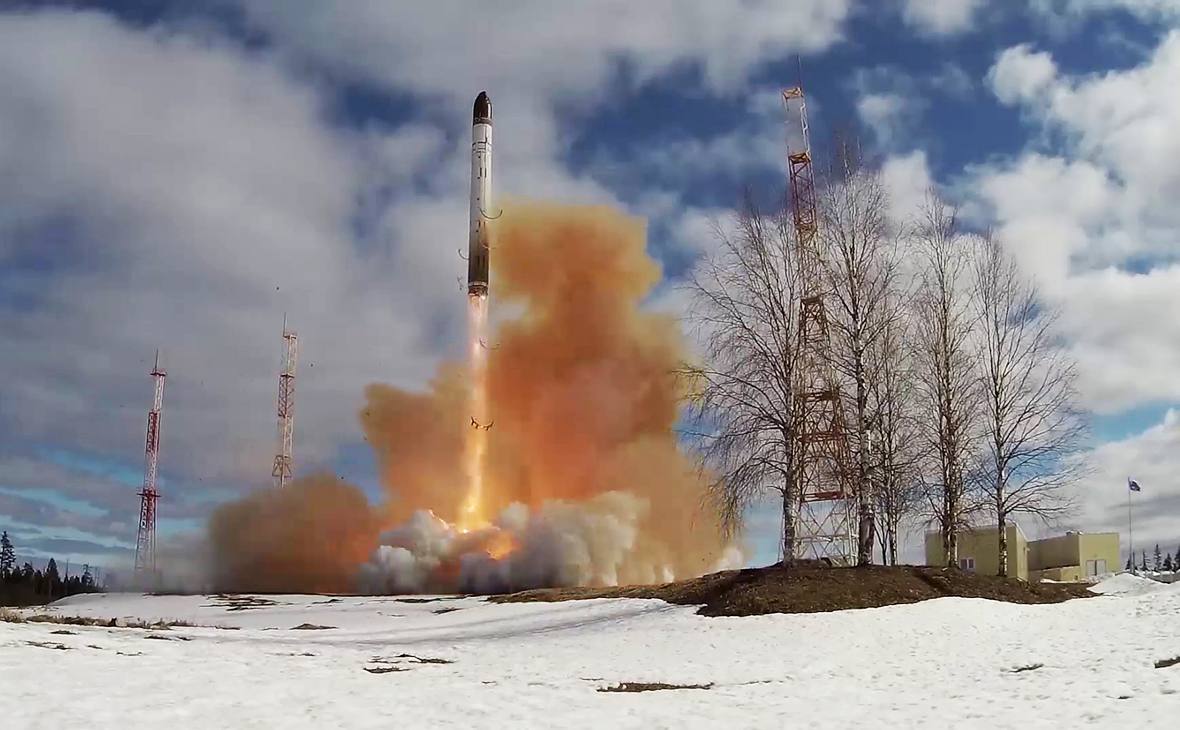
Satellite images suggest Russia may be moving its RS-28 Sarmat intercontinental ballistic missile toward operational service, according to an assessment by the International Institute for Strategic Studies (IISS), a London-based defence think tank.
Source: IISS
Images taken on June 6, 2026, show at least six transport and support vehicles around open silo launcher 13C at the Uzhur missile base in Krasnoyarsk Krai, Siberia, home to the 62nd Missile Division of Russia's Strategic Missile Forces. A crane beside the silo could indicate preparations to install the missile's payload, researcher Matthew Bint wrote in the IISS assessment, published on November 18.
The IISS stressed the limits of what the images prove. The observations "could indicate that a missile section has already been placed inside the underground facility," Bint wrote — but the imagery does not confirm that the missile is fully operational or carrying a nuclear warhead.
What the Sarmat is
The RS-28 Sarmat, known to NATO as "Satan II", is a silo-based, liquid-fuelled heavy intercontinental ballistic missile built to replace the Soviet-era SS-18 Voevoda. The Center for Strategic and International Studies (CSIS) credits it with a range of up to 18,000 kilometres, a length of about 35.3 metres and a payload of up to 10,000 kilograms of warheads or glide vehicles.
The programme has run years behind schedule. Russia's first successful full flight test came on April 20, 2022, and the second confirmed success followed on May 12, 2026. After that test, Strategic Missile Forces commander Colonel General Sergey Karakayev told President Vladimir Putin the first Sarmat regiment would go on combat duty at Uzhur by the end of 2026. The missile was originally meant to enter service between 2018 and 2020.
Why Moscow is pushing ahead
The IISS says Moscow is moving the missile toward deployment after only two successful flight tests because it is under pressure to replace its ageing fleet of Soviet-era liquid-fuelled missiles. The Federation of American Scientists has identified plans for as many as 46 Sarmat missiles at upgraded facilities in Uzhur and Dombarovsky — a projected target, not an established inventory.
Activity has also resumed around the Dombarovsky missile base, where the May test took place. Imagery from around October 22 appears to show an erected transloader frame, a long trailer that may have carried the missile's first stage, and a yellow gantry. The IISS said this may indicate preparations for a third flight test, but it cannot confirm whether another launch has already taken place.
The warning comes as Western intelligence has separately warned NATO that Russia may be preparing to launch a nuclear-armed satellite. Read the earlier story
The IISS concluded that Washington and its allies must now factor the missile into their assessments of Russia's nuclear capabilities, even as questions about its reliability remain. Further Sarmat flight trials may also take place as Moscow looks to ease those concerns.
For India and the wider region, the development is a reminder that nuclear modernisation is accelerating on both sides while the war in Ukraine grinds on — and that new weapons are entering service with only a handful of successful tests behind them.