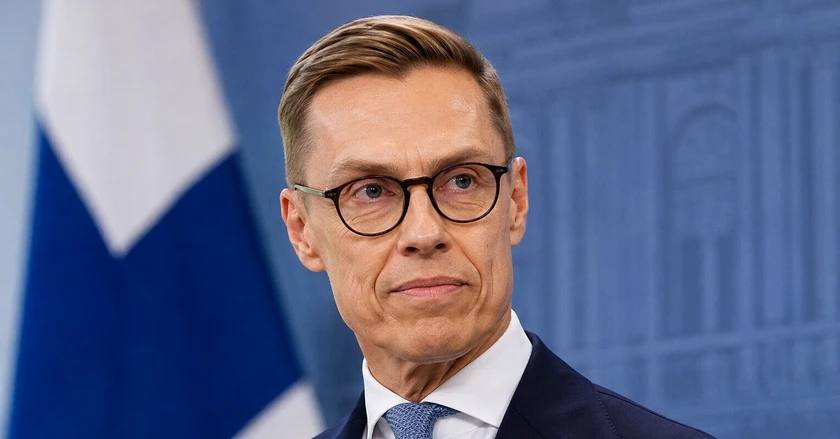
HELSINKI — European leaders must speak directly with Russian President Vladimir Putin instead of leaving negotiations with Moscow to the United States, Finnish President Alexander Stubb said in an interview with the Financial Times published on Tuesday, November 17.
Source: Financial Times, via Reuters syndication (Devdiscourse)
"We have outsourced European engagement with Russia for too long and I think that is irresponsible," Stubb told the newspaper, warning that a US administration may lean towards carving up Europe into spheres of influence. "Now that we have a framework ... I think European leaders should engage directly with Putin with the same message ... (and) common speaking points," he said, referring to the EU's formation of a team to participate in future talks.
Source: Financial Times, via Kyiv Independent
Stubb said Putin is "ready to engage with Europe" and reiterated that Europe must play a more active role: "It's very important that we become agenda setters." But he was blunt about the arithmetic of any settlement: "We have to be realistic that there will be no deal without Putin's agreement." He also cautioned that future talks involving European, NATO, Ukrainian, Russian and US officials could reach an impasse.
Source: Kyiv Independent, Nov 17, 2026
US President Donald Trump's envoy Jared Kushner has previously made a similar remark, telling reporters Putin was ready "to give it a try" when asked about engagement with Europe, the Kyiv Independent reported. Finland, a NATO member that shares a long border with Russia, has been one of Kyiv's strongest and most outspoken allies since Russia's full-scale invasion, backing Ukraine's EU accession as well as its defence and financial needs.
Moscow says it has agreed to no such thing
The Kremlin has repeatedly rejected the idea of Europe securing a seat at the negotiating table. Kremlin aide Yuri Ushakov said on Monday, November 16, that Russia has not agreed to expand the negotiations beyond the trilateral US–Russia–Ukraine format that resumed in Abu Dhabi, and that a great deal would need to be done first — possibly another round, or more than one, of trilateral talks.
Source: Reuters, Nov 16, 2026 (Ushakov remarks)
Ushakov's denial, and Zelenskiy's and Kushner's competing claims that Europe is already at the table, were reported by Awaaz Punjab on Monday. Read the earlier report: Kremlin aide denies Russia agreed to let Europe join Ukraine talks
EU foreign ministers meeting in Brussels on Monday also cautioned that discussing Europe's future security architecture with Moscow before a ceasefire in Ukraine would be premature, urging Europe not to fall into a Russian trap, Reuters reported. The ministers said any such discussions must await a ceasefire and depend on Moscow making meaningful concessions, and they approved 145 new sanctions designations on Russia the same day. Europe's agreed negotiating team comprises non-EU member Britain, France, Germany, Italy and Poland, and the EU institutions — the E5+EU format European Commission President Ursula von der Leyen has said Europe will use to 'closely engage' in future talks.
Source: Reuters, Nov 16, 2026
Stubb has already spoken to Putin himself
Stubb is not speaking in the abstract: he held a phone call with Putin last month — a roughly 90-minute conversation on October 27 placed together with Norwegian Prime Minister Jonas Gahr Støre, after consulting Ukraine — and has defended that outreach as Europe's first direct attempt to convey Kyiv's key messages to Moscow. In the FT interview, as reported in summaries of it, he framed Europe's choice as one between a return to the 1945 Yalta arrangements, which divided the continent into spheres of influence, and the sovereignty and territorial-integrity principles of the 1975 Helsinki Accords.
Source: Financial Times interview, as reported Nov 17, 2026
The October 27 call, in which the Finnish and Norwegian leaders spoke first to Putin and then to President Volodymyr Zelenskiy, was reported by Awaaz Punjab at the time. Read the earlier report: Finland and Norway leaders call Putin, then Zelenskiy
Stubb's call puts him at odds, in tone if not in aim, with EU ministers who warned a day earlier against opening security talks with Moscow before a ceasefire. The test comes at the European Council on November 26–27, and in whether the E5+EU team seeks a direct channel to Putin despite the Kremlin's public refusal — or keeps working through Washington's Abu Dhabi track.