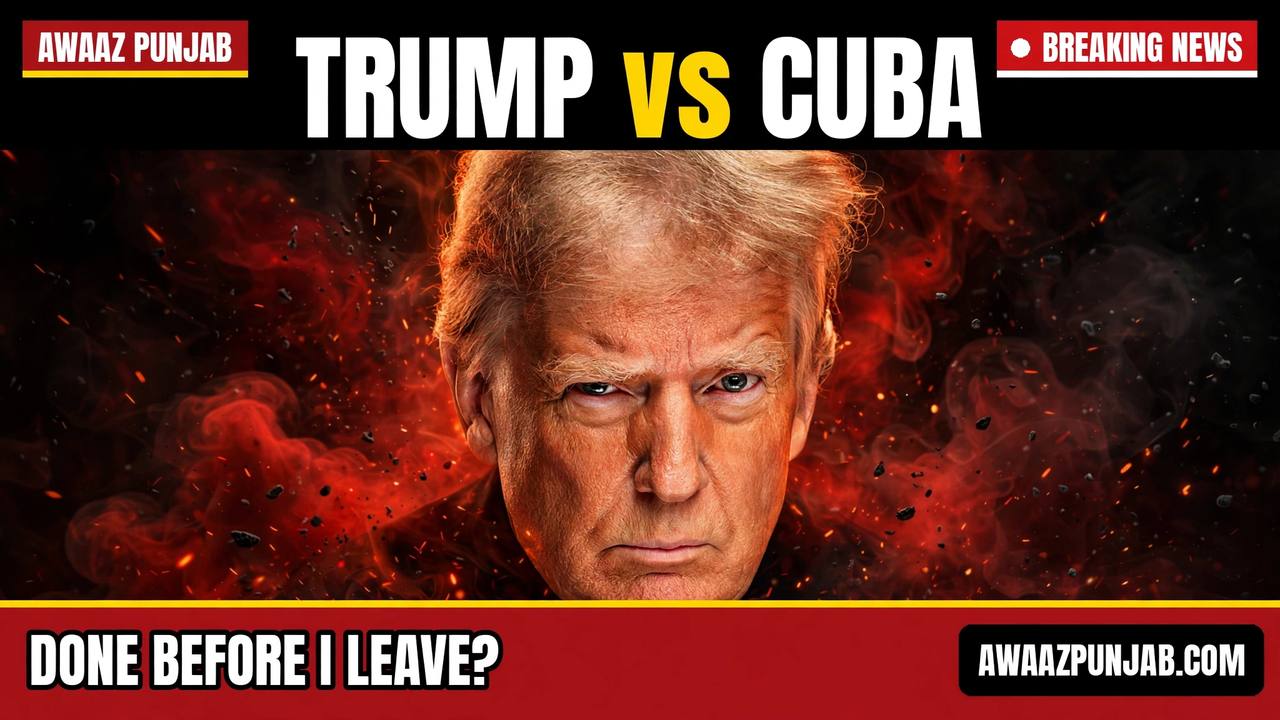
In late October, Trump said the United States would 'take care of Cuba' once the war in Iran was concluded, and Awaaz Punjab reported that vow at the time. Thursday's Hewitt interview goes further in two specific ways: Trump said for the first time that he would 'certainly consider' military force against the island, and — as Politico noted — he attached a deadline to it, saying he wants Cuba 'done' before he leaves office in 2029. Read the October report
US President Donald Trump has said he would 'certainly consider' using military force against Cuba, adding that he wants to 'get Cuba done' before he leaves office in 2029. Trump made the remarks in a phone interview on Thursday, November 12, with conservative radio host Hugh Hewitt of the Salem News Channel, Al Jazeera reported on Friday.
Source: Al Jazeera
Hewitt asked the president whether he was considering 'freeing Cuba' through a military intervention. 'I want to get Cuba done before I leave,' Trump replied, adding that his administration was 'watching it very closely'. He called the island 'essentially a failed … place, nation, whatever you wanna call it'.
Source: Al Jazeera
First timeline on a possible operation — and Rubio 'would love to do it'
Politico reported that it was the first time Trump had put a timeline on a possible operation against Cuba. Trump said Secretary of State Marco Rubio, whose parents are from Cuba, 'would love to do it'. 'I'd love to be able to do it for the people, for the Cubans that came and were treated really badly, and they came to America,' Trump said, adding that he won the Cuban vote in Florida by a wide margin.
Source: Al Jazeera
Spain's Democrata, reporting the same Salem News Channel interview, said Trump kept on the table the option of 'a brief military operation' to take control of the island and force a change of authorities, following the model applied in Venezuela, and quoted him saying: 'I want to resolve the matter of Cuba before I leave, and for that we have a very good guy with a lot of talent called Marco' — referring to Rubio. Awaaz Punjab reports both accounts as descriptions of the same interview; the remarks are a stated consideration, not an announced operation, and no US official has announced any military move.
Source: Democrata
The Hewitt remarks are the latest in a series of escalating statements. On Monday, Trump said Cuba 'will fall fairly soon' and that the US would help it 'on a humanitarian basis'. In March, as the island's power grid collapsed, he said he believed he would have the 'honour of taking Cuba'. In late October he said the US would 'take care of Cuba' after the Iran war.
A year of pressure: oil blockade, sanctions and an arrest warrant
Trump put Cuba under a de facto oil blockade in January, after the United States seized Venezuela's President Nicolas Maduro and cut off Venezuelan oil supplies to the island. He signed an executive order declaring Cuba an 'unusual and extraordinary threat' to the United States and threatened tariffs on any country that supplied it with fuel.
Source: Al Jazeera
The blockade has caused repeated nationwide blackouts and fuel and food shortages, and a humanitarian crisis on the island, Al Jazeera reported; Cuban officials have called it 'collective punishment' — Havana's characterisation, reported here as its position. Washington has added sanctions, including on Cuba's state oil company, President Miguel Diaz-Canel and relatives of former President Raul Castro, and announced a new round this month targeting 10 people and entities tied to the government, the military and the oil industry. The US has also issued an arrest warrant for Castro. Officials from both sides have held talks on the blockade, but Cuba's foreign minister said in June there had been 'no progress'.
No invasion rehearsal, SOUTHCOM said in March — Havana says it is ready
In March, the head of US Southern Command told senators that US troops were not rehearsing for an invasion of Cuba. Cuban officials have said the island was ready for any attack. No Cuban government reaction to Thursday's Hewitt remarks had been reported at the time of publication, and the interview contained no announcement of deployments, orders or deadlines beyond Trump's own 2029 framing.
Source: Al Jazeera
What happens next: the tests of whether this stays rhetoric are practical ones — any comment from Havana or from Rubio's State Department, any Southern Command movement or congressional reaction in Washington, and whether the sanctions and oil-blockade pressure tightens further this month. Until one of those moves, Thursday's interview stands as the clearest statement yet that the White House is keeping a military option for Cuba openly on its own agenda, with a self-imposed deadline attached.
What is solid
- Trump told Hugh Hewitt on Thursday, November 12 that he would 'certainly consider' military force against Cuba and wants to 'get Cuba done' before he leaves office — reported by Al Jazeera and, from the same interview, by Democrata
- Politico reported it was the first time Trump had put a timeline on a possible Cuba operation
- The US imposed a de facto oil blockade on Cuba in January after seizing Venezuela's president, and this month announced sanctions on 10 more people and entities
- In March, the US Southern Command chief told senators US troops were not rehearsing an invasion of Cuba
What is only claimed
- 'Brief military operation' is Democrata's description of the option Trump kept on the table; Al Jazeera's account quotes 'certainly consider' — both describe the same interview, and no operation has been announced
- Cuban officials call the oil blockade 'collective punishment' — that is Havana's characterisation, not a verified finding
- Trump's claim to have won Florida's Cuban vote 'by a wide margin' is his own statement in the interview